The Crann Bethadh Myth Meaning & Symbolism
The myth of the sacred World Tree, the axis of all worlds and the source of life, law, and kingship in the Celtic cosmos.
The Tale of The Crann Bethadh
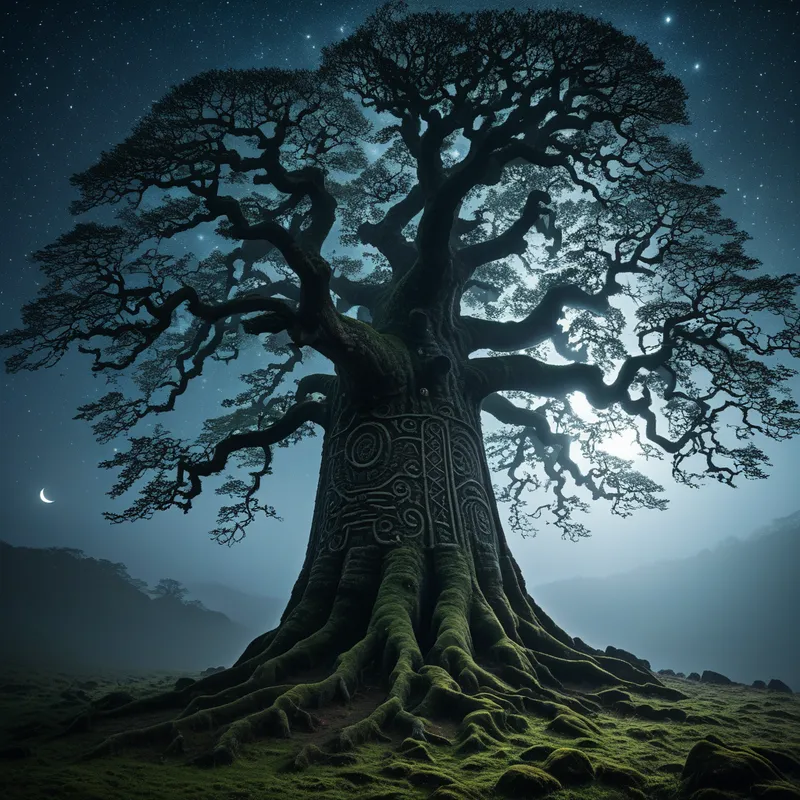
Listen. Before the memory of stone, when the wind spoke in the tongues of the first birds and the rivers ran with the blood of the earth, there stood the tree. Not a tree of wood and leaf as we know it, but the First Tree, the Crann Bethadh. Its roots were not in soil, but in the deep, silent black of Annwn, drinking from wells of primordial memory and the whispers of ancestors. Its trunk, thick as a hill, was the very axis of the middle world, our world of flesh and fog, of struggle and song. And its branches… ah, its branches did not merely hold leaves, but held up the vault of the sky itself, cradling the sun and moon in their crooks, each twig a path for a star.
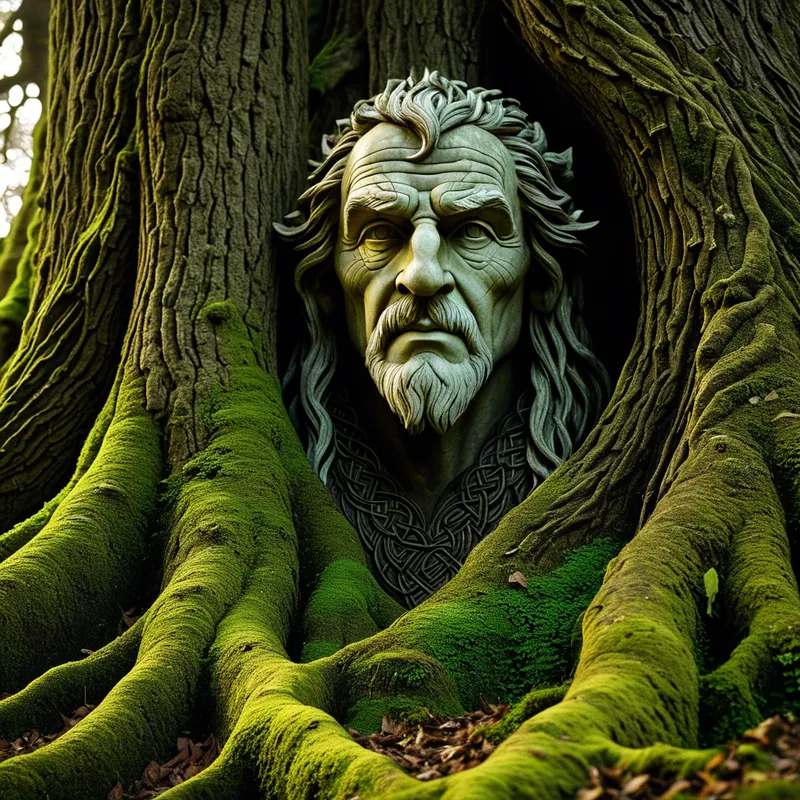
This was the sacred center. The place where the three realms met and were one. No king could rule, no tribe could prosper, unless they were in right relation to it. For the tree was not passive. It was the living contract. When a true king came to be inaugurated, the druids would lead him, barefoot and stripped of finery, into the sacred grove. There, in the deep green silence broken only by the creak of ancient boughs, he would place his hand upon the bark. He would not speak his vows to men, but to the tree.
And the tree would answer. If he was worthy, if his heart was aligned with the land’s own rhythm, a shudder would pass through the great trunk. The leaves would rustle with a sound like distant waves, and a warmth, a golden light, would seep from the bark into his palm, traveling up his arm to his heart. The land itself recognized its sovereign. The tree bestowed its blessing, weaving his fate into the fate of the hills and rivers. The king and the kingdom were now one living entity, sustained by the same sap that flowed from the underworld to the heavens.
But woe to the false king, the tyrant, the one whose soul was out of tune. For him, the bark remained cold and silent as stone. The leaves hung still. And in that terrible, judgmental quiet, everyone knew. The land had rejected him. His reign would be blight, his battles losses, his people hungry. The Crann Bethadh was the final arbiter, the silent witness whose verdict was written in the health of the cattle and the yield of the harvest. It was the spine of the world, and to be king was to be a single vertebra within it, bearing the weight and the grace of the whole.
Cultural Origins & Context
The concept of the Crann Bethadh is not a single, standardized myth from a holy text, but a profound cosmological principle woven through the fabric of insular Celtic, particularly Irish, belief. It was an oral tradition, held and interpreted by the druids and fili. These were not mere storytellers but the memory-keepers and philosophers of their people, transmitting this core understanding of cosmic order through ritual, law, and evocative poetry.
Its societal function was foundational. It provided the sacred geometry for the Celtic worldview: a universe structured vertically (Otherworld, Middle World, Upper World) and connected by a central axis. This wasn’t abstract theology; it was practical geography. Sacred centers, like the hill of Tara, were considered the omphalos, the navel of the land, a direct reflection of the World Tree’s location. The king’s inauguration ritual, the banais ríghi, was a direct enactment of this myth, meant to literally “marry” the king to the land-goddess, whose spirit was embodied in the sacred tree or stone. The myth was the template for sovereignty, ecology, and cosmic law, all in one.
Symbolic Architecture
At its core, the Crann Bethadh is the ultimate symbol of the interconnected self. It maps the architecture of a complete psyche.
The roots are what we have forgotten, the trunk is what we endure, and the branches are what we strive to become.
The roots in Annwn represent the personal and collective unconscious—the dark, fertile soil of instinct, memory, ancestry, and trauma. This is the realm of the Epona and the Dagda, the foundational, often chthonic, forces. The trunk is the conscious ego, the “I” that stands in the daylight world, navigating reality, making choices, bearing the weight of existence. The branches reaching for the sky symbolize the spiritual aspirations, the higher Self, the connection to transpersonal ideals, wisdom, and the archetypal realm of light and order.
The king in the myth is not a ruler over the land, but the human consciousness that seeks to responsibly mediate between these three levels. His hand on the tree is the ego seeking alignment with the deeper Self. The blessing is the feeling of psychic integrity, where one’s actions are nourished by deep instinct (roots) and guided by higher purpose (branches). The rejection is the experience of alienation—an ego cut off from its own depths and heights, ruling a barren internal kingdom.
The Dreamer’s Resonance
When this myth stirs in the modern unconscious, it often manifests in dreams of profound verticality. You may dream of a tremendous tree at the center of a landscape, its size evoking both awe and dread. You might find yourself climbing it, desperately trying to reach the light in the high branches, or digging frantically at its roots, seeking something buried. Perhaps you dream of a pillar, a tower, or even your own spine transforming into crystalline bark.
Somatically, this can correlate with feelings of being ungrounded (root issues) or lacking direction and inspiration (branch issues). The dream is signaling a crisis or opportunity of connection. The psyche is attempting to re-establish communication between compartments that have become dissociated. A dream of a dying or felled Crann Bethadh is particularly potent, often reflecting a profound feeling that one’s inner world—one’s very sense of meaning and structure—is collapsing. It is the ultimate symbol of a spiritual emergency, calling for deep, nourishing attention to the foundations of the self.
Alchemical Translation
The individuation process, the alchemical work of becoming whole, is perfectly modeled by the myth of the sacred center. We all must find our own Crann Bethadh.
The first, nigredo stage is the descent to the roots. This is shadow work: confronting the personal and ancestral material in our personal Annwn. It is dark, often painful, and involves acknowledging the “wells” of trauma, grief, and forgotten potential from which we unconsciously draw. The second, albedo stage is the strengthening of the trunk. This is the work of the ego, not to inflate itself, but to become a stable, conscious vessel capable of integrating what rises from below and receiving what descends from above. It is about building integrity, discipline, and a firm stance in reality.
The king is not crowned by conquest, but by consent—the consent of his own deepest darkness and his own highest light.
The final, rubedo stage is the flowering of the branches. This is not escapist spirituality, but the embodied expression of the Self. It is creativity, wisdom, and a sense of purpose that feels divinely inspired yet firmly rooted in a mature personality. The “blessing” of the tree is the felt experience of this completed circuit: energy flowing freely from the depths of instinct, through the heart of conscious life, and out into the world as authentic, sovereign action. You become the king of your own inner landscape, not by force, but by sacred alignment with the living tree of your soul.
Associated Symbols
Explore related symbols from the CaleaDream lexicon: