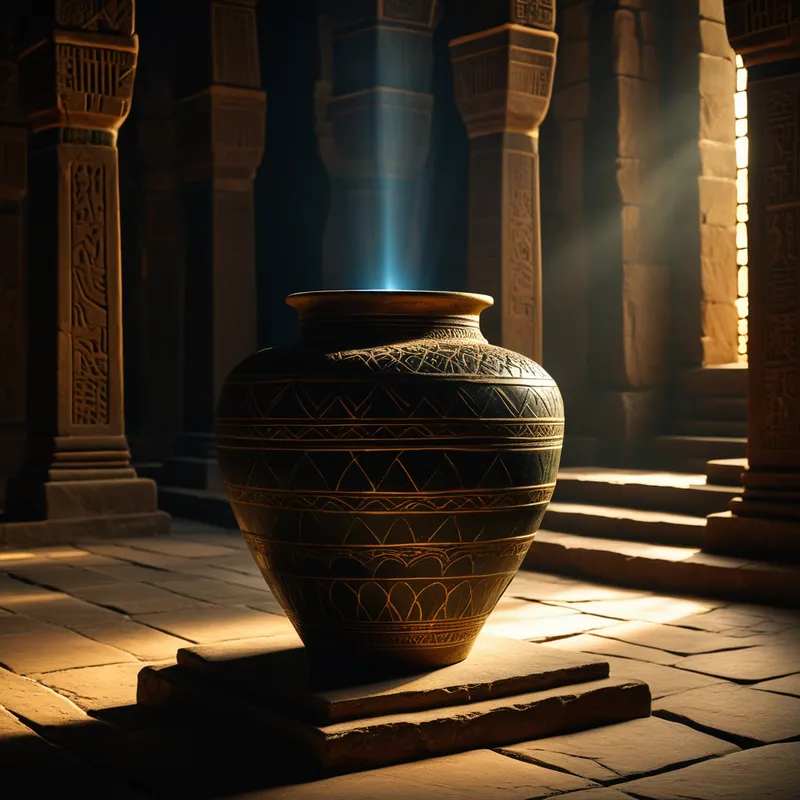
The Cracked Vessel Myth Meaning & Symbolism
A universal tale of a flawed vessel whose cracks become the source of its unique light, teaching that wholeness is found in embracing our fractures.
The Tale of The Cracked Vessel
Listen. In the time before memory, when the world was still soft clay in the hands of the first makers, there was a vessel. It was not born of grand design or royal decree, but of necessity. In a humble village where the river sang with the voice of the earth, a potter sat at her wheel. Her name is lost to the wind, but her hands remembered the shape of things. She needed a jar to carry water from the sacred spring to the hearth, a simple task for a simple form.
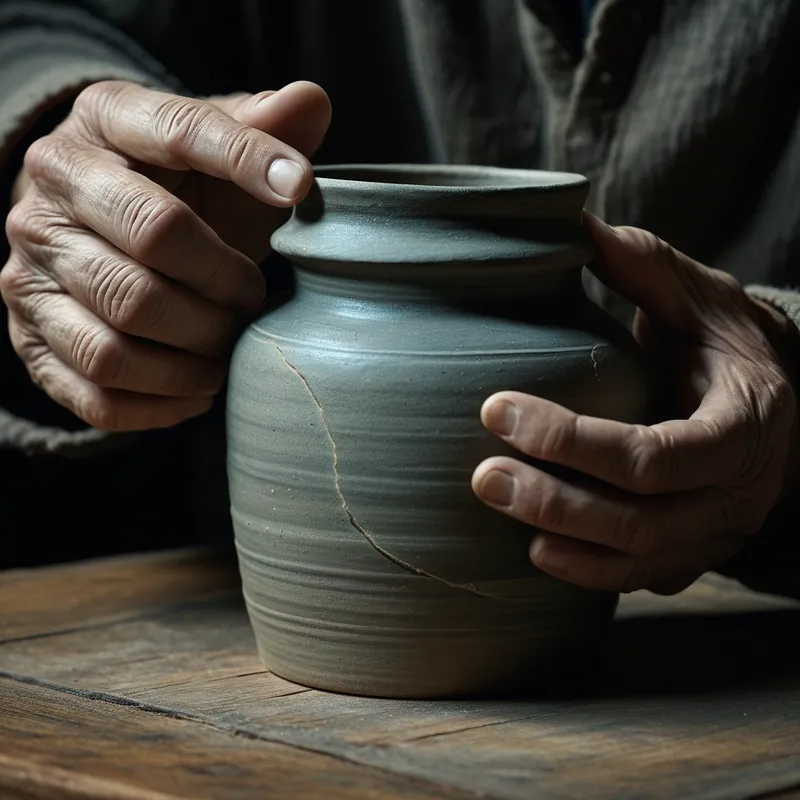
She gathered the clay, the red earth that drank the rain. She centered it on the wheel, her palms a cradle, her thumbs a gentle pressure opening a void. Round and round it spun, a tiny world taking shape. But as she pulled the walls upward, dreaming of a perfect, smooth curve, a grain of sand—a tiny, stubborn piece of the unyielding earth—resisted. The wheel shuddered. Her rhythm broke. And from the rim to the base, a fine, hairline crack appeared, like a lightning bolt frozen in clay.
Her heart sank. A flawed vessel. Useless. It would leak. It would not hold. The law of the village was clear: only the whole could serve the whole. She set it aside from the others, the perfect jars with their seamless bellies, destined for the well. The cracked one was placed on a shelf, destined for the shard-pile, to be ground back into dust.
But that night, a strange weariness took her. In her forgetfulness, or perhaps in a moment of pity, she did not break it. She fired it with the others. In the kiln’s roaring heart, where all things are tested by fire, a miracle occurred. The crack did not widen into a ruin. Instead, the searing heat sealed its edges, making the flaw a permanent feature, a scar baked into its very being.
The next day, distracted and hurried, she grabbed the flawed jar along with the others. At the spring, she filled them all. The perfect vessels held their water, silent and smug. The cracked vessel, she saw with dismay, began to weep. A slow, steady drip fell from its fissure, tracing a dark line in the dust as she walked the path home.
Days passed. The potter, resigned to its nature, used it anyway for the short trips, annoyed by its constant, quiet loss. But then, she began to notice something. Where the water from the perfect vessels merely sat, stagnant, the water from the cracked vessel’s trail did not just vanish. It seeped into the earth along the well-trodden path. And where it fell, life responded.
Tiny, tenacious seeds, long buried in the hard-packed dirt, stirred. First came a green fuzz, then slender shoots. One morning, walking her sorrowful route, she stopped. A line of wildflowers—chicory and forget-me-nots—had bloomed along the exact, meandering trail of the vessel’s tears. A river of blue and gold now flowed from her hearth back to the spring, a path of beauty born from brokenness.
That evening, she placed the cracked vessel on her windowsill. As the last light of the sun, the great Solar Furnace, struck it, another wonder unfolded. The light did not just glance off its surface. It poured into the crack. The fissure, that mark of failure, became a channel. The vessel did not hold the light; it conducted it, spilling a narrow, brilliant beam into the darkening room, painting a golden line on the far wall. The vessel that could not hold water perfectly, held light uniquely. Its flaw was its function. Its breaking was its making.
Cultural Origins & Context
The tale of The Cracked Vessel is a polygenetic myth, appearing not in one sacred text but in the oral traditions of potters, storytellers, and wisdom-keepers from the river valleys of Sumeria to the pueblos of the American Southwest, from the monasteries of Japan to the folklore of Celtic lands. It is a folk archetype, passed not from priest to acolyte, but from grandparent to child at the hearth, or from master artisan to apprentice at the wheel.
Its societal function was multifaceted. For craft guilds, it was a practical lesson in material science and the acceptance of wabi-sabi. No firing is ever perfectly controlled; the flaw is part of the process. For the community, it served as a profound social leveler. It taught that value is not synonymous with perfection, and that what the community discards as “broken” may yet have a sacred purpose. It was often told to those in mourning, to those who had failed, or to the sick, reframing their “crack” not as a reason for exclusion, but as a potential source of unexpected grace. The myth acted as a psychological container for the universal experience of failure and shame, transforming it into a narrative of latent purpose.
Symbolic Architecture
The myth’s power lies in its stark, alchemical symbolism. The Clay represents the primal, undifferentiated Self—full of potential but without identity. The Potter’s Wheel is the whirl of life experience, fate, and conscious effort that gives us form. The Crack, then, is the central symbol. It is not an accident but an inevitability. It represents the wound, the flaw, the trauma, the innate imperfection that seems to ruin the ideal of a “perfect” life.
The vessel is not flawed despite the crack; it is defined by it. The crack is the signature of its unique encounter with reality.
The Kiln’s Fire is the ordeal—the suffering, crisis, or intense pressure that does not destroy the self but seals the wound into a permanent part of our structure. The Water symbolizes life, emotion, and soul-force. A “perfect” vessel hoards it. The cracked vessel shares it involuntarily, and in that sharing, it nurtures life beyond itself. Finally, the Light represents spirit, consciousness, and transcendence. This is the ultimate revelation: the flaw that makes us leaky containers for mundane life is precisely what makes us conduits for the numinous. The crack becomes a lens, a prism.

The Dreamer’s Resonance
When this myth stirs in the modern unconscious, it often manifests in dreams of broken or leaking objects: a cup that won’t hold coffee, a house with a cracked foundation letting in rain, or a boat taking on water. Somatic sensations accompany these dreams—a feeling of draining fatigue, of being unable to “hold it together,” or a chilling draft where there should be warmth.
Psychologically, this dream pattern signals a confrontation with one’s own perceived brokenness. The dreamer is often in a phase where a long-held self-image of competence or wholeness has been shattered—by a failure, a betrayal, an illness, or the simple wear of life. The psyche is not mourning the loss of perfection; it is laboring to reconfigure the self around the fracture. The dream is the first stage of that alchemy, presenting the “cracked vessel” not as a nightmare monster, but as a simple, poignant fact. The emotional tone is key: if the dream carries shame and panic, the ego is still fighting the flaw. If there is a curious sadness or even a hint of the light streaming through the break, the process of transmutation has begun.

Alchemical Translation
The journey of the cracked vessel is a precise map for the individuation process. It begins with the nigredo, the blackening: the creation of the flawed form and its rejection. This is the depression, the shame, the “why me?” of suffering. The ego’s ideal self is shattered.
The albedo, the whitening, occurs in the kiln and on the path. It is the purification through acceptance. The fire of suffering forces us to stop denying the crack and to live with it. We carry our water, even as we leak. This is the hard, practical work of enduring one’s condition without the hope of a magical cure.
The transformation is not in repairing the crack to make it disappear, but in changing its function from a site of loss to a site of transmission.
Finally, the rubedo, the reddening or golden dawn, is the discovery of the light. This is the moment of psychic transmutation. The individual stops trying to be an impenetrable container and instead becomes a conscious channel. The wound, now integrated, becomes a source of empathy (the watering of the path) and a source of unique insight (the channeling of light). The Orphan archetype does not find a perfect home; it discovers that its very orphanhood allows it to carry nourishment and illumination to other orphaned places in the world and within the self. Wholeness is achieved not by being seamless, but by finding the sacred purpose in one’s seams. The vessel becomes truly itself, and truly useful, only when it ceases to mourn the water it loses and learns to celebrate the light it conducts.
Associated Symbols
Explore related symbols from the CaleaDream lexicon: