The Cracked Foundation Myth Meaning & Symbolism
A foundational myth of divine judgment, human transgression, and the paradoxical hope found in a structure built upon a flaw.
The Tale of The Cracked Foundation
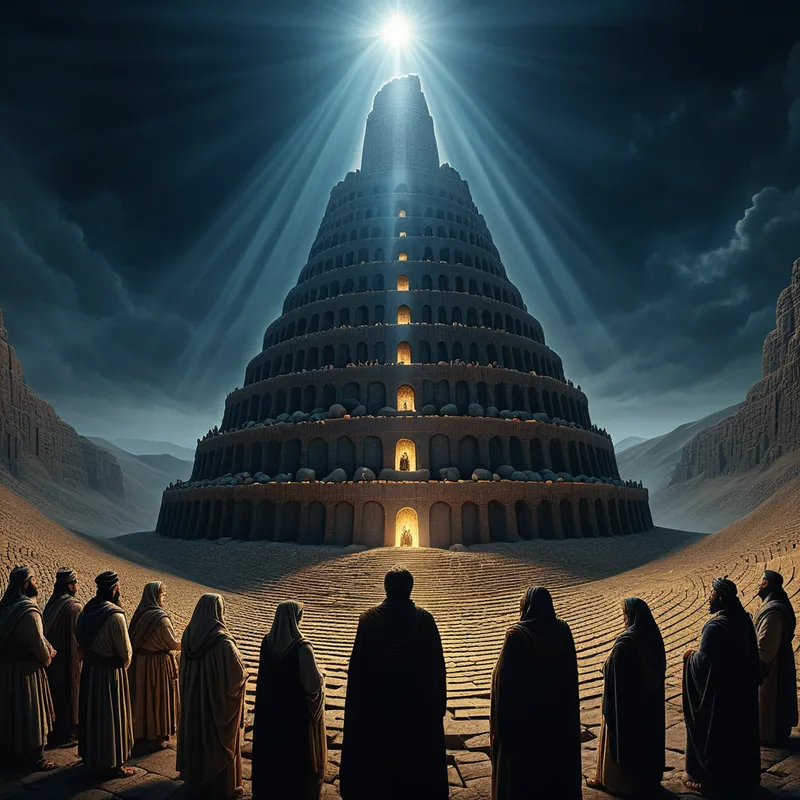
In the days when [the earth](/myths/the-earth “Myth from Hindu culture.”/) was still young in its unity, when the memory of the great waters had receded but the echo of a single command still hummed in the blood of humanity, there arose a people in the land of Shinar. Their hearts were one, and their speech was one. And they said to one another, “Come, let us make bricks, and burn them thoroughly.” And they had brick for stone, and bitumen for mortar.
And they said, “Come, let us build ourselves a city, and a tower with its top in the heavens, and let us make a name for ourselves, lest we be dispersed over the face of the whole earth.”
The ambition was a fire in their bellies. The sun beat down on the plain, baking the clay into hard, red slabs. The air grew thick with the smell of kiln-smoke and hot tar. The sound was a symphony of purpose: the thud of mud in molds, the scrape of trowels, the grunt of men hauling bricks on wooden sledges. Higher and higher the structure rose, a [ziggurat](/myths/ziggurat “Myth from Mesopotamian culture.”/) of human will, its shadow stretching long across the land like a sundial marking their progress toward the divine realm. It was a mountain of their own making, a ladder of baked earth meant to pierce the very floor of [the sky](/myths/the-sky “Myth from Persian culture.”/). They looked upon their work, and it was good in their eyes. Their name would be eternal, their unity unbreakable, their foundation secure upon the earth.
Then, the Lord came down to see the city and [the tower](/myths/the-tower “Myth from Tarot culture.”/), which the children of man had built. The text does not describe a form, but a presence—a pressure in the air, a sudden silence that swallowed the clamor of construction. It was not a presence of anger, but of profound, unsettling contemplation.
And the Lord said, “Behold, they are one people, and they have all one language, and this is only the beginning of what they will do. And nothing that they propose to do will now be impossible for them.”
In that moment, a tremor passed through the earth, not a violent quake, but a deep, resonant shiver, as if [the world](/myths/the-world “Myth from Tarot culture.”/) itself sighed. It began at the base of the great tower, in the very first course of bricks laid with such certainty. A sound like winter ice cracking on a deep lake echoed from within the structure. Hairline fractures, glowing with a faint, impossible light, spiderwebbed through the bitumen and brick. Dust, fine as ash, began to sift from the seams. The foundation was no longer whole; it was flawed at its core.
Then the Lord confused the language of all the earth. The foreman shouted an instruction, and to the mason, it was the guttural bark of a strange beast. The mason cried out in confusion, and to the brickmaker, it was the babble of a madman. The symphony became cacophony. The unity of purpose shattered into a thousand fragments of misunderstanding, fear, and accusation. They left off building the city. The tower, with its cracked and whispering foundation, stood unfinished against the sky, a monument to a scattered people. And the Lord dispersed them from there over the face of all the earth, and the place was called Babel.
Cultural Origins & Context
This narrative, found in Genesis 11:1-9, is an etiological myth—a story explaining the origin of a phenomenon, in this case, the diversity of human languages and the dispersal of peoples. It is a foundational text of the Biblical tradition, positioned after the global flood and before the call of Abraham, marking a pivotal transition from a universal human story to the particular story of a chosen lineage.
Scholars place its origins in the Post-Exilic period. For a people recently returned from exile in Babylon, the tale of Babel would have resonated deeply. They had seen the colossal ziggurats of Mesopotamia, symbols of imperial power and religious aspiration. The myth functions as a potent critique of such centralized, human-centric power. It was passed down not as a simple fable, but as sacred history, told by priests and scribes to illustrate a core theological principle: that unchecked human ambition, divorced from divine sanction, leads to fragmentation and exile. Its societal function was to humble national pride, explain cultural difference as a divine ordinance, and orient identity not around a tower of achievement, but around covenant and relationship.
Symbolic Architecture
The myth’s power lies in its dense symbolic [architecture](/symbols/architecture “Symbol: Architecture in dreams often signifies structure, stability, and the framing of personal identity or life’s journey.”/). The [tower](/symbols/tower “Symbol: The tower symbolizes protection, aspirations, and isolation, representing both stability and the longing for higher achievement.”/) is not merely a building; it is the edifice of the [human](/symbols/human “Symbol: The symbol of a human represents individuality, complexity of emotions, and social relationships.”/) ego, the [monument](/symbols/monument “Symbol: A structure built to commemorate a person, event, or idea, often representing legacy, memory, and cultural identity.”/) to self-sufficiency and the desire for immortal renown (“let us make a name for ourselves”). It represents the [psyche](/myths/psyche “Myth from Greek culture.”/)’s attempt to build a perfect, integrated [structure](/symbols/structure “Symbol: Structure in dreams often symbolizes stability, organization, and the framework of one’s life, reflecting how one perceives their environment and personal life.”/) of [consciousness](/symbols/consciousness “Symbol: Consciousness represents the state of awareness and perception, encompassing thoughts, feelings, and experiences.”/) that can reach the heavens—achieve god-like wholeness—through will and intellect alone.
The cracked [foundation](/symbols/foundation “Symbol: A foundation symbolizes the underlying support systems, values, and beliefs that shape one’s life, serving as the bedrock for growth and development.”/) is the critical [symbol](/symbols/symbol “Symbol: A symbol can represent an idea, concept, or belief, serving as a powerful tool for communication and understanding.”/). It represents the fatal flaw in this project: the denial of a fundamental, grounding [reality](/symbols/reality “Symbol: Reality signifies the state of existence and perception, often reflecting one’s understanding of truth and life experiences.”/).
The foundation cracks not from external assault, but from an internal, divine recognition of a truth the builders refused to acknowledge: that any structure built on the premise of absolute human autonomy is built on a fault line.
That [fault](/symbols/fault “Symbol: A fault signifies an imperfection or error, often representing feelings of guilt or inadequacy in dreams.”/) line is the inherent limitation of the [creature](/symbols/creature “Symbol: Creatures in dreams often symbolize instincts, primal urges, and the unknown aspects of the psyche.”/), the necessary [boundary](/symbols/boundary “Symbol: A conceptual or physical limit defining separation, protection, or identity between entities, spaces, or states of being.”/) between human and divine. The [confusion](/symbols/confusion “Symbol: A state of mental uncertainty or disorientation, often reflecting internal conflict, lack of clarity, or overwhelming choices in waking life.”/) of tongues is not a [punishment](/symbols/punishment “Symbol: A dream symbol representing consequences for actions, often tied to guilt, societal rules, or internal moral conflicts.”/) in a vindictive sense, but the inevitable psychological consequence of the cracked foundation. When the core premise of a unified ego-project is flawed, internal communication breaks down. The psyche becomes a Babel of conflicting impulses, voices, and complexes—the conscious mind no longer understands the [language](/symbols/language “Symbol: Language symbolizes communication, understanding, and the complexities of expressing thoughts and emotions.”/) of the instinct, the [spirit](/symbols/spirit “Symbol: Spirit symbolizes the essence of life, vitality, and the spiritual journey of the individual.”/) cannot converse with the [body](/symbols/body “Symbol: The body in dreams often symbolizes the dreamer’s self-identity, personal health, and the relationship they have with their physical existence.”/). The [dispersal](/symbols/dispersal “Symbol: The act of scattering, spreading, or breaking apart. Often represents release, transition, or loss of cohesion.”/) is the experience of inner [fragmentation](/symbols/fragmentation “Symbol: The experience of breaking apart, losing cohesion, or being separated into pieces. Often represents disintegration of self, relationships, or reality.”/), the feeling of being exiled from one’s own center.
The Dreamer’s Resonance
When this myth activates in the modern psyche, it often manifests in dreams of structural failure. The dreamer may find themselves in a familiar house or a grand, ambitious building they have constructed, only to discover a deep crack in the basement wall, a crumbling pillar, or a floor that groans and shifts. There is a somatic sense of sinking, of instability where solidity was assumed.
Psychologically, this signals a profound process: [the ego](/myths/the-ego “Myth from Jungian culture.”/)’s foundational assumptions are being challenged. This could be a career built on a false premise, a relationship founded on an unspoken lie, or an identity constructed to please others. The “crack” is the intrusion of truth—often a painful, rejected truth from the shadow or [the Self](/myths/the-self “Myth from Jungian culture.”/). The dreamer is going through a necessary deconstruction. The feeling of being “scattered” or unable to communicate in the dream mirrors the inner confusion that arises when old, unifying narratives fall apart. It is the psyche’s way of halting a project of inflation, forcing a descent from the heights of ambition to examine what lies, flawed and real, at the base.
Alchemical Translation
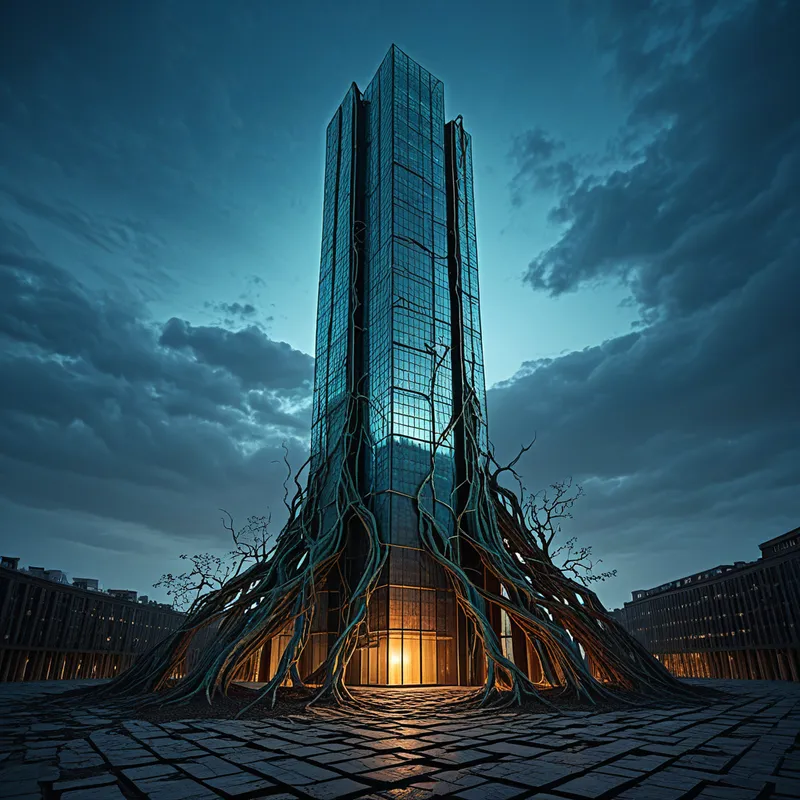
The alchemical process modeled here is not one of building higher, but of surrendering to the crack. Individuation, the journey toward psychic wholeness, does not proceed by perfecting the tower of the [persona](/myths/persona “Myth from Greek culture.”/). It begins when the foundation is revealed to be faulty.
The divine intervention—the “coming down” of the Lord—symbolizes the irruption of the Self, the central archetype of order, into the ego’s neatly planned world. This shatters the illusion of total ego-control (confusio linguarum). The alchemical work is to endure this [nigredo](/myths/nigredo “Myth from Alchemical culture.”/), this blackening and confusion, without fleeing into renewed attempts at building. One must listen to the babble of the inner voices—the neglected fears, the arrogant ambitions, the childlike hopes—and begin the slow, humble work of translation.
Redemption in this myth is not in repairing the crack to build the same tower anew. It is in recognizing the crack as the sacred opening through which a different kind of foundation can be laid—one not of baked brick and tar, but of humble, receptive earth.
The scattering is not the end of the story, but the necessary precondition for a new beginning. From this dispersal, new lineages, new languages, new covenants emerge. Psychically, this is the movement from a monolithic, rigid ego-complex to a diversified, adaptable consciousness that can hold multiplicity. The flawed foundation becomes the site where the individual, no longer seeking a “name” in the heavens, plants the seed of their own unique, grounded, and authentic life. [The tower of Babel](/myths/the-tower-of-babel “Myth from Global/Universal culture.”/) remains, a ruin in the soul’s landscape, a permanent reminder of the limits of will—and the grace that begins where those limits are acknowledged.
Associated Symbols
Explore related symbols from the CaleaDream lexicon: