The Cowboy Myth Meaning & Symbolism
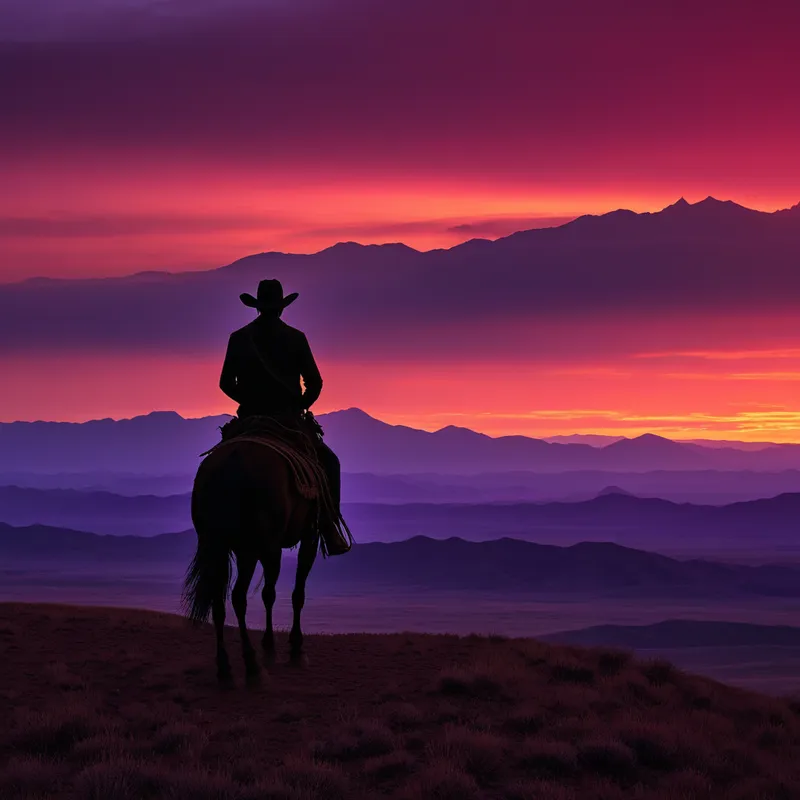
A lone figure on the horizon, mediating between the herd and the wild, embodying the soul's journey between order and chaos.
The Tale of The Cowboy
Listen. [The wind](/myths/the-wind “Myth from Various culture.”/) does not blow here; it sings. A long, low note across a thousand miles of grass, a hymn to emptiness. This is the [Great Plains](/myths/great-plains “Myth from Native American culture.”/), a sea of gold and shadow under a sky so immense it swallows thought. And into this hymn rides a figure.
He is not born of this land, yet he is shaped by it. His skin is leather from the sun’s forge, his eyes are squinted against distances that would break a city soul. He is the Cowboy. His kingdom is not of walls, but of horizons. His charge is the herd—a slow, lowing river of life, a civilization of hoof and hide he must guide across the raw belly of [the world](/myths/the-world “Myth from Tarot culture.”/).
The conflict is eternal and twofold. Before him lies the Wild: the dust storm that erases trails, the lightning that spooks the herd into a thundering stampede, the drought that turns creeks to dust, and the wolf that watches from the rimrock. Behind him, in a place he seldom sees, is the Railhead, the destination, the demand for order and profit. He stands in [the crucible](/myths/the-crucible “Myth from Alchemical culture.”/) between them.
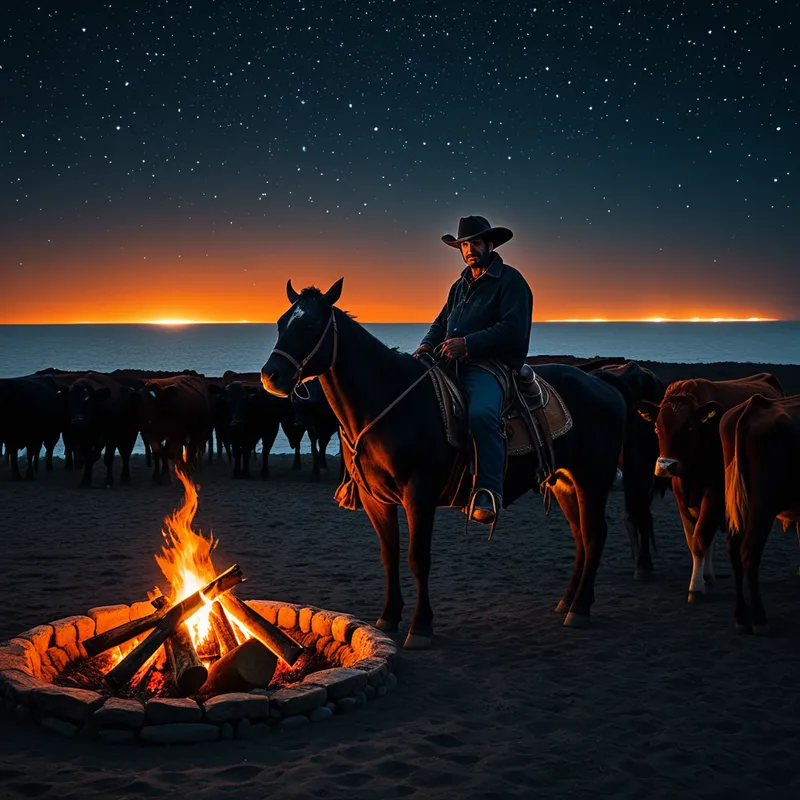
His days are a ritual of mediation. At dawn, he sings the herd to its feet. In the heat of the day, he rides the flanks, a patient, moving boundary. His lasso is an extension of his will, not for capture, but for gentle correction. At night, he takes his turn at the watch, the fire a tiny defiance against the oceanic dark, his presence a calm center for the beasts’ primal fears.
The climax is not a battle with a monster, but a confrontation with chaos itself: the Stampede. It begins with a whisper of fear, then a single startled movement. Then the world dissolves into thunder. [The earth](/myths/the-earth “Myth from Hindu culture.”/) shakes. The herd becomes a single, mindless force of destruction, running blind. The cowboy does not flee. He rides toward the heart of the storm. He pushes his horse to the edge of ruin, riding parallel to the tidal wave of muscle and horn, his voice cutting through the roar—not a shout, but a focused chant, a song of recall. He is trying to turn [the river](/myths/the-river “Myth from Buddhist culture.”/), not by force, but by persuasion, by becoming a fixed point their panicked minds can orbit. He risks being swallowed whole.
And then, the turn. The leading edge begins to curve, the mindless run becoming a wide, circling mill. The thunder slows to a rumble, then to heavy breath. The cowboy, trembling with spent adrenaline, rides slowly around the now-calming sea of backs. He has not conquered. He has re-negotiated the peace. He has brought the chaos back into a temporary, breathing order. He rides on, the destination still far off, [the horizon](/myths/the-horizon “Myth from Various culture.”/) unchanged. The resolution is not an ending, but the resumption of the journey. He is always riding toward a dawn he will never truly reach, forever the guardian of [the threshold](/myths/the-threshold “Myth from Folklore culture.”/).
Cultural Origins & Context
This myth was not etched on temple walls but woven into the fabric of a brief, brutal, and romanticized historical moment: the era of the Cattle Drive. It emerged from the collision of economic necessity, geographic reality, and human spirit. The story was passed down not by bards, but by dime novels, traveling Wild West shows, and later, the silver screen. Figures like Buffalo Bill Cody transformed lived experience into spectacle, while authors like Owen Wister (in The Virginian) codified the cowboy’s silent code of honor.
Its primary tellers were often outsiders looking back, romanticizing the grit and loneliness into an epic of American character. Societally, the myth functioned as a foundational narrative for a nation defining itself against the “Old World.” It celebrated the virtues of self-reliance, stoic endurance, and a personal moral code that existed beyond the reach of courts and churches. It provided a heroic model for the individual pitted against immense natural forces, mediating between the raw resources of the continent and the engine of civilization demanding them.
Symbolic Architecture
Psychologically, the [Cowboy](/symbols/cowboy “Symbol: A cowboy represents freedom, adventure, and a rugged individualism often associated with the American frontier.”/) is the archetypal [Mediator](/symbols/mediator “Symbol: A figure who resolves conflicts between opposing parties, representing balance, communication, and the integration of differences.”/) or [Psychopomp](/myths/psychopomp “Myth from Greek culture.”/) of the [interior](/symbols/interior “Symbol: The interior symbolizes one’s inner self, thoughts, and emotions, often reflecting personal growth, vulnerabilities, and secrets.”/) [landscape](/symbols/landscape “Symbol: Landscapes in dreams are powerful symbols representing the dreamer’s emotional state, personal journey, and the broader context of life situations.”/). He does not reside safely in the town of the conscious ego, nor is he lost in the untamed [wilderness](/symbols/wilderness “Symbol: Wilderness often symbolizes the untamed aspects of the self and the unconscious mind, representing a space for personal exploration and discovery.”/) of the unconscious. His domain is the liminal [space](/symbols/space “Symbol: Dreaming of ‘Space’ often symbolizes the vastness of potential, personal freedom, or feelings of isolation and exploration in one’s life.”/) in between.
The herd represents the instinctual, animalistic drives of the psyche—powerful, vital, but prone to panic and chaos if left unattended. The cowboy’s task is not to slaughter or deny these instincts, but to guide them with a conscious, disciplined presence.
His solitude is not mere [loneliness](/symbols/loneliness “Symbol: A profound emotional state of perceived isolation, often signaling a need for connection or self-reflection.”/), but the necessary [condition](/symbols/condition “Symbol: Condition reflects the state of being, often focusing on physical, emotional, or situational aspects of life.”/) for listening to the inner world. His tools—the [saddle](/symbols/saddle “Symbol: A saddle represents the concept of guidance and support in one’s journey, often associated with control and desire for freedom.”/), the lasso, the horse—symbolize the means by which we harness our own raw [nature](/symbols/nature “Symbol: Nature symbolizes growth, connectivity, and the primal forces of existence.”/) and direct its power. The ever-present [horizon](/symbols/horizon “Symbol: The horizon can symbolize the boundary between the known and the unknown, representing future possibilities and the journey ahead.”/) symbolizes the call of the Self, the distant, guiding totality of the [psyche](/myths/psyche “Myth from Greek culture.”/) that one journeys toward but never fully possesses in time. The myth is ultimately about holding [tension](/symbols/tension “Symbol: A state of mental or emotional strain, often manifesting physically as tightness, pressure, or unease, signaling unresolved conflict or anticipation.”/): between freedom and [responsibility](/symbols/responsibility “Symbol: Responsibility in dreams often signifies the weight of duties and the expectations placed upon the dreamer.”/), wildness and order, self and other.
The Dreamer’s Resonance
When the Cowboy archetype rides into modern dreams, it often signals a psychological process of boundary-keeping and guided integration. Dreaming of being a cowboy, or encountering one, suggests the dreamer is in a life phase requiring stoic self-reliance and a journey through an internal “wilderness”—perhaps a period of uncertainty, transition, or emotional raw-ness.
Somatically, this might feel like a tightness in the shoulders (carrying a burden alone), a watchful alertness, or the fatigue of a long journey. Psychologically, the dream is asking [the ego](/myths/the-ego “Myth from Jungian culture.”/) to take up the mediator’s role. The stampeding herd might manifest as a dream of chaotic emotions, overwhelming responsibilities, or primal fears suddenly breaking free of their fences. The dream-cowboy’s calm attempt to turn the herd is the psyche’s innate wisdom attempting to guide those chaotic forces back into a manageable pattern, not to eliminate them. It is a call to find one’s own centered voice amidst internal or external chaos.
Alchemical Translation
The alchemical process mirrored in the Cowboy myth is that of the [Nigredo](/myths/nigredo “Myth from Alchemical culture.”/) and Albedo—the blackening and the whitening. The long, sun-baked trail is the [Nigredo](/myths/nigredo “Myth from Alchemical culture.”/), the confrontation with [the shadow](/myths/the-shadow “Myth from Jungian culture.”/), the dust, the thirst, and the sheer, isolating vastness of [the self](/myths/the-self “Myth from Jungian culture.”/). The cowboy’s endurance through this is the dissolution of the ego’s pretensions.
The pivotal alchemical act is the night-herding by the campfire. Here, in the conscious vigil against the unconscious dark (the herd/shadow), the mediator holds the tension between opposites. This conscious suffering is the fire that transforms base material.
The successful turning of the stampede is the Albedo—not a final purity, but the emergence of a new, more resilient order from chaos. The herd is integrated, not exiled. For the modern individual, this translates to the hard, daily work of individuation: we must leave the comfortable “town” of our [persona](/myths/persona “Myth from Greek culture.”/), venture into the wilds of our unlived life and unacknowledged drives (the herd), and learn to guide them with a firm but respectful consciousness. We do not become the wild, nor do we utterly civilize it. We become the rider on the boundary, the one who can listen to the wind’s song and still keep moving toward a personal horizon, our own inner Railhead, carrying the valuable, instinctual life within us to a place where it can be of use to our whole being. The journey itself, in its solitude and its steadfastness, is the transformation.
Associated Symbols
Explore related symbols from the CaleaDream lexicon: