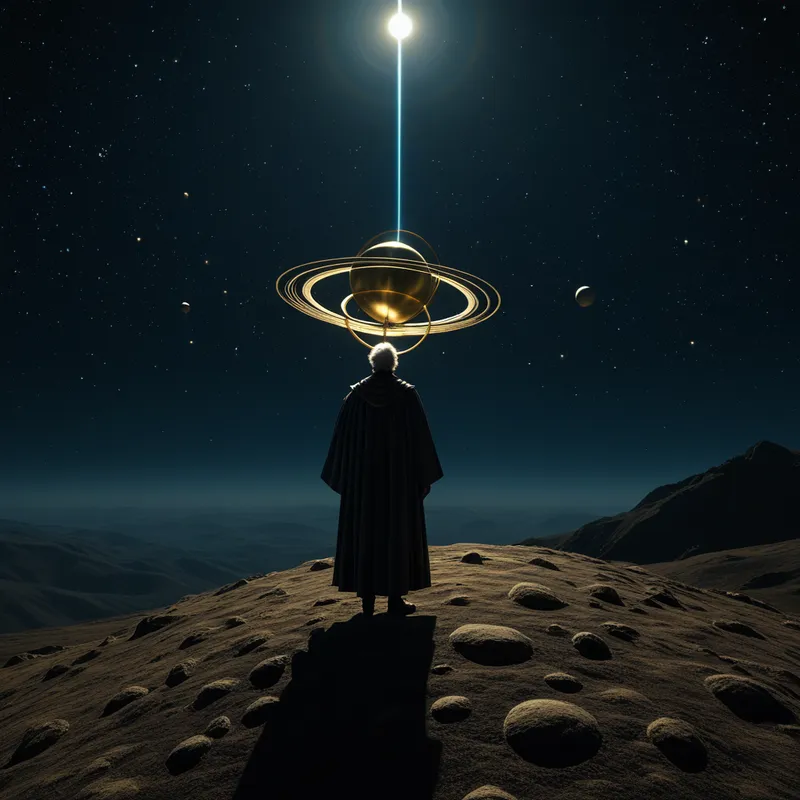
The Copernican Revolution Myth Meaning & Symbolism
A story of cosmic displacement where humanity is dethroned from the center of creation, forced to find meaning in an infinite, indifferent universe.
The Tale of The Copernican Revolution
In the beginning, [the world](/myths/the-world “Myth from Tarot culture.”/) was a stage, and humanity its honored guest. The great dome of the heavens was a perfect, polished sphere of crystal, set in motion by the Prime Mover. At the very heart of this celestial theater, immovable and blessed, sat [the Earth](/myths/the-earth “Myth from Hindu culture.”/). All creation danced for her: [the Moon](/myths/the-moon “Myth from Tarot culture.”/), a loyal companion; the Sun, a golden charioteer; the planets, wandering gods with names of power; and the fixed stars, a tapestry of divine light pinning the fabric of the firmament. This was the truth written in scripture, felt in the bones, and seen with the eyes. It was a story of home.
But in the quiet, a dissonance grew. The wandering gods—planetes—moved with a stubborn irregularity. They would slow, halt, and even trace loops against the starry backdrop, as if lost in a drunken dance. For generations, the keepers of the celestial order, the philosopher-priests, labored to save the appearances. They built models of breathtaking complexity: wheels within wheels, epicycles upon deferents, a clockwork of perfect circles straining to explain the wayward steps of the gods. The machinery grew ornate, a [labyrinth](/myths/labyrinth “Myth from Various culture.”/) of mathematics built to preserve the central, sacred truth: We are the center.
Then came a keeper from a distant land, a canon of the cathedral who watched the night from a lonely tower. His name was Nicolaus. He listened to the dissonant [music of the spheres](/myths/music-of-the-spheres “Myth from Various culture.”/) and heard not error, but a different harmony. In the silence of his study, surrounded by parchments and the ghostly light of reason, he dared a thought that shook the foundations of being: What if the stage itself is moving?
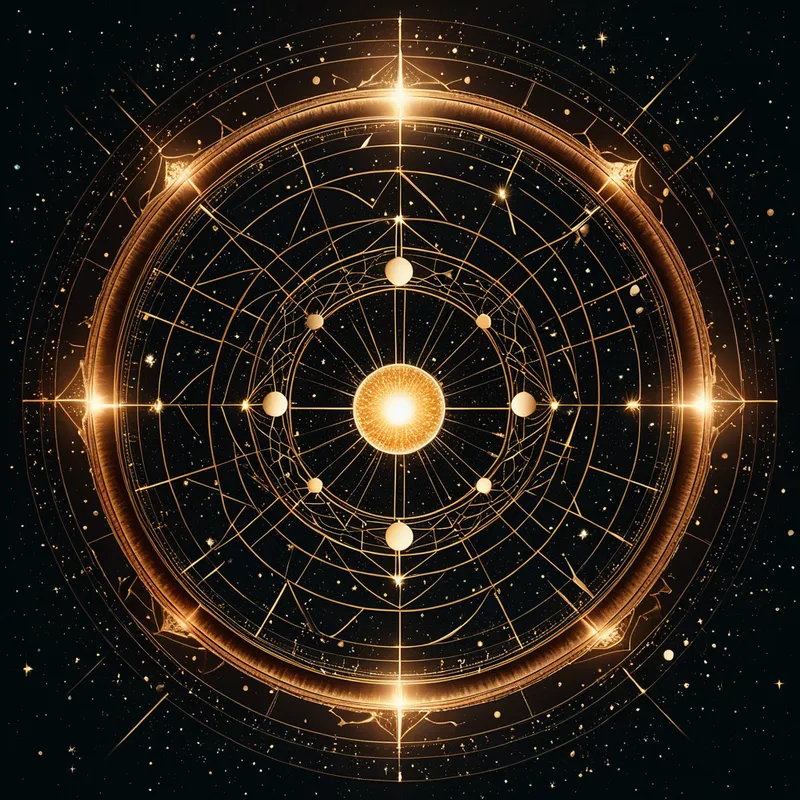
He proposed not a tweak to the machinery, but its utter overthrow. He placed the Sun, that brilliant, life-giving orb, at the silent, unmoving center. The Earth was dethroned, cast from her privileged seat to become merely the third wanderer, spinning on her axis and circling the great central fire. The retrograde loops of Mars and Jupiter were not their confusion, but ours—a simple artifact of our own motion. The model was cleaner, more elegant, yet its beauty was a cold and terrifying [thing](/myths/thing “Myth from Norse culture.”/). It demanded a sacrifice: the cosmic significance of humankind.
For decades, this truth was a whispered secret, a “Commentariolus” shared among a few brave minds. It was a sleeping giant, bound in the pages of De revolutionibus, published only as its author lay on his deathbed, perhaps fearing the upheaval his thought would unleash. The giant awoke slowly. A mathematician named Kepler gave it new limbs, trading perfect circles for elegant ellipses. A stargazer named Galileo armed it with eyes, turning a spyglass to the heavens to find moons orbiting Jupiter—a miniature solar system that proved the Earth was not the sole center of all motion.
The conflict was not merely academic. It was a war for the soul of reality. To accept this new cosmos was to be unmoored, to float in a vast and indifferent space, no longer the beloved child of a geocentric universe but an orphan adrift on a speck of dust orbiting a minor star. The old crystal spheres shattered with a soundless crash heard only in the human spirit. The resolution was not a victory, but a slow, painful awakening to a universe infinitely grander and more humbling than ever dreamed. The center was gone, and with it, a certain kind of innocence.
Cultural Origins & Context
This myth did not emerge from an oral tradition around a campfire, but from the scriptoria, observatories, and printing presses of early modern Europe. Its primary “bards” were natural philosophers, mathematicians, and astronomers—figures like Copernicus, Kepler, Galileo, and later, Newton. They passed it down not through song, but through dense Latin treatises, mathematical proofs, and observed data. Its societal function was profoundly disruptive. It served as the foundational narrative for a new cosmology, directly challenging the theological and philosophical authority of the Church and the Aristotelian-Scholastic tradition that had dominated Western thought for centuries.
The myth’s transmission was a battle itself. It spread through clandestine letters, heresy trials (as with Galileo), and eventually, its incorporation into a new, mechanistic worldview. Its function was to explain humanity’s place in a universe governed by impersonal physical laws, rather than divine purpose centered on Earth. It marked the painful birth of the modern scientific consciousness, one that seeks truth even when that truth displaces us from a cherished, central role.
Symbolic Architecture
At its core, the Copernican [Revolution](/symbols/revolution “Symbol: A fundamental, often violent transformation of social, political, or personal structures, representing upheaval, liberation, and the overthrow of established order.”/) is the myth of the displaced center. It represents the most profound ego-[death](/symbols/death “Symbol: Symbolizes transformation, endings, and new beginnings; often associated with fear of the unknown.”/) in the [history](/symbols/history “Symbol: History in dreams often represents the dreamer’s past experiences, lessons learned, or unresolved issues that continue to influence their present.”/) of Western [consciousness](/symbols/consciousness “Symbol: Consciousness represents the state of awareness and perception, encompassing thoughts, feelings, and experiences.”/).
The greatest trauma is not to be attacked, but to be rendered irrelevant. The Copernican wound is the discovery that the universe is not a narrative about us.
The geocentric [cosmos](/symbols/cosmos “Symbol: The entire universe as an ordered, harmonious system, often representing the totality of existence, spiritual connection, and the unknown.”/) symbolizes the [psyche](/myths/psyche “Myth from Greek culture.”/)-centric [universe](/symbols/universe “Symbol: The universe symbolizes vastness, interconnectedness, and the mysteries of existence beyond the individual self.”/) of the [infant](/symbols/infant “Symbol: The infant symbolizes new beginnings, innocence, and the potential for growth and development.”/) and the tribal mind, where one’s own perceptions and culture are the absolute center of all meaning and value. The Sun, placed at the center by heliocentrism, is not merely a star but the archetypal [symbol](/symbols/symbol “Symbol: A symbol can represent an idea, concept, or belief, serving as a powerful tool for communication and understanding.”/) of consciousness, the illuminating Self around which the complex planets (the facets of [personality](/symbols/personality “Symbol: Personality in dreams often symbolizes the traits and characteristics of the dreamer, reflecting how they perceive themselves and how they believe they are perceived by others.”/)) must orbit. The [hero](/symbols/hero “Symbol: A hero embodies strength, courage, and the ability to overcome significant challenges.”/) of this myth is not a person, but an [idea](/symbols/idea “Symbol: An ‘Idea’ represents a spark of creativity, innovation, or realization, often emerging as a solution to a problem or a new outlook on life.”/)—the Rebel [archetype](/symbols/archetype “Symbol: A universal, primordial pattern or prototype in the collective unconscious that shapes human experience, behavior, and creative expression.”/) that dismantles the ruling dogma of [the ego](/myths/the-ego “Myth from Jungian culture.”/).
The shattered crystalline spheres represent the breaking of projected psychological containers—the rigid dogmas, unquestioned beliefs, and cultural assumptions that make us feel safe and central. The terrifying, infinite [space](/symbols/space “Symbol: Dreaming of ‘Space’ often symbolizes the vastness of potential, personal freedom, or feelings of isolation and exploration in one’s life.”/) that replaces them is the true [landscape](/symbols/landscape “Symbol: Landscapes in dreams are powerful symbols representing the dreamer’s emotional state, personal journey, and the broader context of life situations.”/) of the individuated psyche: vast, unknown, and full of potential, but requiring us to find our own meaning, without the comfort of a pre-ordained cosmic [spotlight](/symbols/spotlight “Symbol: A concentrated beam of light illuminating a specific area or person, often representing attention, visibility, or revelation.”/).
The Dreamer’s Resonance
When this myth activates in the modern psyche, it manifests in dreams of profound disorientation and cosmic reordering. One may dream of the ground falling away, of buildings or worlds turning inside out, or of looking down to find oneself floating in space, untethered from any familiar landmark. These are not nightmares of pursuit, but of context collapse.
Somatically, this can feel like vertigo, a loss of gravitational pull, or a deep, existential nausea. Psychologically, it signals a critical phase in what James Hollis calls “the [middle passage](/myths/middle-passage “Myth from African Diaspora culture.”/)“—the death of the first adulthood, which was built around the received scripts of family, culture, and tribe (the geocentric life). The dreamer is undergoing the painful but necessary process of de-centering the ego. The familiar “world” they built their identity upon is revealed to be not the center of reality, but a small, moving part within a much larger, impersonal system—be it their family dynamic, corporate structure, or belief system. The dream is the psyche’s way of enacting the Copernican shift: you are not the central organizing principle of your universe. Your story is part of a larger story.
Alchemical Translation
The alchemical process mirrored here is the [nigredo](/myths/nigredo “Myth from Alchemical culture.”/), the blackening or dissolution. It is the necessary first step of psychic transmutation, where [the prima materia](/myths/the-prima-materia “Myth from Alchemical culture.”/)—the leaden, ego-centric self—is broken down.
Individuation begins with a Copernican trauma: the realization that the Sun does not rise for you, but that you must learn to orbit the Sun within yourself.
The struggle is the ego’s fierce resistance to its dethronement. We cling to our epicycles—our complex rationalizations, neuroses, and addictions—to preserve the illusion of our central importance (“My problems are the axis around which the world turns”). The [triumph](/myths/triumph “Myth from Roman culture.”/) is the acceptance of a humbler, more authentic orbit. To internalize the heliocentric principle is to shift the center of gravity from the ego to [the Self](/myths/the-self “Myth from Jungian culture.”/). The ego becomes a planet, a valuable and complex entity, but one that must now revolve around the greater, integrating principle of the wholeness of the psyche.
This alchemical translation asks the modern individual to stop trying to force the universe (one’s life, relationships, career) to conform to a self-centered model. Instead, one must observe the true motions, accept the elliptical, sometimes chaotic orbits of desire and fate, and find meaning not in being the static center, but in participating in the majestic, often incomprehensible, revolution of a reality far greater than oneself. The cold vacuum of space becomes the [vas hermeticum](/myths/vas-hermeticum “Myth from Alchemical culture.”/), the sealed vessel where the new, cosmic consciousness is formed. From the ashes of cosmic specialness arises the dignity of cosmic participation.
Associated Symbols
Explore related symbols from the CaleaDream lexicon: