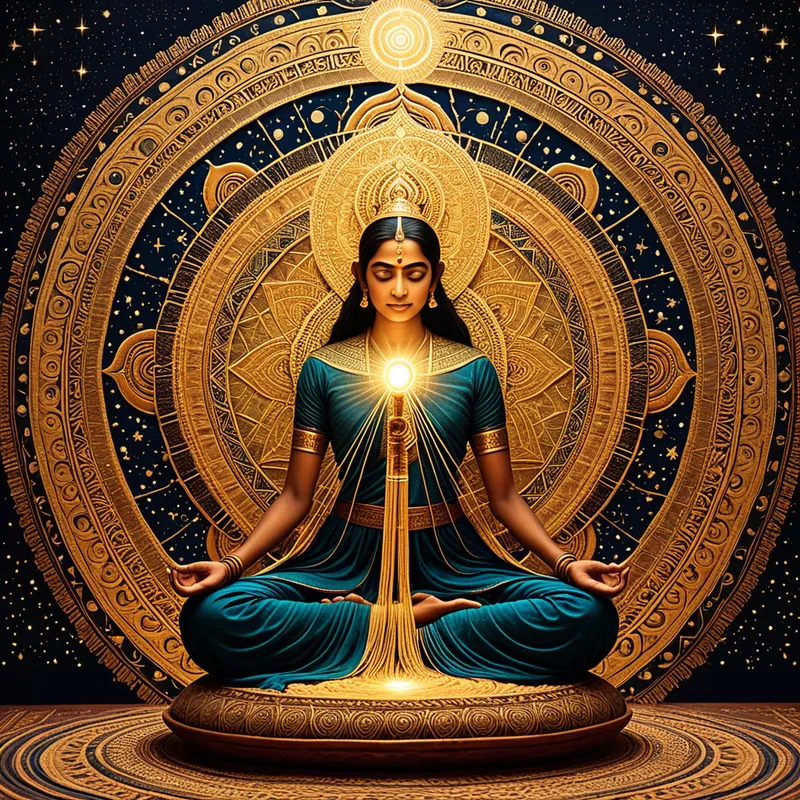
The concept of 'Dharma' in Ind Myth Meaning & Symbolism
The eternal principle of cosmic order and righteous duty, the sacred thread weaving all beings into the fabric of a meaningful universe.
The Tale of The concept of ‘Dharma’ in Ind
Listen. Before the first name was spoken, before the first mountain rose from the primal waters, there was a hum. Not a sound, but the potential for all sound. It was the vibration of Brahman, the unmanifest. And from this hum, a need arose—a need for form, for distinction, for story. Thus, the great exhale began: Maya unfolded like a boundless lotus, and within its petals, the dance of opposites commenced. Light and dark, heat and cold, stillness and motion. But this dance was not chaos; it was held by an invisible, tensile thread.
That thread is Dharma. It is the law that makes the sun know its path and the river remember its course to the sea. It is the covenant that binds the seed to become the tree, and the tree to offer shade. In the first age, the Satya Yuga, Dharma stood on all four legs, and beings moved in perfect harmony with this intrinsic order. Truth was the air they breathed.
But ages turn. The wheel of time, the Kalachakra, grinds forward. With each revolution, Dharma loses a leg. In the second age, it stands on three, then two in the third. Now, in this age, the Kali Yuga, Dharma stands trembling on a single leg. The world groans under the weight of adharma—disorder, falsehood, the self-serving act. The hum is drowned out by the cacophony of desire.
Yet, in the heart of this darkness, the thread persists. It tugs at the conscience of a king, Yudhishthira, as he faces a war where right and wrong are shrouded in grey smoke. It whispers to the prince Rama, who must exile himself to the forest to uphold his father’s word, his personal sorrow a sacrifice upon the altar of cosmic law. It is the unbearable weight on the shoulders of the warrior Arjuna, who on the field of Kurukshetra, drops his bow, his soul sickened at the prospect of killing his kin. Here, at the precipice of collapse, the charioteer Krishna reveals the vision of the universal form—the terrifying, magnificent spectacle of all time and all beings, consuming and creating in an endless cycle, all held within the bounds of Dharma. The thread is not broken; it is revealed as the very warp and weft of existence. The resolution is not a victory of good over evil, but the profound, sobering realization that to act in accordance with one’s own sacred duty, one’s Svadharma, is to become a living pillar holding up the cosmos itself. The story never ends; it is the eternal return to the wheel, the perpetual choice to heed the hum or be lost in the noise.

Cultural Origins & Context
The concept of Dharma is not a single myth but the bedrock upon which the vast edifice of Indic thought—encompassing Hinduism, Buddhism, and Jainism—is constructed. Its origins are as old as the Rig Veda itself, where it is invoked as the sustaining principle of Rta. It was passed down not merely by bards, but by a living culture of ritual, philosophy, and epic narrative. It was debated by sages in forest hermitages, embodied by kings in courtly edicts (like those of Emperor Ashoka), and woven into the daily fabric of life through the Ashrama system. Its primary societal function was integrative and prescriptive: it provided the cosmic justification for social order (Varna) and personal ethics, offering a map for navigating life in alignment with the universe’s deepest truth. It answered the fundamental question: “How should one live so that the world does not fall apart?”
Symbolic Architecture
Dharma is the ultimate symbolic architecture of meaning. It represents the innate, non-negotiable order that precedes and undergirds all phenomena. Psychologically, it symbolizes the Self’s intrinsic blueprint—the organizing principle of the psyche that guides toward wholeness, or individuation.
Dharma is the psychic gravity that pulls the scattered fragments of personality toward the center of meaning. It is the antithesis of chaos, not as imposed control, but as emergent, authentic order.
The figures in its narratives are personifications of this struggle. Yudhishthira is the ego attempting to embody perfect righteousness in an imperfect world. Arjuna’s paralysis represents the ego’s crisis when confronted with the shadow—the painful, intimate aspects of life and self that must be integrated. Krishna, as the charioteer, is the archetypal symbol of the Self, the inner guide who reveals the larger pattern, the Vishvarupa, beyond the ego’s limited sight. The declining legs of Dharma across the Yugas symbolize the increasing difficulty of perceiving and living this inner truth as consciousness becomes more complex and entangled in materialism.
The Dreamer’s Resonance
When this mythic pattern stirs in the modern dreamer, it often manifests as dreams of profound moral or existential crossroads. One might dream of being a judge in a trial where the defendant is their own reflection, or of trying to follow a map where the landmarks keep shifting. There is a somatic quality of weight—carrying a heavy, precious object, or feeling the ground become unstable. Psychologically, this is the process of the ego confronting the demands of the Self. The dreamer is at a threshold where a life pattern, career, or relationship built on adharma—on external validation, fear, or inauthenticity—is collapsing. The psyche is applying the pressure of Dharma, creating the crisis that forces a reckoning with one’s Svadharma. The anxiety in the dream is the friction of the personal will grinding against the grain of one’s deeper nature.

Alchemical Translation
The alchemical process modeled by Dharma is the transmutation of leaden, compulsory living into golden, authentic being. It is the opus of moving from a life dictated by the persona and the expectations of the collective (society, family, tradition) to a life guided by the inner imperative of the Self.
The first stage is nigredo: the dark night of Arjuna on the battlefield, the despair of seeing one’s life as a conflicted, meaningless mess. This is the necessary dissolution of false structures.
The revelation of the universal form by Krishna is the albedo, the illuminating insight. It is the moment one sees their small struggle as part of a vast, purposeful, if often terrifying, cosmic process. The “war” is internal; the relatives one must “slay” are outgrown identifications and dependencies.
The final stage, rubedo, is not a state of perfect, conflict-free bliss. It is the red-hot, committed engagement in one’s Svadharma. It is Yudhishthira ruling a broken kingdom with compassion, or the artisan creating beauty for its own sake. It is action performed with detachment from the fruits, for the sake of the action itself, which aligns the individual will with the cosmic will. One becomes a conscious vessel of Dharma, a living pillar that holds up not the universe, but their own unique, necessary corner of it, thereby finding their irreplaceable place in the great tapestry. The transmutation is complete when duty feels not like a burden, but like the expression of one’s deepest truth.
Associated Symbols
Explore related symbols from the CaleaDream lexicon: