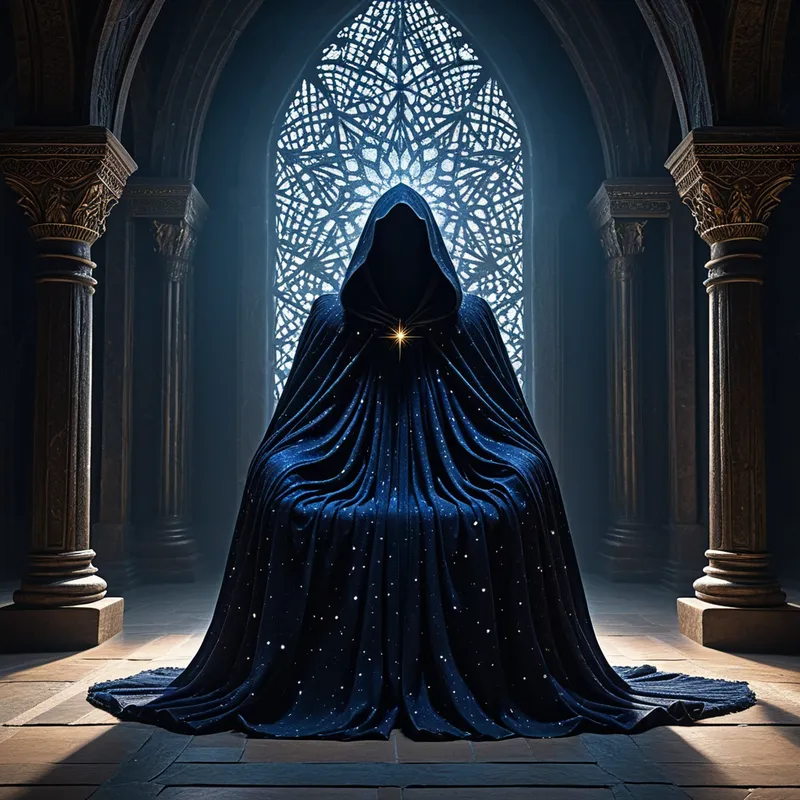
The Cloak of Invisibility from Myth Meaning & Symbolism
A universal tale of a magical garment granting unseen passage, symbolizing the perilous power of withdrawing from the world to see it truly.
The Tale of The Cloak of Invisibility from
Listen, and I will tell you of the garment that is not a garment, the gift that is a curse, the seeing that comes from being unseen. In the time before time was measured, when [the world](/myths/the-world “Myth from Tarot culture.”/) was raw with wonder, there existed a weave known only to the keepers at the edge of things. They were the Threshold Wardens, and their greatest craft was the Cloak of Unseeing.
It was not stolen, but earned. A seeker, hollowed by the noise of the world, their true name lost even to themselves, would journey to [the mist](/myths/the-mist “Myth from Celtic culture.”/)-wrapped crags where the Wardens dwelled. The trial was not of strength, but of stillness. The seeker had to sit in the Cave of Echoing Silence until their own internal clamor—their fears, their desires, their ceaseless thoughts—faded to a whisper. Only when they became a vessel of quiet could the eldest Warden approach.
From a loom that seemed to weave with shadows and moonlight, the Warden would draw forth the Cloak. To the physical eye, it was a shift in the air, a gathering of dusk. When placed upon the seeker’s shoulders, a profound change occurred. The bustling world did not vanish, but the seeker vanished from it. They became a ghost in the machine of life, an unregistered note in the symphony.
The hero—for such they became—would return. They walked through crowded marketplaces unseen, stood in council chambers unheard. They witnessed truths laid bare: the secret kindness of the wretched, the hidden cruelty of the noble, the unguarded sorrow on a king’s face, the genuine joy in a pauper’s hovel. They learned the architecture of power, the pathways of love and hate, all from the privileged prison of invisibility.
But the Cloak, woven from the fabric of separation, exacted its price. The warmth of a direct gaze never touched them. A hand could not clasp theirs in greeting. Laughter never included them. They dwelled in a chilling paradox: to see the world with ultimate clarity, they had to withdraw from its touch completely. The final test was never the wearing, but the removal. Could one who had seen the world’s naked heart choose to re-enter it, vulnerable and seen? To lay the Cloak aside was to be born again, blind in a new way, yet choosing the messy, glorious connection of being perceived.
Cultural Origins & Context
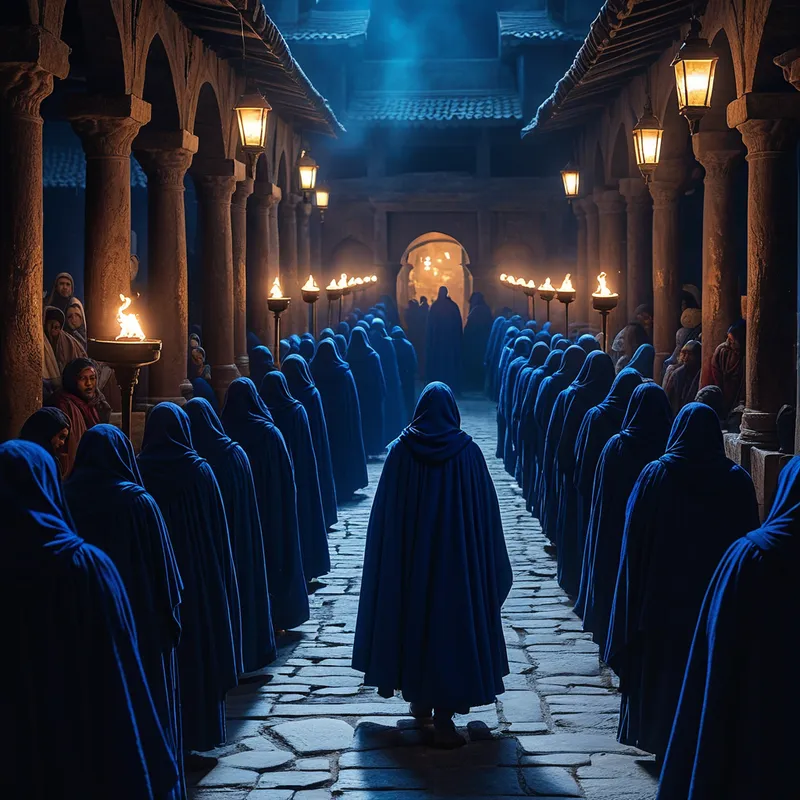
The myth of [the Cloak of Invisibility](/myths/the-cloak-of-invisibility “Myth from Greek culture.”/) is a true universal, appearing not as a single story but as a profound narrative pattern etched into the human [psyche](/myths/psyche “Myth from Greek culture.”/). We find it in the Cap of [Hades](/myths/hades “Myth from Greek culture.”/) from ancient Greece, in the Tarnkappe of Germanic lore, in the mystical veils of Sufi parables, and in the Art of Unnoticed Presence from Taoist and [Shinobi](/myths/shinobi “Myth from Japanese culture.”/) traditions. It was not the property of one culture but a shared answer to a shared human question.
It was passed down by bards, shamans, and elders at the fireside, not merely as entertainment but as a teaching story. Its societal function was multifaceted. For the young, it was a cautionary tale about the dangers of spying and the loneliness of exclusion. For warriors and rulers, it was a manual on strategy—the power of unseen movement. For the mystic and philosopher, it was the central allegory for the journey of enlightenment: the necessary withdrawal from societal projections ([persona](/myths/persona “Myth from Greek culture.”/)) to perceive the underlying reality (the Suchness). The myth taught that ultimate knowledge requires a temporary, perilous divorce from the collective.
Symbolic Architecture
At its core, the [Cloak](/symbols/cloak “Symbol: A garment that conceals identity, protects from elements, or signifies authority and transformation in dreams.”/) is the [symbol](/symbols/symbol “Symbol: A symbol can represent an idea, concept, or belief, serving as a powerful tool for communication and understanding.”/) of radical subjectivity and the [paradox](/symbols/paradox “Symbol: A contradictory yet true concept that challenges logic and perception, often representing unresolved tensions or profound truths.”/) of [consciousness](/symbols/consciousness “Symbol: Consciousness represents the state of awareness and perception, encompassing thoughts, feelings, and experiences.”/). It represents the individual psyche separating from the collective in order to observe it. The [Cloak](/symbols/cloak “Symbol: A garment that conceals identity, protects from elements, or signifies authority and transformation in dreams.”/) is not magic in a childish sense; it is the [condition](/symbols/condition “Symbol: Condition reflects the state of being, often focusing on physical, emotional, or situational aspects of life.”/) of introspection made literal.
The Cloak is the space between stimulus and response, the silent witness within that watches the ego’s drama without participating.
The act of becoming invisible symbolizes the retreat of the ego from its central, performing [role](/symbols/role “Symbol: The concept of ‘role’ in dreams often reflects one’s identity or how individuals perceive their place within various social structures.”/). What is left is the observing Self. The scenes the [hero](/symbols/hero “Symbol: A hero embodies strength, courage, and the ability to overcome significant challenges.”/) witnesses—the hidden truths of others—are symbolic of gaining [insight](/symbols/insight “Symbol: A sudden, deep understanding of a complex situation or truth, often arriving unexpectedly and illuminating hidden connections.”/) into the [shadow](/symbols/shadow “Symbol: The ‘shadow’ embodies the unconscious, repressed aspects of the self and often represents fears or hidden emotions.”/) elements of both society and oneself. You cannot see the [shadow](/symbols/shadow “Symbol: The ‘shadow’ embodies the unconscious, repressed aspects of the self and often represents fears or hidden emotions.”/) of others while brightly lit by your own need for recognition.
The great [danger](/symbols/danger “Symbol: The symbol of ‘Danger’ often indicates a sense of threat or instability, calling for caution and awareness.”/), the myth warns, is identification with the [observer](/symbols/observer “Symbol: An observer represents contemplation, self-awareness, and the act of witnessing one’s experiences.”/). To mistake the temporary cloak for one’s true [skin](/symbols/skin “Symbol: Skin symbolizes the boundary between the self and the world, representing identity, protection, and vulnerability.”/) is to become a ghost, forever analyzing [life](/symbols/life “Symbol: The symbol of ‘Life’ represents a journey of growth, interconnectedness, and existential meaning, encompassing both the joys and challenges that define human experience.”/) but never living it. The fabric of the Cloak is woven from the very stuff of the unconscious—it is the power of the hidden, but to wear it forever is to be consumed by it.
The Dreamer’s Resonance
When this myth pattern stirs in the modern dreamscape, it signals a critical phase of psychological differentiation. To dream of finding or wearing a cloak of invisibility often arises when the dreamer feels overwhelmed by external demands—the “seen” roles of employee, partner, parent, or social persona. The psyche is creating a sanctuary.
Somatically, this may correlate with a felt need to withdraw, to “disappear” from social obligations, sometimes manifesting as fatigue or a desire for solitude. Psychologically, it is the process of [the ego](/myths/the-ego “Myth from Jungian culture.”/) stepping back from its identification with these roles to ask, “Who am I when no one is looking? What do I see when I am not performing to be seen?”
Conversely, dreaming of being trapped in the Cloak, unable to remove it or screaming silently while others look through you, points to a deep fear of irrelevance, isolation, or a sense that one’s true self has become utterly disconnected from the world of relationship. It is [the shadow](/myths/the-shadow “Myth from Jungian culture.”/) of the myth: the curse of perpetual observation without participation, a state of existential loneliness.
Alchemical Translation
The myth models the alchemical process of individuation with stark clarity. The initial journey to the Wardens is the [nigredo](/myths/nigredo “Myth from Alchemical culture.”/)—a conscious entry into the darkness of solitude and the dissolution of social identity. [The Cave](/myths/the-cave “Myth from Platonic culture.”/) of Echoing Silence is [the crucible](/myths/the-crucible “Myth from Alchemical culture.”/) where the noise of the collective unconscious is burned away.
Donning the Cloak is the albedo. It is the stage of illumination, of gaining profound, objective insight into one’s own complexes and the dynamics of the world. This is the “know thyself” phase, but it is sterile and cold if arrested here.
The ultimate transmutation is not in wearing the cloak, but in consciously choosing to fold it away, integrating the witness into the participant.
The removal of the Cloak is the [rubedo](/myths/rubedo “Myth from Alchemical culture.”/). This is the return, the integration. The hero does not return as the naive seeker who left, nor do they remain the detached ghost. They return as a integrated being who has seen and yet chooses to be seen. They carry the knowledge of the Cloak within them—the ability to momentarily retreat into the observer’s stance—but their power is now expressed through vulnerable, authentic engagement. The Cloak becomes not a garment to wear, but a tool to understand, folded into the treasury of the mature Self. The myth teaches that true power lies not in the ability to hide from the world, but in the courage to be present within it, armed with the hard-won sight that only invisibility could grant.
Associated Symbols
Explore related symbols from the CaleaDream lexicon: