The Cloak of Invisibility Myth Meaning & Symbolism
A divine artifact of concealment and revelation, wielded by heroes and gods to navigate the unseen realms of the underworld and the self.
The Tale of The Cloak of Invisibility
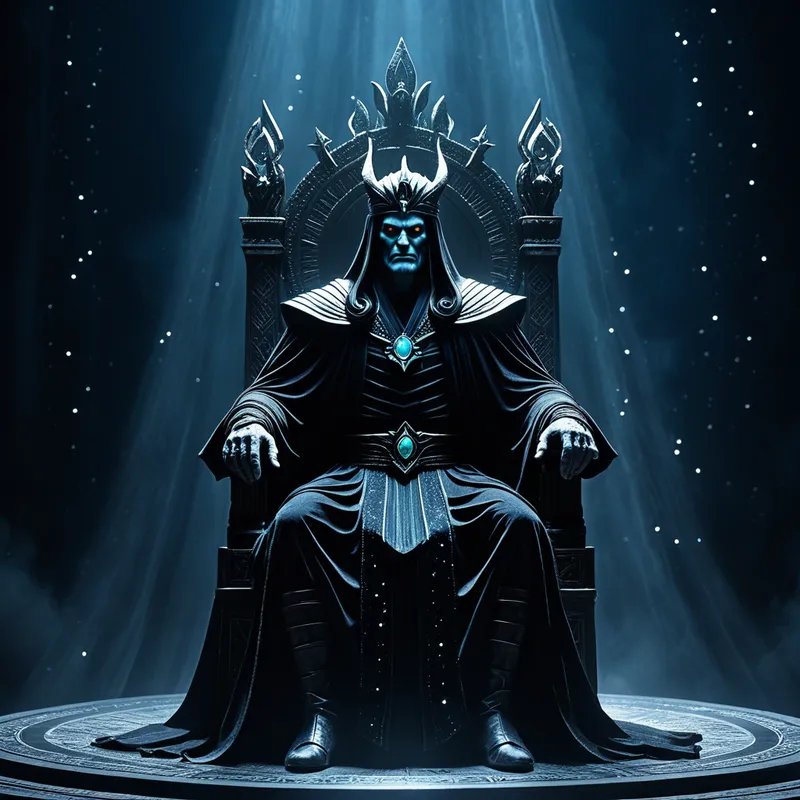
Listen, and hear a tale not of light, but of the dark made useful. It begins not on sun-drenched Olympus, but in the sunless, echoing vaults of the earth, in the realm of Hades. Here, in the palace of polished obsidian and sighs, rules the Unseen One himself. His wealth is not gold, but souls; his light, the pallid glow of asphodel. And among his treasures, forged in the first division of the cosmos, was a wonder: the Cap of Invisibility.
It was not a cloak of cloth, but a helm, a cap of dog-skin, dark as a moonless midnight. To don it was to step outside the gaze of gods and mortals alike. It was the power of the void given form, the privilege of the lord of the dead to move unseen among the living. This was its home, its purpose bound to the throne of shadows.
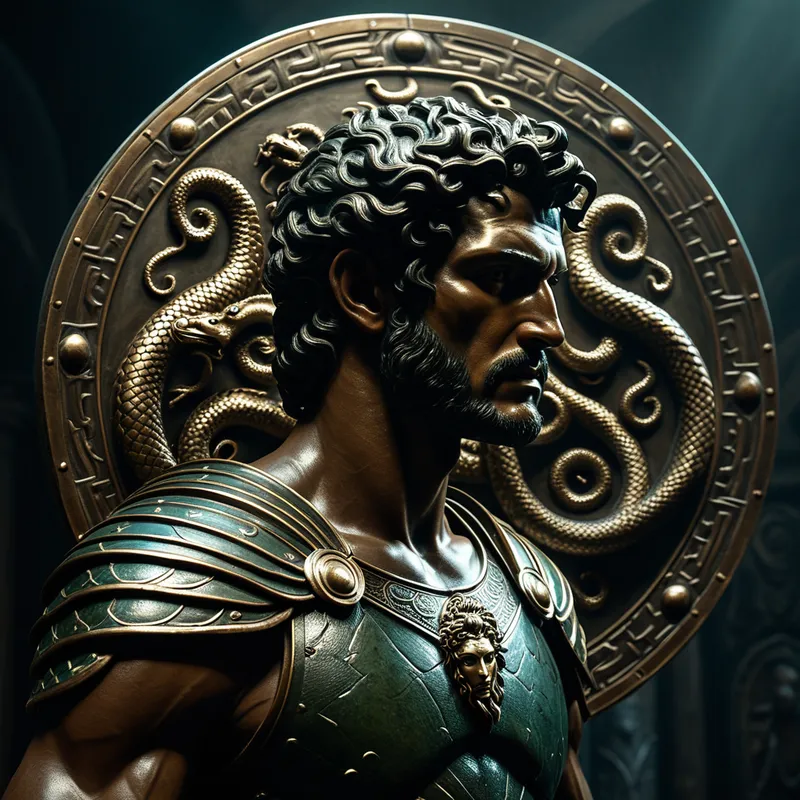
But the Fates weave threads that cross all realms. The hero Perseus, set an impossible task, needed to pass unseen. His quarry was Medusa, and to look upon her was death. He did not journey to Hades, but to the grey sisters, the Graeae, who knew the paths to the nymphs of the west. From these nymphs, guardians of Zephyrus’s secrets, he received the tools of his quest: winged sandals, a magical sack, and—most crucial—the Cap of Invisibility. How it came to them is a mystery lost to the whispers of the west wind, a loan perhaps from the darker brother below.
With the cap upon his head, Perseus became a ghost among the Gorgons’ rocky wastes. The air grew cold and silent around him; his own breath seemed to belong to another. He saw the monstrous forms of Stheno and Euryale, heard their hissing hair, but he was not there for their sight. He saw Medusa, and guided only by her reflection in his polished shield, he struck. As her head fell, her sisters awoke to fury, but they lashed out at empty air. Perseus, shrouded in Hades’ own power, was already gone, a vanishing act that saved his life and sealed his fame.
Cultural Origins & Context
This myth of the Cap of Invisibility, or the Helm of Darkness, is woven into the oldest layers of Greek epic poetry. It appears in the Theogony of Hesiod, where it is listed among the powerful artifacts created for the gods. Its primary association is firmly with Hades, a symbol of his domain’s fundamental nature: invisibility, withdrawal, and the ultimate unseen reality of death. The story of Perseus borrowing it represents a rare narrative incursion of this chthonic power into a heroic, above-world quest. It was a tale told not just to thrill, but to illustrate a profound cultural concept: that to accomplish certain great tasks, one must temporarily employ the powers of the underworld—must become like the dead, unseen and detached—to ultimately reaffirm the order of the living world. It functioned as a mythic precedent for the necessary, if terrifying, engagement with the unseen.
Symbolic Architecture
The Cap of Invisibility is far more than a plot device; it is a profound symbol of the psyche’s relationship with the unseen.
To become invisible is not to cease to exist, but to shift the locus of one’s being from the perceived to the perceiver.
Psychologically, the Cap represents the faculty of introversion and withdrawal. It is the ability to retreat from the collective gaze, from social persona and expectation, into the interior castle of the self. In the hands of Hades, it symbolizes the necessary, autonomous hiddenness of the unconscious—the parts of ourselves that are “lord of the underworld,” ruling a vast, unseen realm of memory, instinct, and potential.
When Perseus wields it, it becomes the tool for confronting the ultimate petrifying terror: the Medusan aspect of the unconscious. One cannot face such a thing directly (to look is to be frozen). One must approach indirectly, via reflection (the shield), and from a place of psychic invisibility—a suspended ego-state where one’s own fears and prejudices are hidden even from oneself, allowing a clear, mediated strike at the root of the paralysis.

The Dreamer’s Resonance
When this mythic pattern stirs in modern dreams, it signals a profound somatic and psychological process: the active engagement with the shadow. To dream of finding or wearing a cloak of invisibility often coincides with a life phase where one feels overly exposed, scrutinized, or forced into a role. The dream-ego seeks refuge in anonymity.
Somatically, this may manifest as a desire to shrink, to make oneself small, or a feeling of being transparent yet tense. Psychologically, it is the psyche’s attempt to grant the conscious self a respite to observe without being observed, to integrate shadow material without the interference of the inner critic or the expectations of the outer world. A dream of losing the cloak, or of it being torn, can indicate a forced return to visibility—a confrontation with aspects of the self or one’s life that can no longer be hidden. The cloak in a dream is not about cowardice, but about the necessary, sacred space for unseen transformation.

Alchemical Translation
The myth models the alchemical process of individuation, specifically the stage of nigredo, the blackening, the descent into the unconscious.
The triumph is not in the slaying, but in the conscious return from invisibility, bearing the transformed token of the darkness.
First, the ego (Perseus) must acknowledge it cannot face its deepest terror (Medusa/the unintegrated complex) with its ordinary, visible tools. It must petition the deeper, often neglected or feared aspects of the psyche (the nymphs, connected to Hades) for aid. Receiving the Cap is the act of consciously choosing introspection and withdrawal—entering the nigredo.
The heroic act performed while invisible is the psychic work done in solitude: the analysis, the active imagination, the grieving, the shadow-work. It is done “unseen” by the outer world and even by parts of the inner personality. The confrontation is mediated (the shield’s reflection), symbolizing the use of symbolic understanding, art, or dialogue to approach the raw terror indirectly.
Finally, the retrieval of the “head” (the Gorgoneion) is the acquisition of a new power from the conquered complex. What once paralyzed now protects and empowers. And the return of the Cap, implied in the myth’s cycle, signifies that the state of deep introversion is temporary. One does not remain forever in Hades’ realm. The goal is to reintegrate into the world of light and form, forever changed, carrying the hard-won wisdom of the unseen within the now-visible self. The cloak is shed, but its memory—the knowledge of how to become unseen—becomes a permanent part of the soul’s toolkit.
Associated Symbols
Explore related symbols from the CaleaDream lexicon: