The city of Babylon from Mesop Myth Meaning & Symbolism
A city built by gods and mortals, a tower reaching for heaven, and a divine scattering that seeded the world with a thousand tongues.
The Tale of The city of Babylon from Mesop
Hear now of the city that was the navel of the world, where the mud of the Two Rivers met the fire of ambition. In the first age, when the memory of the great flood was still a whisper in the wind, humanity was one. One tongue, one voice, one purpose that rolled across the plains like thunder. They said to one another, “Let us build a city, and a tower whose top may reach unto the heavens. Let us make a name for ourselves, lest we be scattered upon the face of the whole earth.”
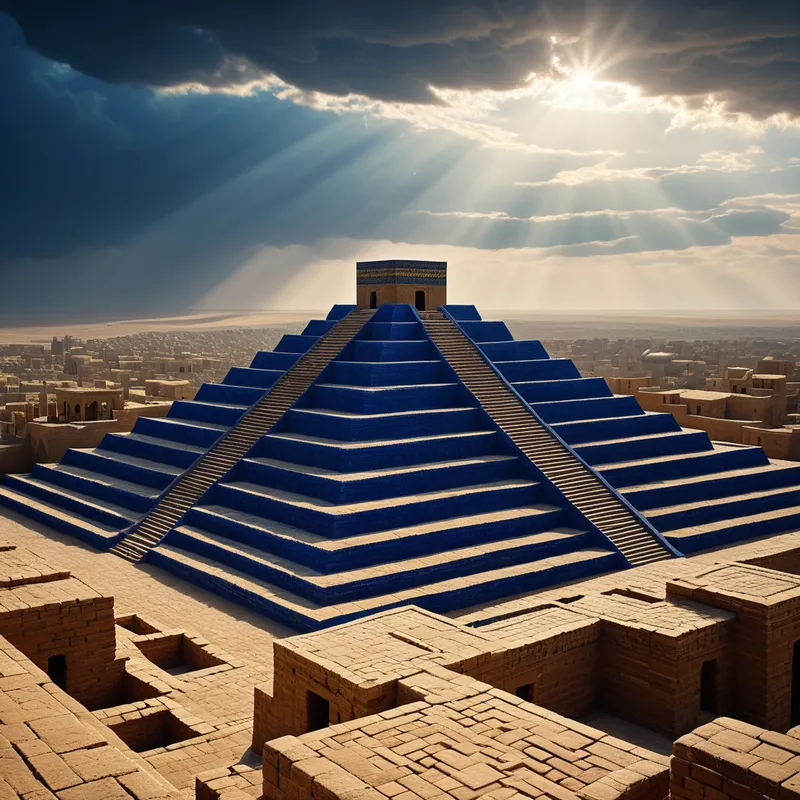
And so they gathered. From the four corners they came, to the place called Bab-ilim. The sun beat upon their backs as they molded the clay into bricks, burning them in great kilns until they were hard as stone, and using bitumen for mortar. The sound was a symphony of purpose: the slap of wet earth, the crackle of fire, the rhythmic chant of laborers hauling baskets up ramps that coiled around the rising structure like a serpent. The tower, a ziggurat, grew. Tier upon tier it climbed, a mountain made by human hands, its shadow stretching for miles. The city sprawled at its feet, a hive of perfect order, its walls thick and high, its gates bronze and formidable. The scent of baking bread, incense, and hot bitumen filled the air. They were close, so close. They could almost feel the cool breath of the firmament on their brows.
But the gods looked down from their celestial abode. Marduk observed the ascending peak, and a profound disturbance stirred in the divine council. “Behold, the people are one, and they have all one language,” the gods murmured. “And this they begin to do: and now nothing will be restrained from them, which they have imagined to do.” It was not the height that frightened them, but the unity. A single will, directed upward, was a challenge to the very order of creation.
Thus, the Enlil of old tales acted. He did not smite the tower with lightning. He did not send a quake to swallow it. He chose a subtler, more profound dissolution. He came down, a presence felt as a sudden, silent wind that stilled the kiln fires. And he confounded their language, so that one could not understand the speech of his neighbor.
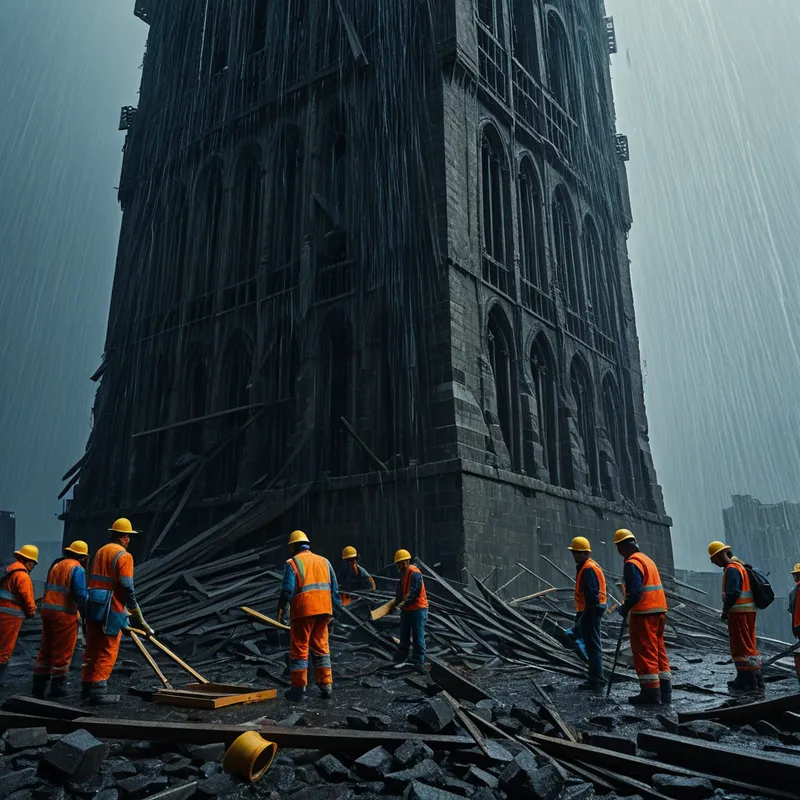
The change was not violent, but it was absolute. A man asking for a brick was met with a look of blank terror. A foreman’s command became a stream of guttural nonsense. The symphony shattered into a cacophony of isolated, frantic sounds. The chant broke. Hands that once moved in unison now flailed in confusion. The shared dream—the name they were making for themselves—evaporated in an instant, leaving only the bewildered echo of a thousand disparate words. They left their bricks in the mud, their tools on the ramps. They scattered from that place across the wide earth, taking their new, lonely tongues with them. And the city was called Babel, for there the single voice of humanity was confounded. The tower stood unfinished, a silent monument to a shattered unity, under a sky that had once seemed within reach.
Cultural Origins & Context
The myth of Babylon and its tower is a foundational fracture in the narrative memory of Western Asia, preserved most famously in the Book of Genesis. However, its roots dig deep into Mesopotamian soil. The historical Babylon was a real cosmopolis, a center of empire, trade, and the cult of Marduk. Its great ziggurat, Etemenanki, was a literal and symbolic axis mundi, connecting earth and heaven. The biblical story functions as an etiological myth, explaining the origin of diverse languages and the dispersal of peoples. It was told not as a dry history, but as a profound theological and moral lesson on the limits of human ambition when divorced from divine sanction. It served as a warning against the pride of empire (often associated with Babylon itself) and a reminder of a primordial unity lost, a theme that resonated through priestly teachings and shaped a worldview where human division was a consequence of overreaching, not an original state.
Symbolic Architecture
The myth is a masterful blueprint of the psyche. The unified people with one language represent the ego in its initial, undifferentiated state—a consciousness that believes its will is absolute, its perspective the only one. The city and tower are the monumental projects of this ego: the rigid structures of identity, the lofty ambitions of the persona, the attempt to build a singular, impregnable “name” or self-concept that reaches the heavens (conscious ideals).
The tower is not destroyed; it is abandoned. The ego’s project is not annihilated by the gods, but rendered meaningless by the eruption of the unconscious.
The “gods” who confound speech are the archetypal forces of the Self, the totality of the psyche which will not be colonized by the ego’s imperialism. The confusion of tongues is the shattering of egoic unity. It is the moment when the repressed contents of the unconscious—the different “voices” of the anima/animus, the shadow, the complexes—make themselves known. They speak in their own languages, which the ruling ego can no longer command or understand. This is the necessary crisis of inflation, where the psyche forces a diaspora of the ego’s monolithic control.

The Dreamer’s Resonance
When this myth pattern stirs in modern dreams, it often manifests as dreams of profound miscommunication. The dreamer may be in a crucial meeting where everyone speaks an alien language, or they may shout warnings that emerge as silent whispers. Architecturally, one might dream of being lost in an impossibly large, grandiose building of their own construction—a corporate headquarters, a personal mansion—that is eerily empty or populated by strangers. The somatic feeling is one of deep frustration, isolation, and vertigo. Psychologically, this signals a rupture in the dreamer’s conscious attitude. A long-held, towering ambition (the career, the relationship, the self-image) has reached a point where its foundational unity is cracking. The psyche is actively “scattering” a too-rigid identification, forcing a confrontation with internal diversity. The dreamer is undergoing a disintegration that feels like failure, but is in fact the prelude to a more complex integration.

Alchemical Translation
The alchemical journey mirrored here is the solve et coagula: dissolve and coagulate. The proud, unified prima materia of the ego-consciousness must first be dissolved (the confusion, the scattering). This is the painful but essential nigredo stage, the darkening, where the old, brilliant project is abandoned in chaos.
The scattering is not a punishment, but a sowing. Each fragmented tongue carries a seed of potential wholeness.
The psychic transmutation occurs when the individual stops trying to rebuild the single tower—to reclaim the old, monolithic identity—and instead begins the humble work of learning the new languages within. This is the slow coagulatio. It means translating the shadow’s anger, the anima’s longing, the body’s wisdom. One does not return to the old Babylon, but one may, through this hard-won multilingualism of the soul, learn to navigate a rich inner cosmopolis. The integrated Self is not a single, towering name, but a well-governed city of diverse inhabitants, where the many internal voices can communicate, trade, and create. The triumph is not in reaching a heaven of perfection, but in accepting and administering the fertile, confusing, and magnificent Babel within.
Associated Symbols
Explore related symbols from the CaleaDream lexicon: