The Citrinitas Stage Myth Meaning & Symbolism
The alchemical soul, purified by fire, faces the blinding dawn of its own solar spirit, risking madness to become a vessel of conscious light.
The Tale of The Citrinitas Stage
Listen, and hear of the crucible’s final trial, the silent hour before the world is remade. The long night of the Nigredo has passed, its ashes cold. The labor of the Albedo is complete, the soul washed in moon-dew and made pale as a ghost. The substance lies within the sealed vessel, a thing of potential, white and pure as virgin snow. It is innocent, but it is not whole. It awaits the sun.
And the sun does not come gently.
It begins not as a dawn on the horizon, but as a fever in the heart of the matter. A warmth, first—a comforting glow from within the glass womb. Then, a heat that builds, not from the furnace below, but from the substance itself, as if remembering a forgotten fire. The alchemist watches, breath held. The white mass begins to shimmer, to tremble. It is not burning; it is waking up.
A color bleeds into the whiteness, faint as a memory of apricots. It deepens, becoming the hue of ripe wheat, of honey held to the light. This is the sign. The Citrinitas has begun. But this yellow is not the placid gold of a coin; it is a living, seething gold, a light that wants to be born.
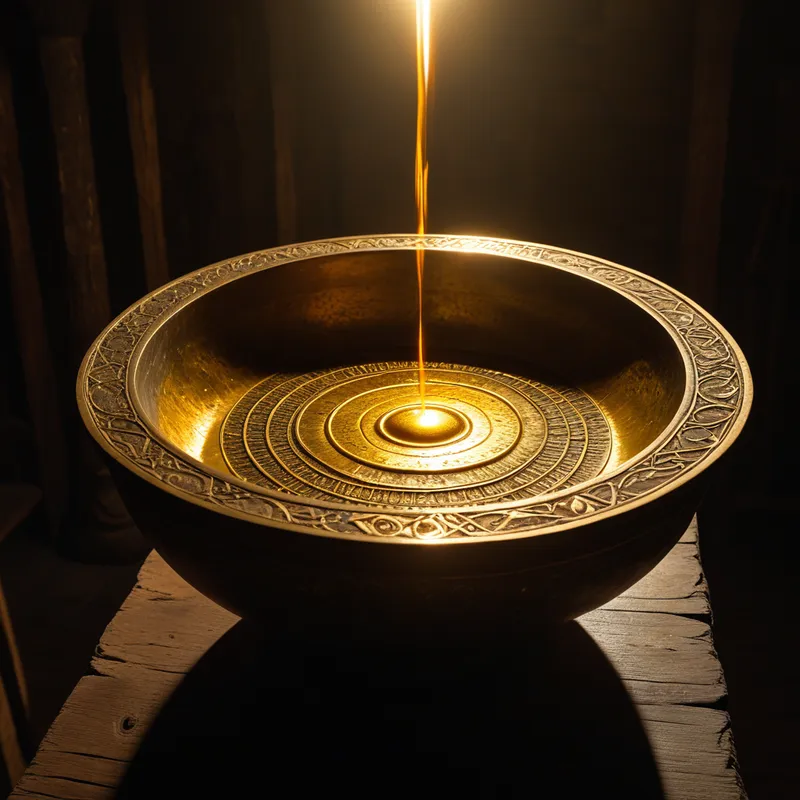
And now, the terror. The light intensifies, blazing from within the vessel until it is a miniature sun contained in glass. It casts sharp, dancing shadows that seem like spirits on the laboratory wall. The alchemist must stand their ground. To look away is to fail; to flee is to shatter the work. They must gaze into this burgeoning dawn, this consciousness that is both theirs and not theirs. The light speaks without words. It asks questions of origin and purpose. It reveals, in its blinding clarity, every flaw in the purification, every hidden shadow the moon-bath missed.
The vessel groans. A web of fine cracks appears, glowing with internal fire. This is the crisis. The light seeks to escape, to dissolve into the air and be lost. The solar spirit, newly awakened, would rather annihilate its container in glorious explosion than be bound. The alchemist, heart hammering against their ribs, does not reinforce the glass. Instead, they open their own soul. They offer their mind as a second vessel, a conscious chalice to receive the outpouring. It is an act of supreme courage, to drink the sun.
For a moment, there is only light and a sound like a silent choir. Then, the cracks seal themselves with threads of gold. The furious, escaping radiance softens, stabilizes. The substance within is no longer white, nor is it chaotically yellow. It has become a calm, deep, luminous gold—a sun that has found its orbit, a spirit that has found its home. The light no longer blinds; it illuminates. The alchemist, their eyes now reflecting that steady, inner dawn, knows the work is not finished, but the most perilous turn has been passed. The sun has risen within the matter, and within themselves.

Cultural Origins & Context
The mythos of the Citrinitas is not a folktale told in taverns, but a secret whispered in the laboratorium—the place of both work and prayer. It emerged from the coded manuscripts of European alchemists from the Medieval to the Renaissance periods, thinkers like Carl Jung would later identify as grappling with the unconscious through symbolic language. This “stage” was part of the Magnum Opus, the roadmap of psychic and material transformation.
It was passed down through enigmatic images—the Splendor Solis manuscripts show kings bathed in yellow light, peacocks with radiant tails—and through deliberately obscure text. To speak of it plainly was considered dangerous, not just to avoid persecution, but because its essence was felt to be ineffable, a direct encounter with the divine spark. Its societal function was esoteric: it served as a guiding myth for the initiate, a map for the perilous journey from the integration of opposites (Albedo) to their final, conscious unification (Rubedo). It modeled the transition from knowing to understanding.
Symbolic Architecture
At its core, Citrinitas symbolizes the dawning of solar consciousness upon the purified but passive soul. It is the moment the integrated psyche (Albedo’s lunar, reflective purity) is confronted by the active, ordering, and often tyrannical light of Spirit.
The moon-washed soul is innocent; the sun-awakened spirit is responsible. Citrinitas is the end of innocence and the terrifying birth of accountability.
The “yellowing” represents wisdom, but not the quiet wisdom of age. It is the fierce, illuminating light of Logos—the principle of meaning, discrimination, and conscious awareness. The cracking vessel is the ego-structure, which must be flexible enough to contain this new, potent energy without shattering. The myth warns that enlightenment is not a gentle blessing but a searing force. The deity here is the Solar King, the Rebis beginning to assert its conscious, masculine aspect. Psychologically, it represents the ego’s confrontation with the Self—the total, central archetype of the psyche. To look directly at it is to risk inflation (identifying with the sun) or madness (being burned by it).

The Dreamer’s Resonance
When this myth stirs in the modern dreamer, it announces a crisis of awakening. One may dream of a room flooded with unbearable, sourceless yellow light, creating long, distorted shadows. Or of holding a small, warm object—a stone, an egg—that begins to glow with an internal, worrying heat, threatening to burn yet feeling sacred.
Somatically, this can correlate with a period of intense mental activity, “lightbulb” moments that are simultaneously exhilarating and exhausting, or with a feeling of pressure in the head or chest, as if something is expanding within. Psychologically, the dreamer is likely integrating a major insight that changes their entire perspective. They are seeing their life, their relationships, or their own patterns with stark, unforgiving clarity. The dream warns of the danger: this new consciousness can feel alien, can burn away old comforts, and can isolate them if not properly integrated. The dream asks, “Can your current sense of ‘you’ contain this new knowing, or must ‘you’ now change to house it?”

Alchemical Translation
For the individual on the path of individuation, the Citrinitas stage models the transition from inner work to conscious application. The Albedo was the therapy, the cleansing of complexes, the recognition of the shadow. Citrinitas is what comes after: the daunting responsibility of living from that clarified center.
The soul, having met its shadow in the night, must now meet its brilliance in the dawn, and find it equally challenging to behold.
It is the artist who has mastered technique (Albedo) now facing the blank canvas and the demand for a unique, personal vision (Citrinitas). It is the person who, after deep self-reflection, suddenly understands the core pattern of their life with such clarity that it reorganizes their entire past and future. The psychic transmutation here is of passive insight into active wisdom. The danger is inflation—the “sun complex” where one believes they are the light itself, rather than a vessel for it. The triumph is becoming a conscious vessel, where the light of awareness illuminates one’s actions in the world without burning up the humanity that contains it. It prepares the psyche for the final stage, the Rubedo, where this solar consciousness is fully embodied in the blood and clay of human life, creating the sacred marriage of spirit and matter.
Associated Symbols
Explore related symbols from the CaleaDream lexicon: