
The Citrinitas Myth Meaning & Symbolism
The myth of the final solar dawn within the soul, where the purified spirit emerges from darkness, radiant and complete.
The Tale of The Citrinitas
Listen, and hear the tale not of a beginning, but of a dawning. It is a story whispered in the embers of the furnace, seen in the last star before sunrise.
For an age uncounted, the Work lay in the domain of Nigredo. The prima materia, the soul-stuff, had been dissolved in its own tears, a black sun of despair. Then came the long labor of Albedo, a bleaching by the cold, chaste light of the moon. A white stone was born, pure but passive, a queen of silver silence. Yet the Work was not complete. A profound stillness, deeper than the Nigredo’s turmoil, settled over the athanor. It was the stillness of anticipation, the quiet of the world holding its breath before the sun breaches the horizon.
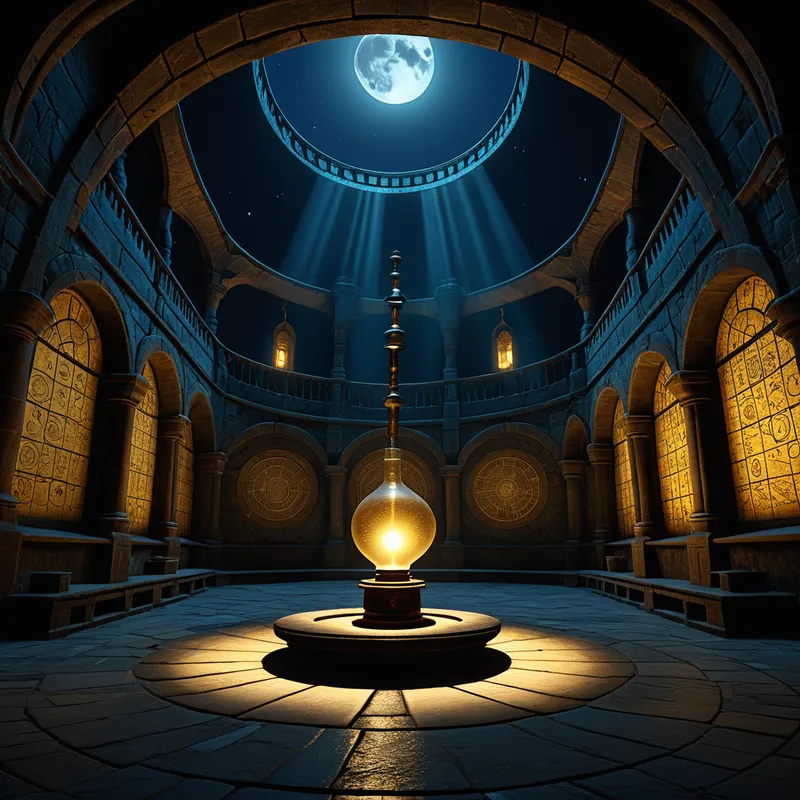
Within the sealed vessel of the cosmos—or perhaps it was a single, round glass flask in a tower room scented of salt and ozone—this white essence waited. It did not strive. It had passed beyond striving. It simply was, a pearl at the bottom of a midnight sea. Then, from within its own core, a warmth began. Not the fire of the furnace, which is external and consuming, but a gentle, pervasive heat, like the first memory of summer in the depths of winter soil.
This warmth was a presence. Some called it the Sol Internus, the Inner Sun. It stirred, and as it stirred, the flawless white began to blush. A faint, honeyed hue tinged its edges, like the first light touching the highest cloud. The hue deepened, becoming the color of ripe wheat, of aged parchment, of liquid amber. This was the Yellowing, the Citrinitas.
It was not a violent change, but an inevitable one, as inevitable as dawn. The white luminance of the moon was being gently, utterly, consumed by a solar radiance from within. The figure of the White Queen did not vanish, but was seen now through a lens of gold. Her silver crown melted and reformed, not as metal, but as light itself—a corona of rising sun. She became the Solar King, not by conquest, but by revelation. The final shadows of literal understanding, the last clinging impurities of unrefined thought, burned away in this gentle, internal dawn. What remained was not a thing, but a quality: a luminous, intelligent warmth, a consciousness that had become its own source of light. The myth ends not with a bang, but with a silent, radiant exhalation—the first golden breath of a world made new from within.
Cultural Origins & Context
The Citrinitas is not a myth of popular culture, but a hieros mythos of the laboratory. It emerged from the coded manuscripts and emblematic drawings of European alchemists between the 13th and 17th centuries. Unlike public epics, this story was never told around a fire; it was encoded in the sequence of colors observed in the vas during the Magnum Opus.
Its primary “storytellers” were adepts like Arnaldus de Villa Nova and the anonymous authors of texts such as the Rosarium Philosophorum. They passed it down through a chain of initiation, using the myth as a mnemonic and spiritual map. Its societal function was deeply subversive and interior: it served a clandestine community seeking not social power, but gnosis—direct knowledge of the divine through the transformation of matter and self. The myth of the Citrinitas acted as a beacon, assuring the practitioner that the bleakness of dissolution (Nigredo) and the sterile purity of washing (Albedo) were not the end, but necessary precursors to this ultimate inner illumination.
Symbolic Architecture
Psychologically, the Citrinitas represents the critical moment when insight becomes integrated wisdom. The Albedo gives us clarity—the “aha” moment—but it is often cool, analytical, and separate. The Citrinitas is the warming of that insight with the heat of the heart and the light of the ego now aligned with the greater Self.
It is the dawning of the inner sun, where understanding is no longer something you see, but something you are illuminated by.
The White Queen symbolizes the soul purified of personal complexes, but still operating in a kind of pristine, lunar receptivity. Her transformation into the Solar King is not a gender change, but the awakening of the active, radiating principle of spirit. The “yellowing” itself is the key symbol: it is the color of the mind (traditionally associated with air and intellect) being infused with the gold of spirit. It is the intellect becoming wise, the mind becoming a vessel for a consciousness greater than itself. The final burning away of “literal shadows” signifies the transcendence of dogmatic, one-dimensional thinking, allowing for a multidimensional, luminous comprehension of reality.

The Dreamer’s Resonance
When this myth stirs in the modern unconscious, it often manifests in dreams of a specific, profound quality. The dreamer may find themselves in a place that is clean, white, and orderly—a sterile hospital, an empty museum, a blank canvas—but feels a deep, unsettling lack of vitality. The dream’s turning point is the arrival of a warm, golden light from an unknown source: sunlight pouring unexpectedly into a white room, a book with gilded pages that feels warm to the touch, or the dreamer’s own hands beginning to emit a soft, amber glow.
Somatically, this parallels a psychological process of enlivenment after purification. The individual has likely been through a period of intense analysis, therapy, or ascetic discipline (the Albedo), which has left them “clean” but perhaps emotionally cool or disconnected. The Citrinitas dream signals the body-mind’s readiness to re-inhabit this purified space with warmth, value, and personal meaning. It is the psyche’s announcement that the time for detached observation is over; the dawn of embodied wisdom is at hand. There is often a feeling of deep, quiet joy and rightness upon waking, a sense that a long winter is definitively ending.

Alchemical Translation
In the journey of individuation, the Citrinitas models the penultimate stage of psychic transmutation. We spend much of our lives in the Nigredo of confusion and the Albedo of sorting and understanding. But Jung warned of the “inflation” of the purified spirit—the danger of becoming identified with one’s insights, living in a detached, spiritualized ivory tower.
The Citrinitas is the cure for this inflation. It is the process by which the transcendent insights of the Self are yellowed—warmed, humanized, and made capable of radiating into the world. It is when a person’s deep realizations cease to be just fascinating concepts and begin to inform their presence, their actions, and their relationships with a palpable, gentle warmth.
The goal is not to become a white, pure spirit, but to become a golden, human one—a spirit fully incarnate and illuminating its own life.
For the modern individual, this translates to the moment when healing becomes wisdom, when recovery becomes creativity, and when self-knowledge blossoms into a genuine, grounded compassion that can withstand the complexities of the world. The final stage, the Rubedo, is the full embodiment of this golden dawn in the blood and clay of everyday life. But it is the Citrinitas that provides the essential light by which to see that path forward, no longer the reflected light of the moon, but the born-from-within light of the inner sun.
Associated Symbols
Explore related symbols from the CaleaDream lexicon: