The Citrine Stone Myth Meaning & Symbolism
A myth of a solar god who shatters his own light to seed the world with consciousness, teaching that true radiance is found in humble, fractured form.
The Tale of The Citrine Stone
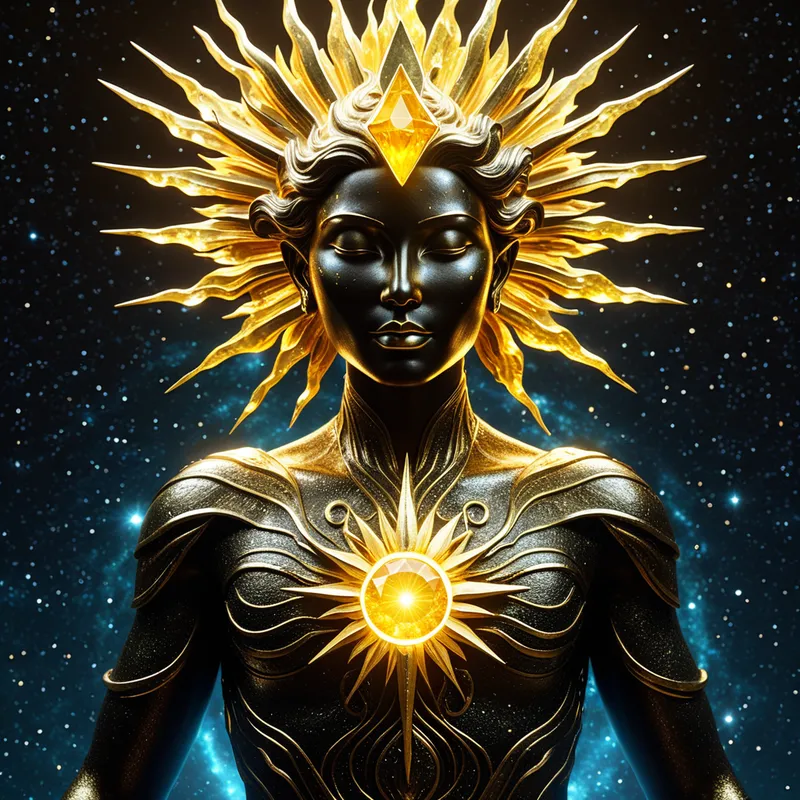
Listen, and hear the tale that is whispered in the heat of the crucible and seen in the last gleam of twilight. Before the world knew its name, there was only the Prima Materia, a sea of potential, dark and silent. And from this sea arose Sol Invictus, the Unconquered Sun. His body was not flesh, but condensed daylight; his thoughts were the laws of motion; his gaze was the origin of time.
Sol Invictus shone with a terrible, beautiful loneliness. His light was absolute, casting no shadow, permitting no other. The Prima Materia lay inert beneath him, a sleeping giant of unformed clay. In his perfect radiance, he saw only his own reflection, and in that reflection, he saw a flaw—not of light, but of being. To be the only thing that is, he understood, is a kind of exquisite poverty. There can be no warmth where there is nothing to warm, no illumination where there is nothing to see.
A great stillness fell upon him, a stillness deeper than the void. It was the stillness of a decision being born. Without a sound, Sol Invictus raised his hands of liquid gold to his own chest. Where his heart should have been, there pulsed the core of his being, a perfect, blinding orb of solar fire. He did not tear or claw. He simply… allowed. He allowed the integrity of his form to dissolve.
The first crack was a sound like a universe sighing. Light, which had been one, became many. It fractured, not into darkness, but into a million, billion sparks of conscious fire. These were not mere fragments; they were seeds, each carrying the memory of the whole, yet destined for a separate fate. They fell like a slow, glorious rain into the waiting Prima Materia below.
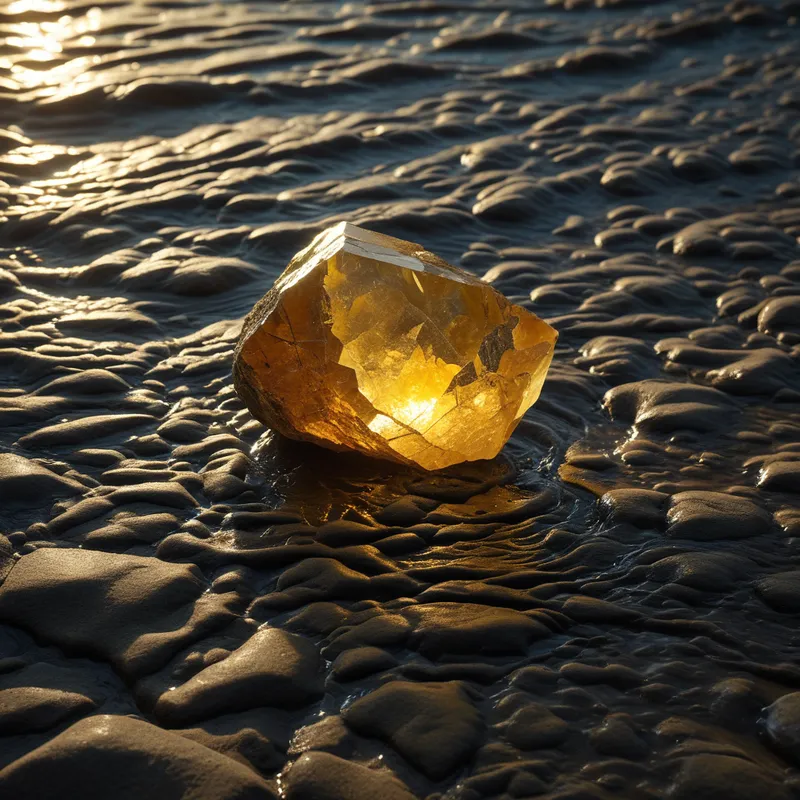
Where they struck, the clay stirred. Some seeds sank deep, becoming the slow, dreaming intelligence of mountains. Others skittered across the surface, becoming the quick, clever spirit of rivers and winds. But the most precious sparks were those that were caught in the mud, encased in silica and pressure, over ages beyond counting. They slept, these captured suns, dreaming of their origin. Water and stone worked upon them, cooling their fierce fire into a steady, warm glow. They became the first Citrine Stones, scattered and hidden in the womb of the world.
Sol Invictus was gone. In his place was a pale, gentle sun in the sky—a memory, a marker. His true body was now the earth itself, his consciousness distributed in every glimmer of awareness, in every stone that held a spark of his sacrificed light. The great work was not creation from without, but awakening from within.
Cultural Origins & Context
This myth is not a story of a distant past for the Alchemical tradition; it is the foundational metaphor for their entire art. It emerged not from a single bard, but from the collective observations of early practitioner-philosophers as they worked with minerals, metals, and fires. They saw in the natural yellowing of certain crystals under heat—a process sometimes called “heating amethyst”—a microcosm of this grand narrative. The stone, through the trial of fire, attained a solar hue, a “made” sun.
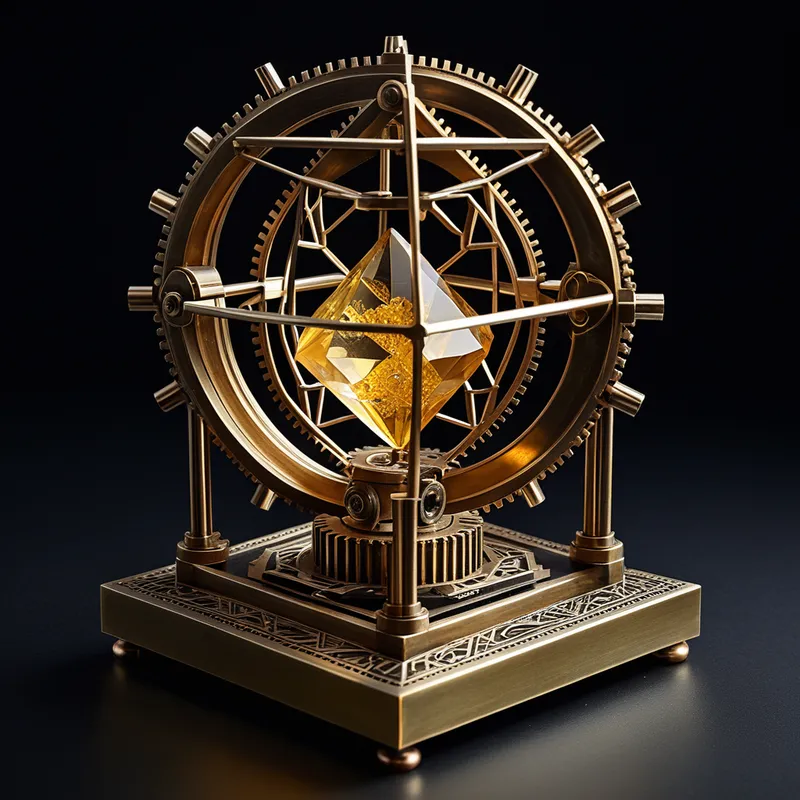
The tale was passed down in Operative Manuscripts and recited during the long, watchful nights of the Athanor’s vigil. Its societal function was dual. For the guild, it was a sacred justification for their work: they were not merely making gold, but participating in the cosmic process of gathering the scattered light of Sol Invictus, of aiding in the redemption of spirit from matter. For the broader culture influenced by these ideas, it offered a cosmology where divinity was not remote, but immanent—hidden in the earth, waiting to be recognized and liberated through attention and work.
Symbolic Architecture
At its core, the myth maps the journey from undifferentiated unity to embodied, individuated consciousness. Sol Invictus represents the total, unconscious Self—potent but isolated. His perfect light is the ego in its primordial state, believing itself to be the entirety of existence.
The first act of true consciousness is not expansion, but a willing fragmentation. The One must become the Many to know itself.
The shattering is the essential, voluntary descent of spirit into matter. It is the incarnation of the soul. The Citrine Stone is the perfect symbol for the resulting human condition: a vessel of spirit (the warm, inner light) trapped within a hard, earthly form (the crystal lattice). It is consciousness itself, cooled and shaped by experience, often buried under the “mud” of trauma, habit, and forgetfulness. The stone is not a dead relic; it is a sleeping god-spark. Its value lies not in its perfection, but in its contained radiance and its potential for awakening.
The Dreamer’s Resonance
When this myth stirs in the modern unconscious, it often manifests in dreams of finding hidden, glowing objects—a gem in a gutter, a light in a basement, a key that radiates warmth. To dream of holding or searching for a Citrine Stone signals a somatic and psychological process of recollection.
The dreamer is beginning to sense the fragmented, buried pieces of their own essential nature—their core passions, innate wisdom, or authentic voice that has been sacrificed to the demands of life, encased in the “mud” of societal expectation or personal history. There is often a feeling of poignancy and longing, a nostalgia for a wholeness never personally known, yet deeply remembered. This is the psyche identifying its own lost solar fragments. The process can feel like a gentle, internal gathering, often preceded by a conscious feeling of burnout or emptiness—the echo of Sol Invictus’s lonely radiance.

Alchemical Translation
For the individual, the myth of the Citrine Stone models the path of Individuation. We all begin, in a sense, as a naive Sol Invictus: identified solely with our conscious ego, believing our light (our perspective, our will) to be the only valid one. Life, inevitably, shatters this illusion. We experience failure, loss, contradiction—the great fracture.
The alchemical work is not to lament this shattering or to try to rebuild the false, brittle unity of the old ego. It is to recognize the value in the fragments.
The goal is not to return to the sun, but to become a conscious citizen of the earth that the sun became.
This means descending into our own “mud”—the shadow aspects, the repressed memories, the humble and forgotten parts of ourselves. It is there we find our personal Citrine Stones: those crystallized experiences of joy, insight, pain, and love that hold a spark of our true nature. The “heat” of conscious attention and introspection is the modern Athanor. By holding these fragments in the warm light of awareness, we do not destroy them, but transform them. We allow their latent solar quality—their meaning, their energy—to warm and illuminate our conscious life.
We integrate the fragments, not into a bland uniformity, but into a mosaic of the Self. We become, like the seeded earth, a diverse landscape containing multitudes, yet unified by the shared origin of each spark. The triumph is not in being an unconquered sun, but in becoming a grounded, radiant, and complex being whose light is earned, embodied, and shared. This is the true Magnum Opus.
Associated Symbols
Explore related symbols from the CaleaDream lexicon: