The Children of Lir Myth Meaning & Symbolism
Four royal children are transformed into swans by a jealous stepmother, enduring nine centuries of exile on wild waters before finding final release.
The Tale of The Children of Lir
Hear now a story woven from the mist and the sighing of the waves, a tale not of battles won, but of sorrow endured. In the time when the Tuatha Dé Danann still walked the green hills, there lived a great king named Lir of Armagh. His heart was a kingdom of joy, for he had four children: Fionnuala, the radiant daughter, and her three brothers, Aodh, Fiachra, and Conn. Their laughter was the sweetest music in his hall.
But the wheel of fate turns on a fragile axle. When their mother died, Lir wed again, a woman named Aoife, sister to their mother. At first, she feigned love for the children, but a poison seed of jealousy took root in her heart, fed by the king’s boundless love for them. It grew into a dark, twisting vine that choked all reason.
One autumn day, under a sky the colour of slate, Aoife took the children to bathe in the lake of Derravaragh. The water was cold and clear. As they played, she stood on the shore, a druid’s staff of rowan in her hand. Her words were not a song but a curse, a spell of bitter transformation. She struck them not with the staff, but with the venom of her will.
“Live now as wild swans!” she cried. “Your home shall be the lonely waters for nine hundred years. Three hundred on the lake of Derravaragh, three hundred on the stormy Sea of Moyle, and three hundred on the western sea by Inis Glora. Only the sound of a Christian bell shall break your enchantment.”
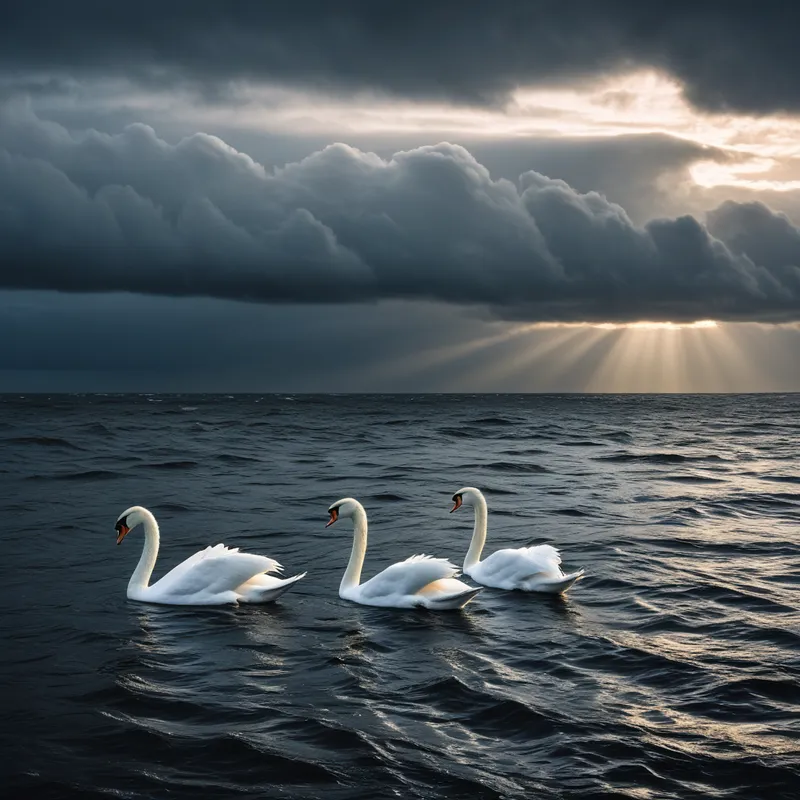
And so, their human forms fell away like discarded robes. Feathers, white as winter’s first snow, covered their skin. Wings grew where arms had been. Yet, their minds and voices remained their own—a cruel mercy. They raised a music of such profound lament that it silenced the birds of the air. Fionnuala, with a wisdom beyond her years, gathered her brothers beneath her wings. “We must stay together,” she sang, her voice a haunting melody over the water. “Our hearts are one.”
For three centuries, they haunted Lake Derravaragh, their songs bringing comfort to all who heard, their father a broken man weeping on the shore. Then, driven by the geas of the spell, they flew to the merciless Sea of Moyle. Here, their true torment began. Icy winds tore at them, salt spray burned their eyes, and they were often driven apart by tempests, crying out for each other across the raging foam, only finding reunion in the calms that were as rare as kindness.
Finally, they came to the wild Atlantic waters off Inis Glora. Weathered, ancient, their swan-bodies holding spirits worn thin as old parchment, they waited. The centuries had taught them the language of storms and the patience of stone. Then, one morning, carried on a wind from the east, came a new sound: the clear, resonant peal of a Christian bell. They followed it to shore, where a holy man, Saint Mo Chua, had built his cell.
Hearing their human speech from swan-throats, he brought them to his chapel. As the bell tolled and blessings were spoken, the feathery enchantment melted away. But time, that relentless tide, had done its work. Before the saint stood not children, but four beings withered to the very brink of dust—ancient, skeletal, their eyes holding the memory of oceans. With a final, shared breath, they released their nine-hundred-year sigh and died. The saint buried them together, as one, and it is said peace, at last, settled over the western sea.
Cultural Origins & Context
This myth is a cornerstone of the Mythological Cycle of early Irish literature, specifically part of the Tri Thruíthe na Scéalaíochta (The Three Sorrows of Storytelling). It was preserved not by the ancient Druids directly, but by Christian monks who, between the 11th and 15th centuries, transcribed the oral traditions of the fili into manuscripts like the Lebor na hUidre.
Its societal function was multifaceted. On one level, it was an aetiological myth, explaining the haunting beauty of swan song and the melancholic atmosphere of certain Irish lakes and seas. On a deeper level, it served as a profound narrative of cultural transition. The enchantment, cast with the old druidic magic of the Tuatha Dé Danann, is broken by the new sound of the Christian bell. The myth thus elegantly encapsulates the painful, centuries-long shift from the old pagan world to the new Christian order, framing it not as a conquest, but as a bittersweet release from an endless, sorrowful exile.
Symbolic Architecture
At its heart, this is a myth of the psyche in a state of suspended animation. The transformation into swans is not a death, but a freezing—a traumatic arrest of natural development. The children are exiled from their human form, their royal home, and the linear flow of time.
The swan is the soul in exile, beautiful in its sorrow, singing a song only the depths can understand.
The jealous stepmother, Aoife, represents the corrosive power of the unintegrated Shadow—the part of the psyche that feels threatened by the innocent, beloved aspects of the self (the children). Her spell is the psychic injury that splits consciousness, forcing a vital part of the self into a non-human, enduring, but isolated form. The three locations—the inland lake, the narrow strait, the open western ocean—map a journey of deepening alienation: from the contained grief of the personal unconscious (the lake), to the turbulent straits of the cultural and familial complex (the Sea of Moyle), to the vast, impersonal depths of the collective unconscious (the Atlantic).
The nine-hundred-year duration signifies a trial that transcends a single human lifespan; it is the soul’s time, the duration required for a profound karma or complex to work itself out. The retention of their human minds and speech is the crucial symbol of consciousness preserved within suffering—the enduring awareness of the Self, even in its most distorted and imprisoned state.
The Dreamer’s Resonance
When this myth stirs in the modern dreamer, it often manifests as dreams of being trapped in a non-human form—feeling like an animal, a bird, or an object while retaining full human awareness. One may dream of floating endlessly on a vast, lonely body of water, or of being separated from loved ones by an impassable storm. The somatic sensation is often one of profound weariness, a deep-bone chill, or the feeling of being “stuck” in a phase of life.
Psychologically, this signals an encounter with what James Hillman called the “Senex-Puer” complex. The youthful, innocent, creative spirit (the puer) has been enchanted, frozen in time by a harsh, jealous, or conditioning authority (the senex, represented by Aoife). The dreamer is living a life of beautiful sorrow—perhaps in a job, relationship, or identity that feels like a glorious but gilded cage. The dream is the psyche’s presentation of the exile, a cry from the swan-self that remembers its true name and home.
Alchemical Translation
The alchemical journey mirrored in this myth is not of turning lead to gold, but of enduring the solve—the dissolution—until it becomes a coagula—a reconstitution in a new key. The children are dissolved from their human form (the initial solve) and spend centuries in the aqua permanens, the permanent water of the lakes and seas. This is the long, slow soak of the soul in the waters of grief, limitation, and fate.
The final release comes not by breaking the spell through force, but by answering a new call that resonates with a higher order.
Their passive endurance is not a failure of heroism, but a different kind of work—the work of holding. They hold their connection to each other (the integrity of the psyche). They hold their memory (continuity of consciousness). They hold their song (expression of the soul’s truth). For the modern individual, this models the individuation process when one is in the grip of a deep, chronic complex or life circumstance that cannot be immediately changed—a long illness, a period of exile, a protracted grief. The task is not to escape, but to be in the condition consciously, to sing its truth, and to wait for the transformative sound.
That sound, the Christian bell, symbolizes the arrival of a reconciling symbol from a transcendent dimension. In psychology, this is the new organizing principle—the Self—that can finally integrate the split and end the exile. The release is immediate, but the transformed ones cannot live in the old world; they have become creatures of a different time. Their death and burial is the final alchemical stage: the return of the liberated spirit to the prima materia, not as a defeat, but as a sacred release of a long-held pattern back into the soul of the world. The ordeal ends not in a triumphant return to the castle, but in a quiet grave by the sea—the ultimate integration of the exiled soul into the eternal.
Associated Symbols
Explore related symbols from the CaleaDream lexicon: