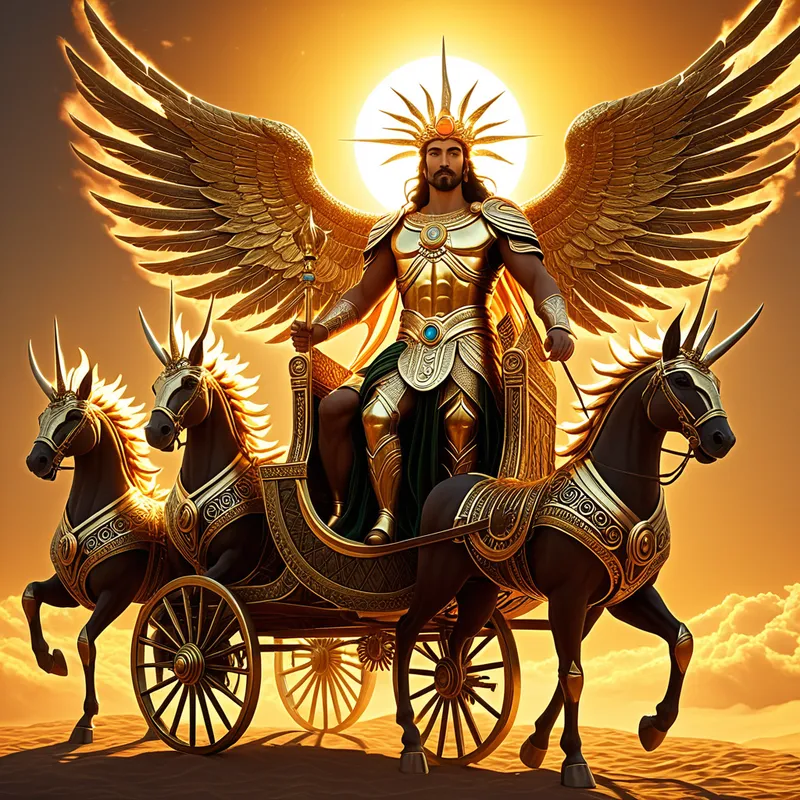
The Chariot of Helios Myth Meaning & Symbolism
The sun god Helios drives his chariot daily across the sky, a sacred duty whose disruption unleashes chaos, symbolizing the peril and power of divine responsibility.
The Tale of The Chariot of Helios
Hear now the tale of the path that lights the world, a road of fire etched across the dome of heaven each day since time’s first breath. It begins not at dawn, but in the deep, silent stables of the East, where the air shimmers with impending heat.
There stands Helios, crowned with a diadem of pure, piercing light. His eyes hold the steady, terrifying gaze of a star. Before him, stamping hooves that strike sparks from the aether, are his four immortal steeds: Pyrois, Aeos, Aethon, and Phlegon—Fire, Dawn, Blaze, and Flame. They are harnessed to a chariot wrought of gold and electrum, a vessel so brilliant no mortal could look upon it and live. This is his sacred charge, his kosmos: to guide this terrible power on its ordained path from the rosy-fingered gates of Eos to the shadowy shores of the Western Ocean where the weary Horai await.
He mounts the chariot. The reins, woven from the threads of fate itself, lie heavy in his hands. A touch, a whisper, and the steeds leap forward. The world holds its breath. Up they surge, climbing the steep vault of the sky. Below, the dark earth softens to grey, then green, then gold as Helios pours his light upon it. The sea glitters like a shattered mirror. He does not race; he proceeds with the immense, deliberate certainty of a celestial body. This is the great compromise of existence: infinite power bound by infinite law. The chariot’s heat is life, but a hair’s breadth off its track, and it becomes annihilation.
But once, the law was broken. A voice, proud and pleading, echoed in the halls of the sun. It was Phaethon, who came to claim his divine lineage. To prove his birthright, he asked for the one thing that could not be given: to guide the chariot for a single day. Bound by an oath sworn on the river Styx, Helios, with a heart of lead, consented.
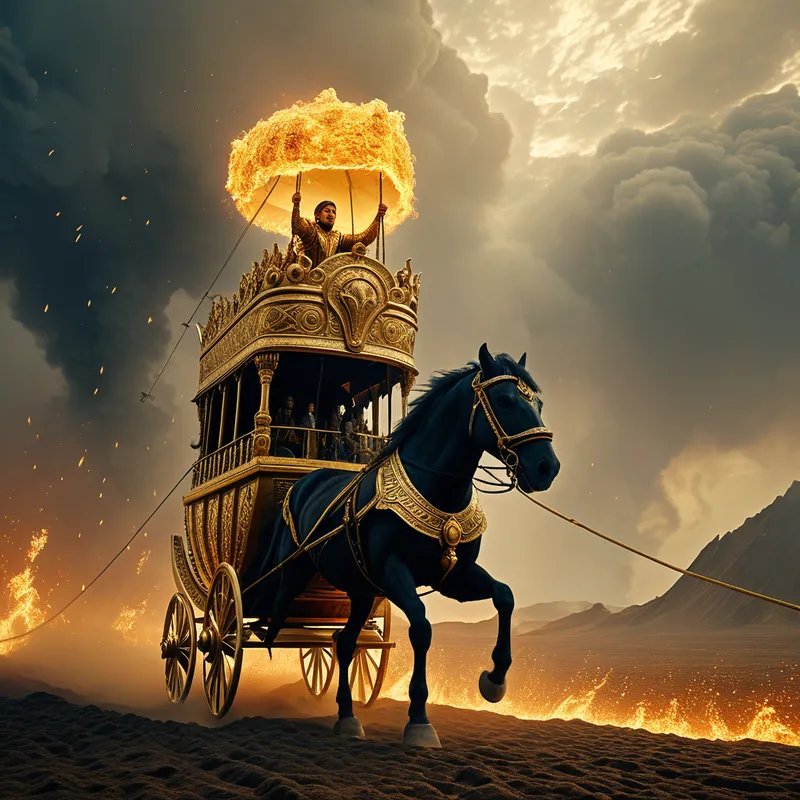
The youth seized the reins with ignorant joy. The moment he stood in the divine driver’s place, he felt the raw, untamed fury of the cosmos thrum through the leather straps. The horses knew a weak hand. They bolted. The chariot lurched—too high, and the stars themselves cried out in cold fear; too low, and the earth screamed. Rivers boiled away into steam. Forests became sheets of fire. Great Gaia herself, scorched and cracking, raised a cry to the heavens.
It was Zeus, the wielder of justice, who acted. With a thunderbolt forged in necessity, he struck the chariot from the sky. A charred trail cut through the air. Phaethon fell like a shooting star, his ambition extinguished in the waters of the river Eridanos. The horses, scattered, were gathered by a grieving Helios. Order, painfully, was restored. The next dawn, with solemn duty, Helios once again took the reins. The scorched earth healed, bearing the memory of the fire as a lesson etched into the very bones of the world. The path was sacred. The driver must be worthy.
Cultural Origins & Context
This myth is a cornerstone of the Hellenic worldview, primarily preserved in the epic poetry of Ovid’s Metamorphoses and referenced by earlier writers like Hesiod. It was not merely a fantastical story but a fundamental cosmological narrative. In a pre-scientific age, the reliable journey of the sun was the ultimate symbol of kosmos triumphing over chaos. The myth explained the terrifying reality of drought and wildfire (Phaethon’s misadventure) and the comforting certainty of the solar cycle (Helios’s faithful duty).
Bards and poets would recite this tale as a warning against hubris and a parable on the nature of divine responsibility. It served a societal function of reinforcing hierarchical order: just as the sun has its fixed path, so too do kings, fathers, and citizens have their ordained roles. To step out of one’s station, to grasp power one cannot comprehend or control, is to invite cosmic disaster. The myth was a cultural container for the profound anxiety surrounding the fragility of the natural order and the catastrophic cost of its disruption.
Symbolic Architecture
At its core, the Chariot of Helios is a master symbol of the conscious ego’s relationship with the awesome, life-giving, yet potentially destructive power of the Self—the central archetype of wholeness in the psyche.
The Chariot is the vehicle of consciousness itself, and the Sun it carries is the luminous, essential core of being. To drive it is to undertake the supreme task of individuation.
Helios represents the mature, integrated consciousness. He is the archetypal Ruler, who has mastered the fiery steeds of instinct, passion, and primal energy (the four horses) and harnessed them to a transcendent purpose—the daily journey of illuminating the world (the process of making the unconscious conscious). His path is the disciplined application of will in alignment with a greater law.
Phaethon, in stark contrast, is the inflated, uninitiated ego. He possesses the desire for the glory of the Sun (the Self) but none of the strength, wisdom, or discipline required to wield it. His journey is a catastrophic portrait of psychological inflation: the ego identifying with the power of the Self, seizing control of the entire psychic system, and promptly losing control to the untamed instincts (the bolting horses), resulting in inner and outer devastation—a psychic burnout.

The Dreamer’s Resonance
When this myth stirs in the modern dreamscape, it often signals a critical juncture in the dreamer’s relationship with their own power, ambition, and sense of control.
Dreaming of driving a radiant but uncontrollable vehicle—a car with blinding headlights, a speeding train, a spacecraft—points directly to the Phaethon complex. The dreamer may be experiencing a surge of ambition, a new role, or a burst of creative energy that feels thrilling yet terrifyingly beyond their skill to manage. The somatic feeling is often one of exhilarating speed coupled with dread, a churning gut as the “vehicle” veers off course. This is the psyche warning of inflation, of taking on a “divine” responsibility (a project, a leadership role, a personal transformation) without the necessary inner development.
Conversely, dreaming of witnessing a perfect, majestic celestial transit—a sun or star moving with serene, inevitable grace—can reflect a moment of alignment. It symbolizes the ego functioning properly as the steward of the Self, experiencing the harmony of Helios on his path. The feeling is one of awe, peace, and rightness.
Alchemical Translation
The myth models the complete alchemical cycle of psychic transmutation, from the nigredo of Phaethon’s fall to the rubedo of Helios’s restored journey.
The initial state is one of latent, unintegrated solar power—the gold in the raw ore. Phaethon’s request is the separatio, the foolish attempt to claim this gold (the glory of the Self) without the necessary purifying work. His disastrous ride is the mortificatio or calcinatio—the burning away of the ego’s illusions in a conflagration of failure and shame. He is reduced to ashes, a necessary humiliation.
Individuation is not about seizing the sun, but becoming strong enough to bear its light and wise enough to follow its path.
Helios represents the next, crucial stages. His grief and the restoration of order are the albedo, the washing clean. His return to the chariot the next day is the citrinitas, the dawning of a sober, humble, yellow wisdom. Finally, his continued, faithful duty is the rubedo—not a single moment of glorious triumph, but the sustained, red-gold practice of conscious responsibility. The alchemical gold is not the chariot itself, but the ability to drive it true.
For the modern individual, the process asks: Where in your life are you Phaethon, grasping for a glory you are not yet equipped to handle? And where can you begin to cultivate the steadfast, disciplined consciousness of Helios? The goal is not to avoid the chariot, but to undergo the trials that transform one from the boy who would burn the world into the god who, day after day, faithfully lights it.
Associated Symbols
Explore related symbols from the CaleaDream lexicon: