The Chariot of Apollo (Greek m Myth Meaning & Symbolism
The god Apollo's daily journey across the sky, a sacred duty of cosmic order imperiled by mortal ambition and divine wrath.
The Tale of The Chariot of Apollo
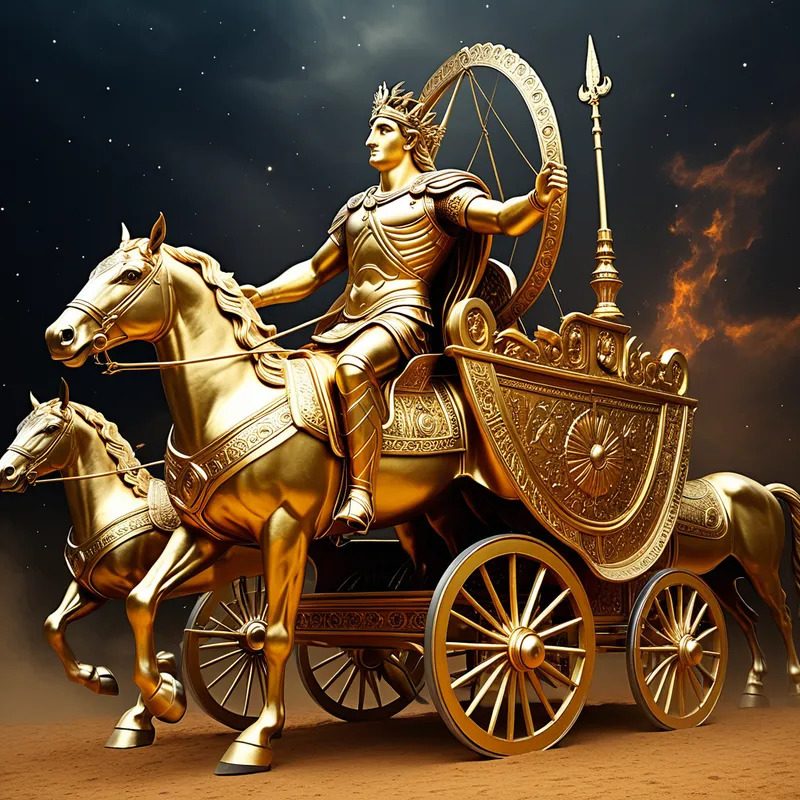
Hear now of the path that burns across the dome of heaven, the sacred track that divides chaos from cosmos, night from day. It is a road of fire, trodden not by mortal feet, but by the hooves of immortal steeds and the wheels of a chariot wrought in the forges of [Hephaestus](/myths/hephaestus “Myth from Global/Universal culture.”/). Its driver is Apollo, the Far-Darter, the Unshorn, he whose brow is eternally crowned with the light of truth.
Each dawn, in the rosy-fingered halls of the East, Apollo dons his radiant mantle. He approaches his team—four horses of living flame, their names a whispered litany of power: Pyrois, Aeos, Aethon, Phlegon. They stamp and snort, scattering sparks that become morning stars. With a firm, divine hand, Apollo takes the reins of gold and electrum. The great gates are swung open by Eos, and with a shout that is both command and song, he launches [the chariot](/myths/the-chariot “Myth from Tarot culture.”/) into the vault of sky.
This is the divine ordinance, the unbreakable rhythm of [the world](/myths/the-world “Myth from Tarot culture.”/). The chariot climbs the steep arc of morning, reaches its terrifying zenith at noon where the sun hangs, a blinding eye, and then descends the gentle slope of afternoon into the waiting arms of the Ocean in the West. There, the horses are cooled in deep, celestial waters, and the chariot is borne on a golden boat back to the East, to begin again. This is order. This is law.
But into this perfect circuit, a crack of mortal yearning intruded. [Phaethon](/myths/phaethon “Myth from Global/Universal culture.”/), son of Apollo by a mortal woman, burned with a need to prove his glorious lineage. He journeyed to the palace of the sun, a structure of polished brass and gold that no mortal eye should behold. There, before his radiant father, he made his plea: “Grant me but one day, Father. Let me drive the chariot of the sun, that all may know I am truly your son.”
Bound by a reckless oath, Apollo assented, his face clouded with dread. He anointed the boy’s face with a protective salve, fastened the solar diadem upon his head, and whispered frantic instructions. “Hold the middle path! Do not soar too high, nor sink too low!”
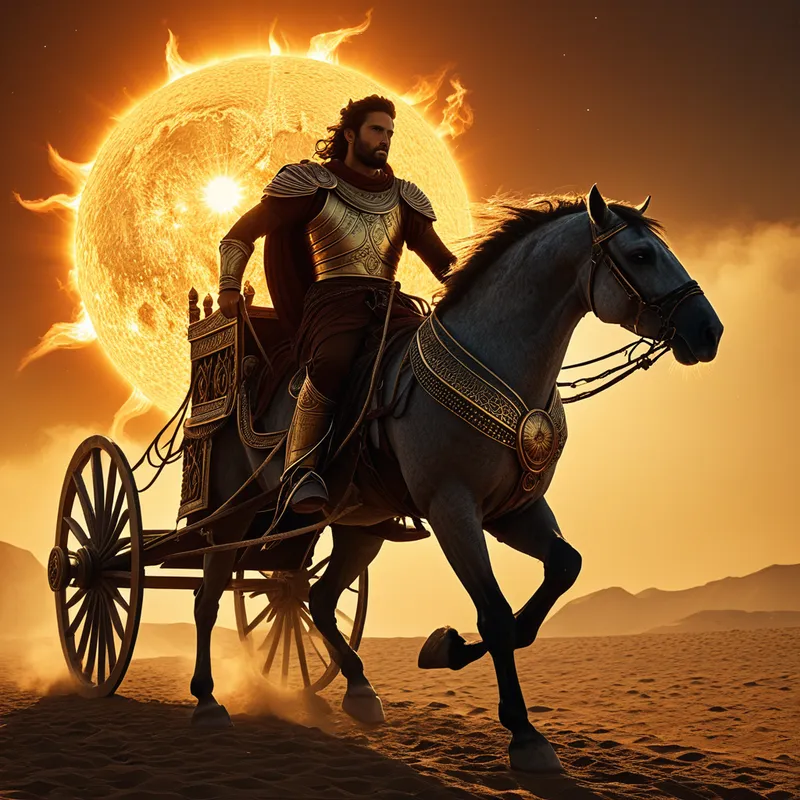
But the moment Phaethon seized the reins, the cosmic horses knew their master was gone. They bolted. The chariot lurched wildly, first scraping the zenith, scorching the constellations and creating [the Milky Way](/myths/the-milky-way “Myth from Greek culture.”/), then plunging earthward, setting mountains ablaze and boiling the seas. The world cried out in agony. Zeus, from his cloudy throne, saw the fabric of creation unraveling. With a grim face, he took up his weapon of last resort—the thunderbolt, the cleaver of fate. A single, world-shattering flash, a cry cut short, and Phaethon fell like a shooting star, trailing smoke, into the wide river Eridanus.
The scorched earth was healed by rains sent by Zeus. Apollo, in grief, refused to drive his chariot for a day, until the other gods persuaded him back to his duty. And so, the golden track was restored, the horses once more answering to the firm, knowing hand of the god. But the scar across [the sky](/myths/the-sky “Myth from Persian culture.”/) remained, and the banks of [the river](/myths/the-river “Myth from Buddhist culture.”/) held a new, smoldering memory.
Cultural Origins & Context
This myth, primarily preserved in Ovid’s [Metamorphoses](/myths/metamorphoses “Myth from Greek culture.”/), is a masterwork of Hellenistic and later Roman synthesis. It is not a primitive creation tale, but a sophisticated exploration of cosmic philosophy and human psychology. The image of the sun as a chariot driven by a god is Indo-European in origin, shared by cultures from Vedic India ([Surya](/myths/surya “Myth from Hindu culture.”/) in his chariot) to Norse mythology (Sol chased by Sköll). In the Greek context, it represents the pinnacle of the Olympian ordering of the universe—a move from chaotic, elemental forces (like the sun-titan [Helios](/myths/helios “Myth from Greek culture.”/), often conflated with Apollo) to a rational, artistic, and law-bound principle.
Told by poets and dramatists, the story served as a powerful exemplum—a warning. It functioned in the civic and educational sphere to illustrate the dangers of hubris, of overstepping one’s ordained place in the great chain of being. For the ancient listener, it explained the existence of the Milky Way, the deserts of Libya, and the dark skin of the Ethiopians (scorched by the sun’s descent). More profoundly, it affirmed a worldview where cosmic order (cosmos) is precariously maintained by divine intelligence and is terrifyingly vulnerable to the uninitiated, impulsive will.
Symbolic Architecture
At its [heart](/symbols/heart “Symbol: The heart symbolizes love, emotion, and the core of one’s existence, representing deep connections with others and self.”/), the myth is a profound [allegory](/symbols/allegory “Symbol: A narrative device where characters, events, or settings represent abstract ideas or moral qualities, conveying deeper meanings through symbolic storytelling.”/) of [consciousness](/symbols/consciousness “Symbol: Consciousness represents the state of awareness and perception, encompassing thoughts, feelings, and experiences.”/), [responsibility](/symbols/responsibility “Symbol: Responsibility in dreams often signifies the weight of duties and the expectations placed upon the dreamer.”/), and the [structure](/symbols/structure “Symbol: Structure in dreams often symbolizes stability, organization, and the framework of one’s life, reflecting how one perceives their environment and personal life.”/) of the [psyche](/myths/psyche “Myth from Greek culture.”/) itself.
The Sun-Chariot is the archetypal symbol of the conscious ego in its highest, most disciplined form: the vehicle that must navigate between the heights of spiritual inflation and the depths of unconscious engulfment.
Apollo represents the ruling principle of the psyche—the ego in its mature, solar function. He is light, reason, form, and [music](/symbols/music “Symbol: Music in dreams often symbolizes the harmony between the conscious and unconscious mind, illustrating emotional expression and communication.”/). His daily [journey](/symbols/journey “Symbol: A journey in dreams typically signifies adventure, growth, or a significant life transition.”/) is the disciplined [application](/symbols/application “Symbol: An application symbolizes engagement, integration of knowledge, or the pursuit of goals, often representing self-improvement and personal development.”/) of consciousness to the tasks of [life](/symbols/life “Symbol: The symbol of ‘Life’ represents a journey of growth, interconnectedness, and existential meaning, encompassing both the joys and challenges that define human experience.”/), bringing [illumination](/symbols/illumination “Symbol: A sudden clarity or revelation, often representing spiritual awakening, intellectual breakthrough, or the dispelling of ignorance.”/) and distinction to the world. The [chariot](/symbols/chariot “Symbol: The chariot signifies control, direction, and power in one’s journey through life.”/) is the structure of the [personality](/symbols/personality “Symbol: Personality in dreams often symbolizes the traits and characteristics of the dreamer, reflecting how they perceive themselves and how they believe they are perceived by others.”/) itself, and the four fiery horses are the powerful, instinctual drives (the libidinal [energy](/symbols/energy “Symbol: Energy symbolizes vitality, motivation, and the drive that fuels actions and ambitions.”/) of the Self) that must be harnessed and directed.
Phaethon is the inflated, uninitiated ego—the [puer aeternus](/symbols/puer-aeternus “Symbol: The eternal youth archetype representing perpetual adolescence, divine child energy, and resistance to mature adulthood.”/) or “eternal boy” complex. He is pure identification with the glorious [father](/symbols/father “Symbol: The father figure in dreams often symbolizes authority, protection, guidance, and the quest for approval or validation.”/) ([the Self](/myths/the-self “Myth from Jungian culture.”/)) without the [strength](/symbols/strength “Symbol: ‘Strength’ symbolizes resilience, courage, and the ability to overcome challenges.”/), wisdom, or discipline to embody that [role](/symbols/role “Symbol: The concept of ‘role’ in dreams often reflects one’s identity or how individuals perceive their place within various social structures.”/). His desire is not for true sovereignty, but for the [appearance](/symbols/appearance “Symbol: Appearance in dreams relates to self-image, perception, and how you present yourself to the world.”/) of it—the reflected glory. His failed drive is the catastrophe of psychic [inflation](/symbols/inflation “Symbol: A dream symbol representing feelings of diminishing value, loss of control, or expansion beyond sustainable limits in one’s life or psyche.”/), where [the ego](/myths/the-ego “Myth from Jungian culture.”/), identifying with the power of the [archetype](/symbols/archetype “Symbol: A universal, primordial pattern or prototype in the collective unconscious that shapes human experience, behavior, and creative expression.”/), is utterly consumed by it.
Zeus’s thunderbolt is the necessary, ruthless intervention of a transcendent [authority](/symbols/authority “Symbol: A symbol representing power structures, rules, and control, often reflecting one’s relationship with societal or personal governance.”/)—the Self correcting a catastrophic ego-possession. It is the shocking [insight](/symbols/insight “Symbol: A sudden, deep understanding of a complex situation or truth, often arriving unexpectedly and illuminating hidden connections.”/), the devastating failure, or the profound [crisis](/symbols/crisis “Symbol: A crisis symbolizes turmoil, urgent challenges, and the need for immediate resolution or change.”/) that shatters a delusional state, forcing a fall back into the waters of the unconscious (the Eridanus) for [dissolution](/symbols/dissolution “Symbol: The process of breaking down, dispersing, or losing form, often representing transformation, release, or the end of a state of being.”/) and potential [rebirth](/symbols/rebirth “Symbol: A profound transformation where old aspects of self or life die, making way for new beginnings, growth, and renewal.”/).
The Dreamer’s Resonance
When this myth stirs in the modern unconscious, it often manifests in dreams of catastrophic driving or flying. To dream of being behind the wheel of a powerful vehicle that becomes uncontrollable, speeding wildly or careening off a cliff, is to dream as Phaethon. The somatic experience is one of panic, overheating, and a terrifying loss of agency. Psychologically, the dreamer is likely in a state of “driving too hard”—pushing a project, an identity, or a ambition with unsustainable force and without the necessary inner authority or skill.
Conversely, a dream of successfully navigating a difficult, luminous path across a great height, with a sense of solemn duty and radiant calm, touches the Apollo archetype. This resonates with periods of successful integration, where one’s talents and energies are harmoniously aligned and effectively applied in the world. The dreamer is, for a moment, in right relationship with their own inner sun—not identified with it, but serving as its capable charioteer.

Alchemical Translation
The alchemical process mirrored here is the opus of forging a conscious personality capable of bearing the light of the Self without being annihilated by it. It is the journey from Phaethon to Apollo.
The individuation task is not to become the sun, but to learn to drive its chariot—to mediate the overwhelming, creative-destructive energy of the unconscious into a sustainable, life-giving rhythm.
[The first stage](/myths/the-first-stage “Myth from Alchemical culture.”/) is the inflation (Phaethon’s boast): the ego is seduced by an archetypal image of power, brilliance, or specialness. This is a necessary, if dangerous, awakening to a potential beyond one’s current station.
The second is the catastrophe (the wild ride and the thunderbolt): the inflated position proves untenable. Life itself—through failure, illness, or crisis—strikes the ego down. This is a brutal but essential mortificatio, the burning away of the immature identification.
The third is the integration (Apollo resuming his duty): after [the fall](/myths/the-fall “Myth from Biblical culture.”/) into the river (the [solutio](/myths/solutio “Myth from Alchemical culture.”/), or dissolution), a new relationship to the solar principle is possible. One returns to the task not as a boy claiming a birthright, but as a god accepting a destiny. The ego learns it is not the source of the light, but its faithful, disciplined vehicle. The goal is not to possess the chariot, but to become worthy of holding its reins, day after day, in service to the greater order of the soul. This is the ultimate rulership—the archetype of the ruler not as a tyrant, but as a steward of a sacred, cosmic trust.
Associated Symbols
Explore related symbols from the CaleaDream lexicon: