The Cave of Trophonius Myth Meaning & Symbolism
A hero descends into a terrifying cave-oracle, emerging forever changed by a direct encounter with the divine, raw, and terrifying truths of the underworld.
The Tale of The Cave of Trophonius
Listen, and hear of a place where the earth itself dreams, and men go to drink from its nightmares.
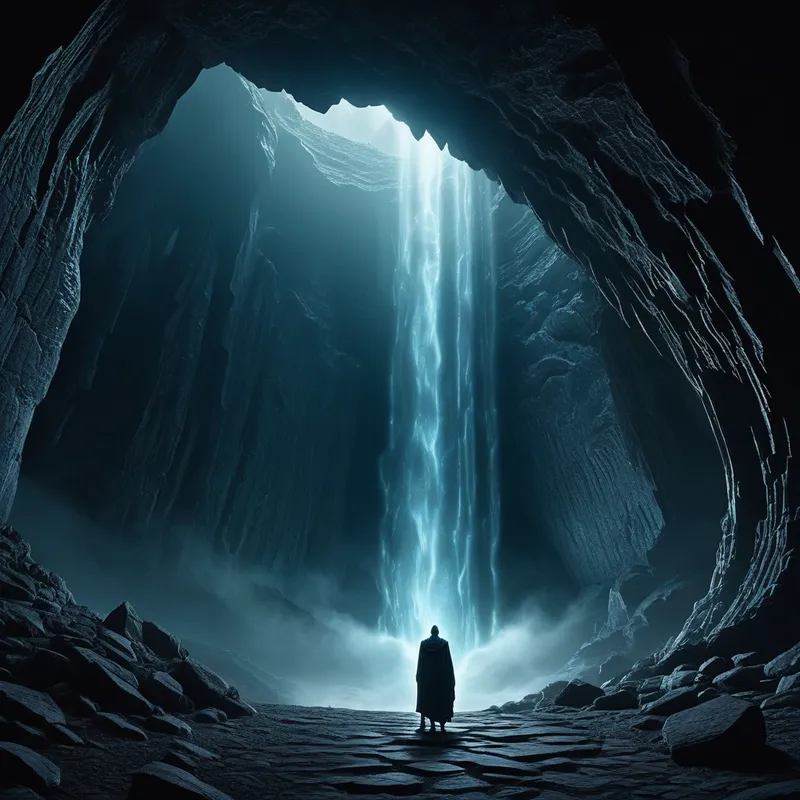
In the heart of Boeotia, near the town of Lebadeia, the ground holds a secret too terrible for the sun. It is not a cave of stone, but a cave of a god—or what remains of one. This is the sanctuary of Trophonius, son of Erginus, or perhaps of Apollo himself. With his brother Agamedes, he was a builder of legend, crafting the temple for Zeus at Delphi and the treasury for a king. But their story turned to shadow. For their cleverness—some say they built a secret entrance to steal the king’s gold—they met a grim fate. Agamedes was trapped; Trophonius severed his brother’s head to escape discovery, and was then swallowed by the earth at Lebadeia. He did not die. The earth consumed him and made him its own.
Thus was born the Oracle. Not like the sun-touched priestess of Delphi, who breathed vapors and spoke in riddles. No. This was an oracle of descent. To seek counsel from Trophonius, one did not ask a question. One was taken by the question.
The seeker, after days of purification, sacrifices of black rams to the darkness, and drinking from the twin springs of Lethe and Mnemosyne, was brought to the hillside. There, a narrow chasm gaped in the rock, no larger than a man’s body. A ladder was placed into the utter black. Heart pounding with a fear beyond mortal dread, the supplicant would descend, feet finding a small hollow far below. Then, lying on his back in the absolute dark, he would wait.
And the cave would take him. Some say he was pulled by the ankles, drawn deeper into the earth’s belly. Others tell of a rushing wind, a vortex of sound and vision. He would see things—gods, horrors, the spinning wheels of fate, the faces of his ancestors, the shape of his own death. He would hear truths, not in words, but in a knowing that seared the soul. The experience was not of this world; it was a rupture, a direct infusion of the chthonic mind. It could last a moment or an age in that timeless dark.
Then, violently, he would be expelled, feet-first, back into the world of light. He would emerge not enlightened, but shattered. His face was frozen, often in a rictus of terror or awe, his mind unmoored. The priests would seat him upon the Throne of Mnemosyne, and there, trembling, he would slowly piece together the visions. Only then could the oracle be interpreted. And the man? He was never the same. To “have consulted Trophonius” became a Greek proverb for one who has been plunged into a profound, debilitating melancholy. He had seen the foundation of things, and the foundation is terrifying.
Cultural Origins & Context
The myth and cult of Trophonius are rooted in the complex chthonic (earth/underworld) religious practices of ancient Greece, specifically within the chthonic cults of Boeotia. Unlike the Olympian gods who ruled from the sky, chthonic powers were of the earth, associated with fertility, death, and the raw, ancestral truths buried in the land itself. Trophonius began as a local hero—a cunning master builder—whose violent, earth-swallowed death transformed him into a daimon, a powerful spirit inhabiting the locale of his passing.
His oracle functioned for centuries, mentioned by historians like Herodotus and the travel-writer Pausanias, who provides our most detailed account. It served a specific societal function: it was the court of last resort. When all other oracles—Delphi, Dodona—failed to provide clear answers, one turned to Trophonius. His counsel was not for the mundane, but for existential crises of state or soul. The ritual’s intense, traumatic nature acted as a filter; only those with a question worth risking their sanity would dare approach. The community, through its priests, mediated this terrifying encounter with the raw divine, translating the individual’s shattering experience into actionable, communal wisdom.
Symbolic Architecture
The Cave of Trophonius is not merely a location; it is a perfect symbolic model for the encounter with the unconscious, specifically the terrifying, foundational layer psychologist Carl Jung called the psychoid realm, where psyche and matter, image and instinct, are one.
The oracle is not in the answer given, but in the psyche’s rupture. Truth is not found, but inflicted.
The Cave itself symbolizes the unconscious mind—a hidden, interior space that must be entered voluntarily, yet which then takes control. The Descent is the ego’s journey inward, away from the conscious “light” of day. The ritual Preparations (the springs of Lethe and Mnemosyne) are crucial: one must first drink of Forgetfulness to release the grip of conscious identity and personal history, then of Memory to retain the raw, impersonal visions of the deep.
Trophonius, the Daimon in the Dark, represents the autonomous, transformative power of the unconscious itself. He is not a guide, but a force. He is the archetype of the prima materia—the chaotic, foundational “stuff” of the soul that must be confronted in its raw, often terrifying state. The seeker’s Expulsion, feet-first, mirrors a traumatic rebirth. He returns to the world not as a hero crowned in glory, but as an infant—disoriented, vulnerable, and carrying a knowledge he cannot yet hold. The Throne of Mnemosyne represents the necessary, painful process of integration, where the shattered pieces of the self are slowly gathered and the numinous experience is translated into something the conscious mind can bear.
The Dreamer’s Resonance
When this mythic pattern stirs in the modern dreamer, it signals a profound, non-negotiable call from the depths of the psyche. It is the somatic and psychological process of being taken by a truth too large for the waking self to contain.
Dreams of being pulled into a small, dark space (a drain, a tunnel, a crack in a wall); of feeling an unseen force grab the ankles; of experiencing overwhelming, non-verbal visions in darkness; or of emerging from such an experience mute and terrified—all resonate with the Trophonian descent. The dreamer is not exploring their shadow; they are being consumed by it. The body may respond with sleep paralysis (the feeling of being held down), night terrors, or intense somatic sensations of falling or swirling.
Psychologically, this indicates a moment where a core complex, a buried trauma, or an archetypal truth is breaking through the ego’s defenses with volcanic force. It is not a gentle insight, but a psychic earthquake. The dreamer is undergoing a numinous trauma—an encounter with the sacred that, by its very power, wounds the structure of the familiar self. The process is one of dissolution. The ego’s job in the aftermath is not to “fix” itself, but to sit, trembling, on its own Throne of Memory, and patiently piece together what the depths have shown.
Alchemical Translation
In the alchemical journey of individuation—the process of becoming one’s whole, unique self—the Cave of Trophonius models the dreaded but essential stage of nigredo. This is the “descent into darkness,” the confrontation with the massa confusa (confused mass) of the soul.
The alchemist does not transmute lead into gold by will alone. He must first descend into the lead, be dissolved by its nature, and be reborn from its essence.
For the modern individual, the “consultation” begins with an insoluble life problem, a depression, or a loss that acts as the “king’s treasure”—a prize that has trapped the ego in its own cunning. The purification rituals are the often-futile attempts at self-help, therapy, or distraction that precede the real work. The true descent happens when these fail, and one is forced to stop seeking and start being taken—by grief, by breakdown, by a collapse of meaning.
Lying in the dark cave is the experience of surrender to this process. It is allowing the psychic material to act upon you, to show you its horrific and divine faces. The “oracle” received is not a solution, but a fundamental re-ordering of perception. The expulsion is the painful return to daily life, where one feels alien, “melancholic,” unable to communicate the scale of the inner catastrophe.
The alchemical gold is forged in the subsequent integration. The individual who has been to this cave and back carries a gravity, a depth of knowing that is unshakeable because it was written in the bones of experience, not learned from a book. They have met the daimon in their own foundation and survived. Their wisdom is not bright and shining, but deep and resonant, etched by the shadows of the cave. They become, in their own way, a living oracle—not one who predicts the future, but one who speaks from the truth of the underworld they have inhabited and remembered.
Associated Symbols
Explore related symbols from the CaleaDream lexicon: