The Cave of the Sibyl Myth Meaning & Symbolism
A mortal woman granted eternal life but not eternal youth, who delivers cryptic prophecies from a sacred cave, embodying the agony of divine truth.
The Tale of The Cave of the Sibyl
Beneath the brooding brow of a mountain that scrapes the belly of [the sky](/myths/the-sky “Myth from Persian culture.”/), there is a crack in [the world](/myths/the-world “Myth from Tarot culture.”/). It is not a gentle opening, but a gash, a yawn of stone that exhales a breath older than the temples of men. This is the place where the rock remembers it was once molten star-stuff, and the air hums with the memory of chthonic whispers. Here, at Cumae, in [the shadow](/myths/the-shadow “Myth from Jungian culture.”/) of Apollo’s claimed domain, [the earth](/myths/the-earth “Myth from Hindu culture.”/) itself became a throat.
And in that throat lived a voice.
She was not born a goddess, but a woman—a mortal daughter of the soil, with a spirit so vast and clear that it became a mirror for the divine. They say Apollo himself, the Far-Shooter, the Lord of Light, saw her and was captivated not by fleeting beauty, but by the potential for perfect truth within her. He offered her a bargain, as gods are wont to do: he would grant her as many years of life as the grains of sand she could hold in her hand. In her mortal innocence, or perhaps her profound longing, she accepted. But she forgot to ask for enduring youth. The god, in his passion or his cruelty, gave her the years but let time have its way with her flesh.
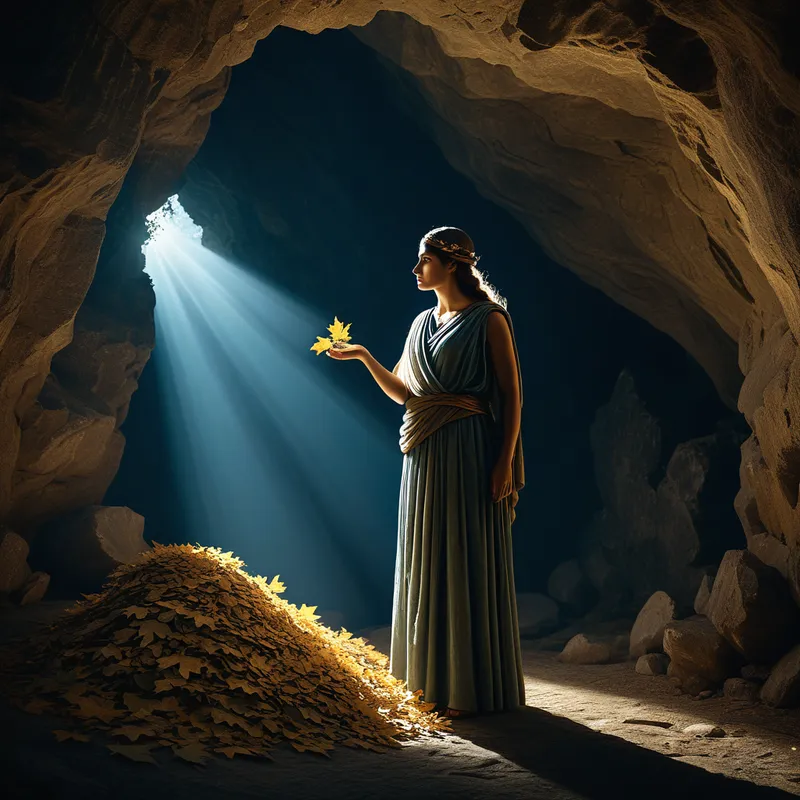
So she retreated into the mountain’s wound, into [the Cave](/myths/the-cave “Myth from Platonic culture.”/) of the Sibyl. For centuries uncounted, she shriveled within the stone, her body becoming a wisp of parchment, her voice gaining the texture of grinding tectonic plates. Pilgrims—kings, heroes, and desperate souls—would climb the treacherous path. They would bring offerings and tremble before the cavern’s mouth. They did not see her, but they heard her. The prophecies did not come as clear speech, but as riddles breathed onto fallen oak leaves. Her attendants, priestesses of the cave, would gather these leaves at the entrance, where the sacred winds of prophecy swirled. They would attempt to order them, to piece together the future from the chaotic fragments. But often, [the wind](/myths/the-wind “Myth from Various culture.”/) would scatter the leaves, and the message would be lost or rendered more cryptic still.
Her voice wove [the fates](/myths/the-fates “Myth from Greek culture.”/) of empires. She foretold the coming of a savior from the east for the Etruscans. She guided Aeneas through the [Underworld](/myths/underworld “Myth from Greek culture.”/), showing him the shadowy future of Rome that would spring from his line. Her prophecies were collected in sacred books, the Sibylline Books, which Roman emperors consulted in moments of direst crisis. Yet with each prophecy uttered, her cage of centuries tightened. She possessed the ultimate knowledge—the shape of what is to come—but was cursed to experience the relentless, wearying passage of all the days leading there. In the end, it is said, she shrunk so small she was kept in a jar, and when children asked what she wanted, her only reply was, “I want to die.”
Cultural Origins & Context
The figure of the Sibyl is not a singular character from a single epic, but a powerful archetype that permeated the ancient Mediterranean world. [The word](/myths/the-word “Myth from Biblical culture.”/) “Sibyl” itself likely derives from an ancient phrase meaning “the will of the god.” While many places claimed their own Sibyl, the Cumaean Sibyl became the most famous in the Roman world, immortalized by the poet Vergil in his national epic, the Aeneid.
Her cave was a real geographical feature—a long, trapezoidal tunnel cut into the rock at Cumae, which archaeologists have identified. This was not a myth born purely in fantasy, but one anchored in a tangible, awe-inspiring location. The myth functioned as a bridge between the chaotic, ancient chthonic powers (the cave, the earth) and the later, more structured Olympian order of Apollo. She represented a dangerous, raw form of prophecy that civilization sought to harness and institutionalize, as seen in the Roman Senate’s guarded control of [the Sibylline Books](/myths/the-sibylline-books “Myth from Greek culture.”/). She was the wild voice of fate that the state apparatus tried, and often failed, to neatly interpret and control.
Symbolic Architecture
The Cave of the [Sibyl](/symbols/sibyl “Symbol: A prophetic priestess in ancient Greek and Roman mythology who delivered divine oracles, often through ecstatic trance, representing hidden knowledge and fate.”/) is a master [symbol](/symbols/symbol “Symbol: A symbol can represent an idea, concept, or belief, serving as a powerful tool for communication and understanding.”/) of the prophetic unconscious. The cave is the [psyche](/myths/psyche “Myth from Greek culture.”/) itself—dark, deep, and connected to the foundational bedrock of [reality](/symbols/reality “Symbol: Reality signifies the state of existence and perception, often reflecting one’s understanding of truth and life experiences.”/). The [Sibyl](/symbols/sibyl “Symbol: A prophetic priestess in ancient Greek and Roman mythology who delivered divine oracles, often through ecstatic trance, representing hidden knowledge and fate.”/) within is the [archetype](/symbols/archetype “Symbol: A universal, primordial pattern or prototype in the collective unconscious that shapes human experience, behavior, and creative expression.”/) of the Self, the central organizing principle of the [psyche](/myths/psyche “Myth from Greek culture.”/) that holds [knowledge](/symbols/knowledge “Symbol: Knowledge symbolizes learning, understanding, and wisdom, embodying the acquisition of information and enlightenment.”/) of our totality and [destiny](/symbols/destiny “Symbol: A predetermined course of events or ultimate purpose, often linked to spiritual forces or cosmic order, representing life’s inherent direction.”/), but which is often inaccessible, fragmented, and agonizing to confront.
The prophecy is never a clear narrative; it is a scattering of leaves. Truth from the depths arrives not as a solved equation, but as a set of symbols awaiting our conscious assembly.
Her tragic bargain is the core of the symbol. She gained infinite [consciousness](/symbols/consciousness “Symbol: Consciousness represents the state of awareness and perception, encompassing thoughts, feelings, and experiences.”/) ([prophecy](/symbols/prophecy “Symbol: A foretelling of future events, often through divine or supernatural means, representing destiny, fate, and hidden knowledge.”/), [awareness](/symbols/awareness “Symbol: Conscious perception of self, surroundings, or internal states. Often signifies awakening, insight, or heightened sensitivity.”/) of time’s full span) but at the cost of being trapped within the process of time (aging, decay). This speaks to the burden of consciousness itself. To truly see—to understand the patterns of one’s [life](/symbols/life “Symbol: The symbol of ‘Life’ represents a journey of growth, interconnectedness, and existential meaning, encompassing both the joys and challenges that define human experience.”/), one’s complexes, and one’s [fate](/symbols/fate “Symbol: Fate represents the belief in predetermined outcomes, suggesting that some aspects of life are beyond human control.”/)—is not a blessing of ease, but a [weight](/symbols/weight “Symbol: Weight symbolizes burdens, responsibilities, and emotional loads one carries in life.”/) of [responsibility](/symbols/responsibility “Symbol: Responsibility in dreams often signifies the weight of duties and the expectations placed upon the dreamer.”/). It can feel like a [curse](/symbols/curse “Symbol: A supernatural invocation of harm or misfortune, often representing deep-seated fears, guilt, or perceived external malevolence.”/), isolating the knower from the simple, unreflective flow of [life](/symbols/life “Symbol: The symbol of ‘Life’ represents a journey of growth, interconnectedness, and existential meaning, encompassing both the joys and challenges that define human experience.”/). The scattered oak leaves represent the [nature](/symbols/nature “Symbol: Nature symbolizes growth, connectivity, and the primal forces of existence.”/) of deep psychological [truth](/symbols/truth “Symbol: Truth represents authenticity, honesty, and the quest for knowledge beyond mere appearances.”/): it is never handed to us whole. Insights from dreams, synchronicities, or therapy often arrive as fragments. Our conscious mind, like the Sibyl’s attendants, must diligently and humbly work to order them, knowing a disruptive wind (repression, [anxiety](/symbols/anxiety “Symbol: Anxiety in dreams reflects internal conflicts, fears of the unknown, or stress from waking life, often demonstrating the subconscious mind’s struggle for peace.”/)) can scatter them again at any [moment](/symbols/moment “Symbol: The symbol of a ‘moment’ embodies the significance of transient experiences that encapsulate emotional depth or pivotal transformations in life.”/).

The Dreamer’s Resonance
When this myth pattern stirs in the modern psyche, it often manifests in dreams of seeking hidden knowledge in confined, subterranean spaces. One might dream of finding a hidden room in their house, a basement filled with ancient books, or a tunnel leading to a wise but terrifying old woman. The somatic feeling is one of both awe and dread—a tightening in the chest, a sense of sacred pressure.
Psychologically, this indicates a confrontation with what Carl Jung called the “archetype of meaning.” The dreamer is at a crossroads where their conscious identity is being called to acknowledge a deeper, more fateful pattern in their life. The “Sibyl” in the dream may appear not as a prophetess, but as a forgotten family member, a stern teacher, or even a disembodied voice. The process is one of reluctantly accepting a call to a deeper, more responsible level of self-awareness, which often feels like a burden before it is recognized as a guide. The scattered leaves in the dream are the unintegrated insights the dreamer is currently receiving but failing to coherently understand.

Alchemical Translation
The myth models the alchemical opus, [the great work](/myths/the-great-work “Myth from Alchemical culture.”/) of individuation. The hero’s journey here is not to slay a monster, but to endure the terrifying process of gaining true self-knowledge.
[The first stage](/myths/the-first-stage “Myth from Alchemical culture.”/) is the descent into the cave—the voluntary engagement with the unconscious, often initiated by a crisis (Aeneas seeking his destiny). The confrontation with the Sibyl is the [nigredo](/myths/nigredo “Myth from Alchemical culture.”/), the blackening. It is the painful realization of one’s own conditioned fate, one’s complexes, and the sheer weight of existence. Her aged, shriveled form represents the initially horrifying face of the Self, which seems like decay and death to [the ego](/myths/the-ego “Myth from Jungian culture.”/).
The curse of endless life is the blessing of the objective psyche, which exists beyond time; the agony of aging is the ego’s subjective experience of being forced to contain it.
The gathering of the leaves is the albedo, the whitening. This is the careful, patient work of analysis, of gathering the symbolic fragments (dreams, patterns, memories) and attempting to see the order within them. It is a work of humble service to the truth. The final stage is not a “cure” for the Sibyl’s condition, but an integration. The individual does not escape fate but learns to carry it consciously. The prophetic voice ceases to be an external, haunting oracle and becomes an internal compass. The individual becomes, in a sense, their own Sibyl—not omniscient, but connected to an inner source of guidance that understands the pattern of their life. They accept the burden of consciousness as the price for authentic existence, transforming the curse of foresight into the hard-won wisdom of insight.
Associated Symbols
Explore related symbols from the CaleaDream lexicon: