The Cave of Plato Myth Meaning & Symbolism
Prisoners chained in a cave mistake shadows for reality. One escapes to see the sun, returning with a truth they cannot share.
The Tale of The Cave of Plato
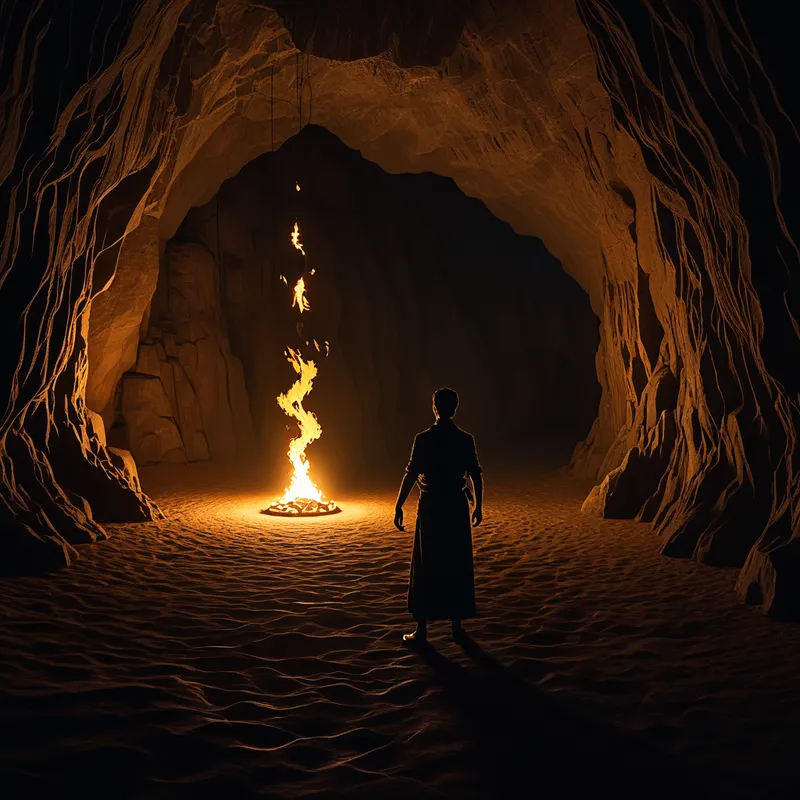
Imagine a place where the world is born from fire and shadow. Not a cavern of stone, but a womb of perception, deep in the earth’s silent belly. Here, from childhood, men and women are bound. Not by malice, but by a fate so complete it feels like nature itself. Their legs and necks are fastened so they cannot turn their heads; they can only look forward, at the wall before them.
Behind them, a fire burns on a high ledge. Between this fire and the prisoners runs a low wall, like the screen at a puppet show. And along this wall pass other people, carrying all manner of vessels, statues, and figures of animals and men, made of stone and wood. These are the puppet-masters, unseen. The firelight casts the shadows of these objects onto the wall the prisoners face. The echoes of the carriers’ voices bounce from the wall and reach the prisoners’ ears.
This is their entire universe: the dance of shadows, the chorus of echoes. They name the shadows as they pass—horse, amphora, god. They discuss their sequences, their qualities, believing themselves wise in the ways of these phantoms. The shadows are their reality, their truth, their only comfort.
Now, picture one among them. Perhaps a strange ache in the neck, a dream of a sound not an echo, a primal itch of curiosity. Their bonds, through some accident or forgotten flaw, loosen. They turn their head.
Pain. Blinding, searing pain from the fire’s direct glare after a lifetime of dim, reflected light. Confusion. The moving figures, the low wall, the fire—a chaotic, senseless jumble compared to the clean narrative of the shadows. They would wish to return to their familiar wall. This new sight is agony, less real than the comfortable certainty of the cave.
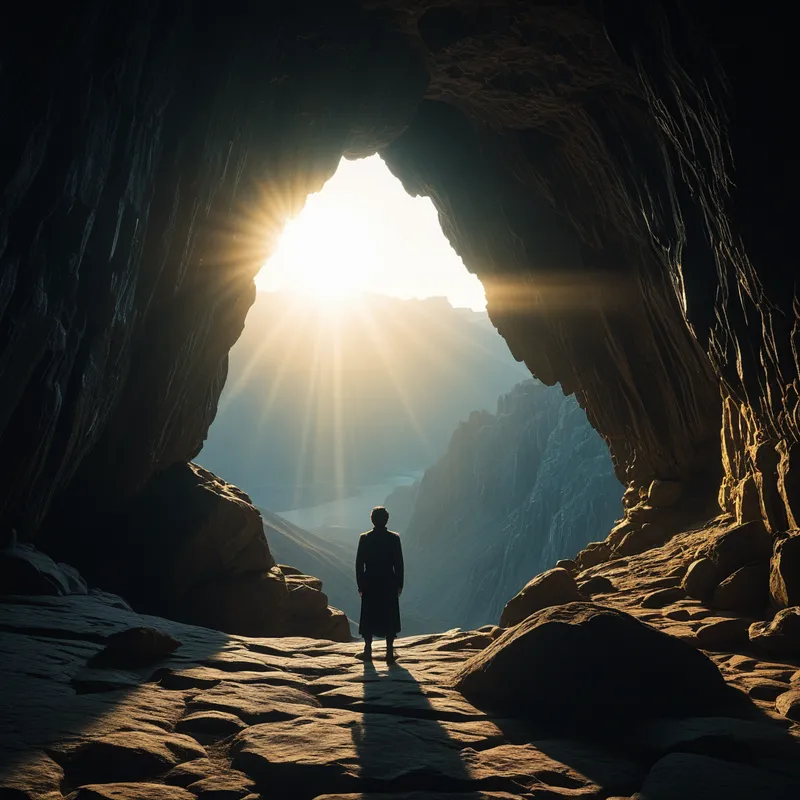
But a force, a daimon, pulls them further. They are dragged, resisting, up the rough, steep, and rocky ascent toward the cave’s mouth. The journey is brutal, a struggle against the very pull of their known world. They emerge, at last, into the open air.
And here, the true dying begins. The light of the world overwhelms them. They can see nothing of the things we call real. Their eyes are pierced by the sun’s brilliance. Slowly, painfully, their vision adjusts. They see shadows first, cast by real things under the moonlight. Then the reflections of men and trees in water. Then, finally, the things themselves. And last of all, they can lift their eyes to the heavens and behold the sun itself, not as a rival to the fire in the cave, but as the source of all—the giver of seasons, the guardian of life, the cause of all they now see.
They understand. Their entire former life was a play of ghosts. Pity fills them for their companions, still naming shadows in the dark.
Driven by this pity, they descend back into the cave. Their eyes, now accustomed to the sun, are blind in the darkness. They stumble. As they try to explain the upper world—the sun, the trees, the true Forms of things—their old companions laugh at them. They mock their ruined sight, their foolish journey. They declare that the ascent has destroyed their mind. And if they could, they would kill the one who tried to free them, to lead them up. For the cave is safe. The shadows are known. The light is a liar.
Cultural Origins & Context
This is not a myth from the age of Zeus or Athena. It is a philosophical allegory, a crafted story told by Plato in Book VII of his seminal work, The Republic (c. 375 BCE). Plato used such stories—myths of his own making—as pedagogical tools to illustrate complex ideas that pure logic struggled to convey.
In the context of Athenian society, this tale functioned as a radical critique of conventional knowledge and political life. The cave represents the city-state (polis), its customs, its popular opinions, and the persuasive but empty rhetoric of the Sophists—the “puppet-masters.” The fire is the imitative arts and flawed human understanding. The journey out is the philosopher’s arduous education in dialectic, leading to the vision of the Good (the Sun), the ultimate Form and source of all truth and reality. The philosopher’s return, against their own desire, models Plato’s ideal of the Philosopher-King, who must reluctantly govern the unenlightened.
It was passed down not by bards, but by students in the Academy, copied on papyrus and later parchment. Its societal function was transformative: to awaken the individual soul to a higher calling and to justify the rule of wisdom over democracy or tyranny.
Symbolic Architecture
The Cave is one of the most potent psychological symbols ever conceived. It maps the architecture of the human psyche and its relationship to reality.
The prisoners represent the ego in its default state—identified entirely with the contents of its consciousness, believing the flickering images of thought, memory, and sensation to be the totality of existence. The shadows are the phenomenal world, the world of appearances we take for granted.
The chains are not iron, but identification. We are bound not by what we see, but by our belief that we are the seer of it.
The fire is the light of the personal psyche—the subjective, ego-bound intellect and passion that casts the shadows of personal complexes and cultural conditioning. The ascent is the painful process of psychic differentiation—dis-identifying from the personal unconscious (the cave) and integrating its contents. The sun is the Self, the transcendent source of consciousness and meaning, the archetype of wholeness. To see it is to achieve a state of gnosis, where one perceives the unifying patterns behind the multiplicity of experience.
The return is the most tragic and necessary part. It symbolizes the integration of this transcendent awareness back into the mundane world, a process often met with resistance, both internally and externally. The enlightened one must now live in two worlds, often appearing blind or mad to those who dwell in one.
The Dreamer’s Resonance
When this myth stirs in the modern dreamer, it announces a profound shift in consciousness. You may dream of being in a basement, a subway tunnel, or a room with no windows—all modern caves. The feeling is one of constriction, of watching a screen (the wall) with compulsive focus. The somatic sense is of numbness in the limbs, a stiff neck.
The moment of turning the head in a dream is critical. It is often preceded by a sound from behind—a voice, a melody, a drip of water. This is the call of the daimon, the Self. To turn is to initiate a process of disillusionment. The dream-ego experiences acute disorientation and anxiety as its familiar reality destabilizes.
Dreams of climbing a difficult, dark staircase, of emerging into blinding light, or of trying to explain a beautiful, obvious truth to uncomprehending, hostile faces are direct translations of the allegory. They mark the psyche’s struggle to assimilate a new, broader perspective that threatens the old, cohesive (but false) sense of self. The psychological process is one of ego-death and rebirth, where former certainties must be sacrificed for a more complex, often lonelier, relationship to truth.
Alchemical Translation
The Cave models the alchemical nigredo and albedo, the core of psychic transmutation or individuation.
The initial state is the unconscious identification (nigredo). The ego is fused with the shadow-play of personal and collective complexes. The first alchemical operation is solutio—the loosening of the bonds. This is often precipitated by a crisis, a “divine discontent” that corrodes the chains of habit.
The ascent is the separatio and illuminatio (albedo). The soul separates from the prima materia of the unconscious and is purified in the fire of insight. This is an intellectual and spiritual distillation, a burning away of projections. To behold the sun is to achieve the Lapis Philosophorum, the recognition of the Self as the central, ordering principle.
The return to the cave is the final, most crucial operation: the rubedo, the reddening. The gold of enlightenment must be made useful, brought down to earth.
For the modern individual, this means the often-grueling work of embodying one’s hard-won awareness in relationships, work, and community. It is the translation of private epiphany into a life of integrity. The one who has seen the sun must learn to see by its light even in the darkness of the cave, to bear the blindness of others without contempt, and to speak a truth that may only be heard as an echo. The triumph is not in permanent escape, but in becoming a secret conduit for that distant sun within the very heart of the world’s shadow.
Associated Symbols
Explore related symbols from the CaleaDream lexicon: