The Cave Allegory Myth Meaning & Symbolism
Prisoners in a cave mistake shadows for reality. One escapes, sees the sun, and returns, forever changed and burdened by the truth.
The Tale of The Cave Allegory
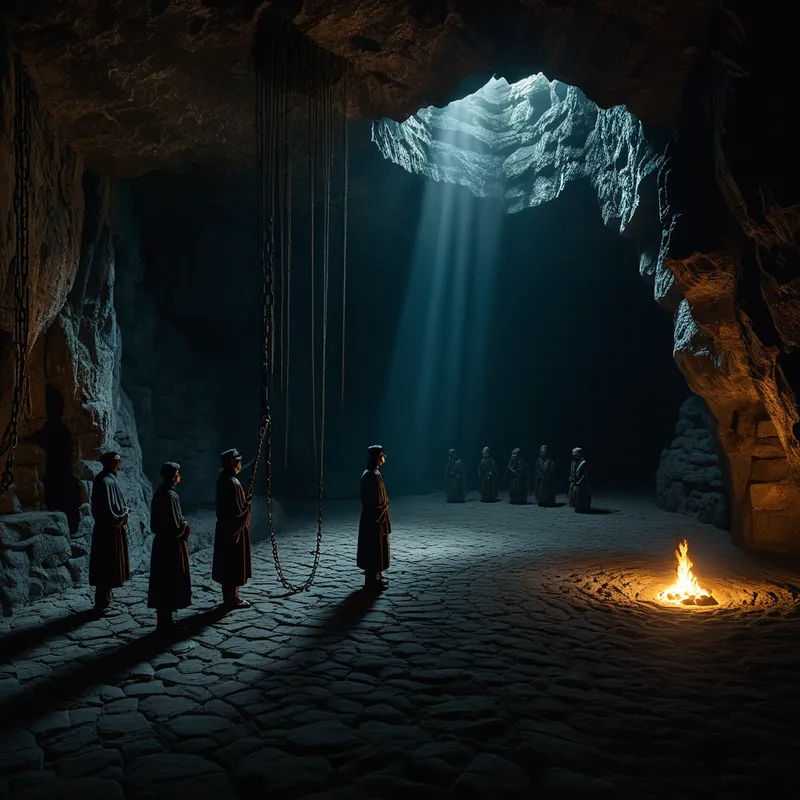
Imagine a people dwelling in a subterranean cavern, a den whose mouth opens upward toward the light. From childhood, their legs and necks have been fettered, so they remain in the same spot, able to see only what is directly before them. The chains hold their heads immobile.
Behind them, a fire blazes at a distance. Between the fire and the prisoners runs a low wall, like the screen at a puppet show. Along this wall, carriers walk, bearing all manner of vessels and statues and figures of animals and humans, which project above the wall. They speak, and their voices echo off the cavern wall before the prisoners.
The prisoners see only the shadows of these crafted forms, cast by the firelight onto the stone in front of them. They hear only the echoes. For them, the truth is literally nothing but the shadows of the artifacts. They name the shadows, debate their sequences, honor the quickest or the loudest. This is their world, its entire substance and meaning.
Now, picture one among them being freed. His chains are suddenly loosed. He is compelled to stand up, to turn his neck, to walk and to look toward the light. The fire! It pains his eyes. The moving figures are confusing, less clear than their shadows. He is dragged, against his will, up the steep and rugged ascent, out of the cave and into the light of the sun itself.
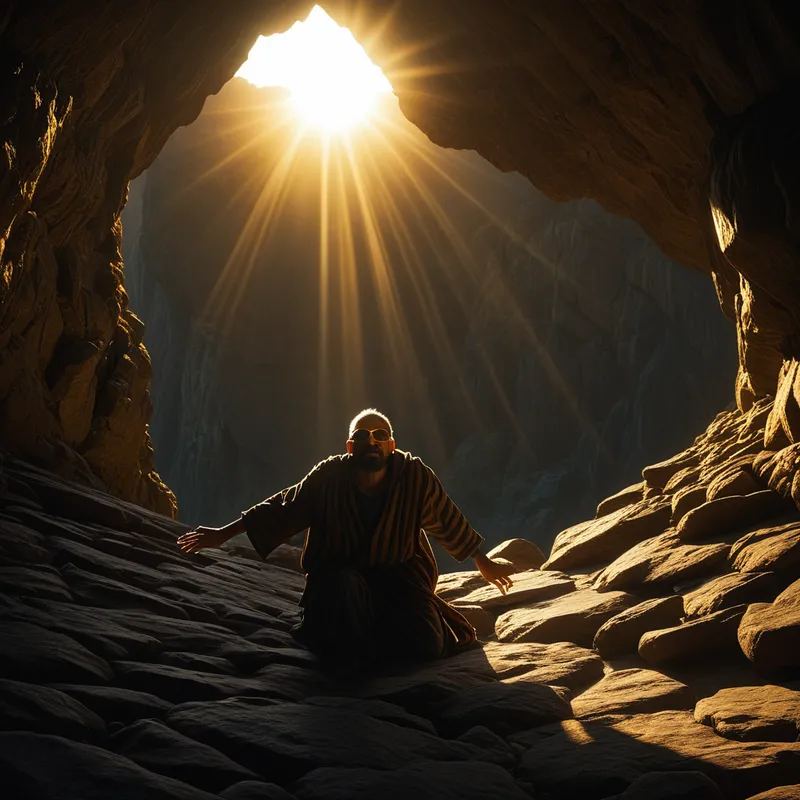
At first, he can see nothing. The radiance floods and blinds him. He is in agony. He would flee back to the familiar shadows. But slowly, his eyes adjust. He sees reflections in water first, then the things themselves: trees, flowers, the earth. He gazes at the stars and the moon by night. Finally, he can behold the sun itself, not as a reflection in water or in any alien setting, but in its own proper place. He understands it as the source of the seasons and the years, the guardian of all in the visible world.
He pities his old companions in the cave. Their honors and prizes seem hollow, childish. His mind turns to his old dwelling, the darkness, and the wisdom held there.
He descends back into the cave. His eyes, now accustomed to the sun, are plunged into darkness. He stumbles. The prisoners, seeing him clumsy and blind, laugh. They say his journey upward has ruined his sight. They declare it better not even to think of ascending. If anyone tried to free them and lead them up, they would seize him and kill him.
The freed man sits among them again. But he no longer sees their world. He sees only the chains, the fire, the puppets. He knows the truth of the shadows. He is a stranger in his own home, bearing a knowledge that is also a profound and isolating burden.
Cultural Origins & Context
This is not a myth of gods and heroes, but a philosophical parable crafted by the Athenian thinker Plato, recorded in Book VII of his dialogue, The Republic (c. 375 BCE). It was not passed down by bards but by students in the Academy. Its function was didactic and revolutionary.
Plato used this story not to explain the cosmos, but to illustrate his core theory of the Forms. The cave represents the physical, sensory world of opinion (doxa). The journey upward is the soul's arduous ascent to the intellectual world of true knowledge (episteme), culminating in the Form of the Good, symbolized by the sun. The story was a tool for philosophical conversion, meant to shock the listener out of complacency and toward a life dedicated to the pursuit of truth, even—especially—when that truth is painful and isolating.
Symbolic Architecture
The Cave is the persona and the collective unconscious of a society—the agreed-upon reality, built from projections, echoes, and inherited images. We are born into its narrative.
The chains are not of iron, but of identification. We are bound not by force, but by the belief that the shadow is the substance.
The Shadows are the phenomena of our lives: our social roles, cultural values, media narratives, and even our internalized self-concepts. They are real in their effects, but they are derivatives, copies of deeper archetypal patterns (the statues carried behind the wall).
The Fire is the intermediary light source—the ego-consciousness, or the dominant cultural paradigm that casts the shadows. It provides enough light to see, but not enough to see by what or for what purpose we are seeing.
The Ascent is the initiation of individuation. It is a violent unshackling from the known. The pain is the death of the old self, the disintegration of a worldview. To see the Sun—the Self, the Form of the Good—is to encounter the source of all consciousness and value. It is not an intellectual concept, but a blinding, transformative experience of reality-as-it-is.
The Return is the most tragic and necessary part. The enlightened one must descend back into the shared darkness, not as a savior, but as a witness. His blindness in the cave is not ignorance, but the inability to participate in the collective illusion any longer.
The Dreamer's Resonance
When this myth stirs in the modern dreamer, it often manifests as dreams of being trapped in basements, elevators, or tunnels. The dreamer may be trying to read a book with fading text, or watch a television showing only static, sensing vital information is just out of reach. The somatic feeling is one of constriction in the chest, a literal heaviness—the dream-body remembering the chains.
A pivotal modern motif is dreaming of breaking a screen—a phone, computer, or television—and finding only a blank wall or a simpler, older technology behind it. This is the psyche questioning the source of the shadows. Another common pattern is the dream of emerging into a landscape of overwhelming, almost painful beauty after a long confinement, accompanied by a feeling of profound solitude. This is the ascent. The subsequent dream of trying to explain this landscape to uncomprehending, dismissive friends or family is the return. The dreamwork here is the psyche's attempt to integrate a new level of awareness that has made the old social self obsolete.
Alchemical Translation
The alchemical process mirrored here is solutio (dissolution) followed by coagulatio (coagulation). The prisoner's reality is a coagulated, solid state of shadow-identification. His release is the solutio: the fiery pain of the sun dissolves his certainty, his ego-structure, his entire perceptual framework. He is returned to a psychic liquid state.
Enlightenment is not an addition of light, but a subtraction of walls.
The slow adjustment to the upper world is the new coagulatio—the re-formation of a personality around the central, solar fact of the Self, rather than the shadow-play of the ego. This is the creation of the Philosopher's Stone: a consciousness that has seen the source and is now irrevocably structured by it.
The final, alchemical stage is the rubedo, the reddening, often associated with the suffering of the wise. The returned philosopher, ridiculed and blind in the dark, embodies this. His triumph is not in conquest, but in bearing the tension of the opposites: he holds both the memory of the sun and the reality of the cave simultaneously. His transformed consciousness becomes the hidden fire in a new way—not one that casts distracting shadows, but one that, if another prisoner should turn, might illuminate the very chains that bind them. The myth thus models the ultimate psychic transmutation: from being a prisoner of the spectacle, to a spectator of the machinery, and finally, to becoming, oneself, a potential source of liberating light.
Associated Symbols
Explore related symbols from the CaleaDream lexicon: