The Cave Myth Meaning & Symbolism
Prisoners chained in a cave mistake shadows for reality until one is freed, ascending to see the blinding sun of true knowledge.
The Tale of The Cave
Listen, and I will tell you of a prison not made of iron, but of familiar darkness.
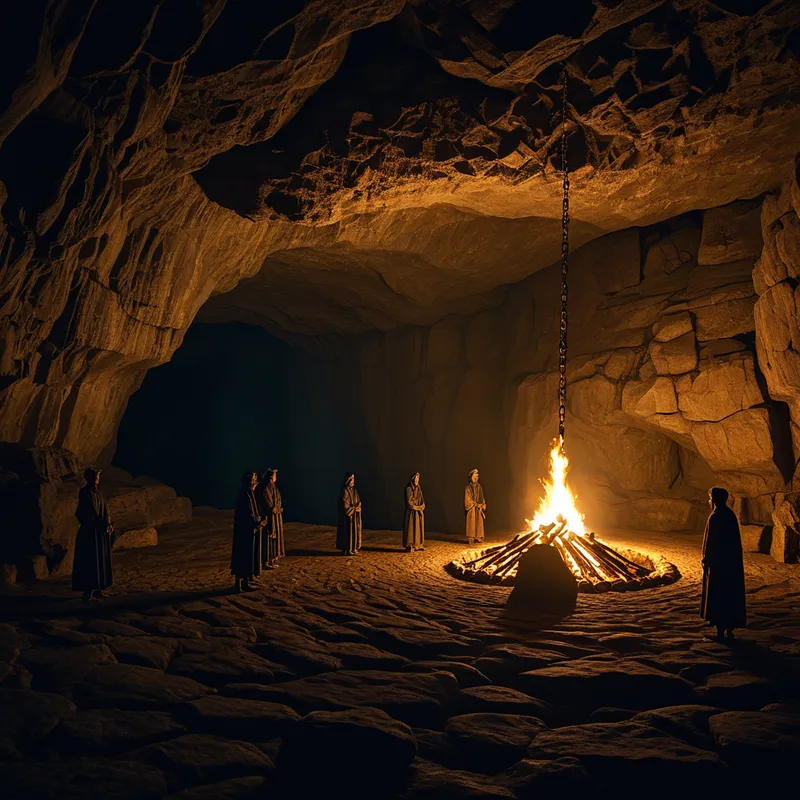
Deep within the belly of [the earth](/myths/the-earth “Myth from Hindu culture.”/) lies a cavernous chamber, its air thick with the smell of damp stone and burning pitch. Here, since childhood, dwell a company of people. But they are not free inhabitants; they are prisoners, bound by neck and leg to a cold stone bench, facing a blank, towering wall. Behind them, a long, raised walkway stretches, and behind that, a great fire roars upon a ledge, casting a restless, orange glow. Between the fire and the prisoners, unseen hands carry all manner of objects—statues of men and beasts, vessels of wood and stone, shapes of every kind. The firelight throws the silhouettes of these objects onto the wall before the captives.
For these prisoners, [the world](/myths/the-world “Myth from Tarot culture.”/) is this wall. The dancing shadows are their reality: [the shadow](/myths/the-shadow “Myth from Jungian culture.”/) of a cup is a cup; the shadow of a dog is a dog. The echoes of voices from the walkway bounce off the wall and seem, to them, to come from the shadows themselves. They name the shadows, debate their sequences, award honors to whoever is quickest to predict which shadow will next flit across their stony screen. This is their entire cosmos—a play of flickering forms, a consensus of illusion.
Now, imagine one prisoner is suddenly, forcibly, released.
The chains are struck from him. He is dragged up, turned around, and made to look at the fire and the objects themselves. The light is agonizing; it burns his eyes, which have known only the gentle gloom of the wall. The objects seem less real than their shadows, for they are crude and confusing in their three-dimensionality. He stumbles, he protests, he longs for the comfort of his old bench, for the clear, flat certainty of the shadow-world.
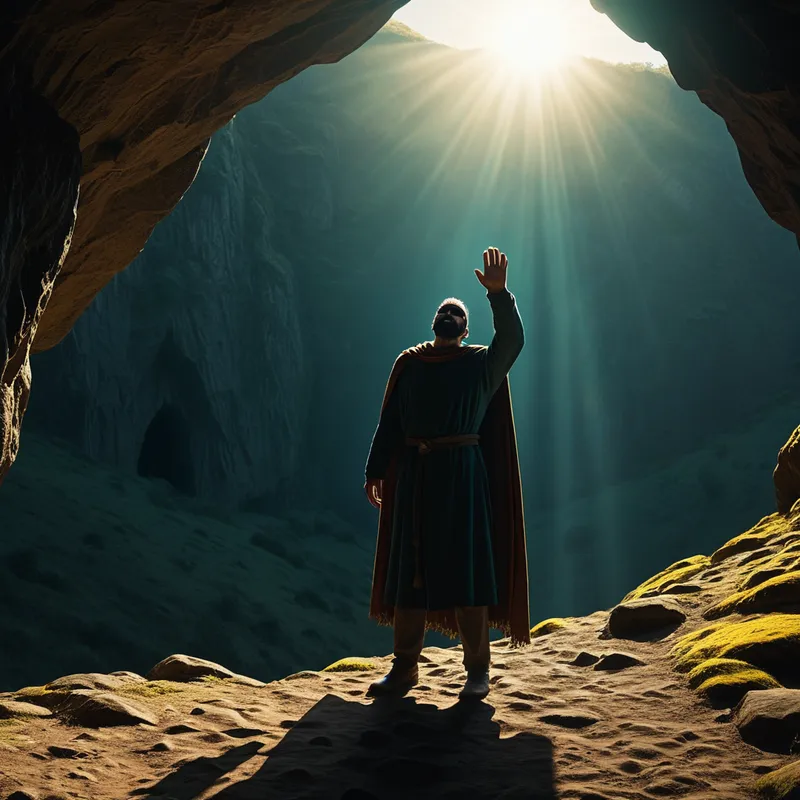
But his guide is relentless. He is pulled further, up the rough and steep ascent out of the cavern itself, dragged toward a light far more terrible than the fire—the light of the sun. The journey is one of pure pain and disorientation. Each step is a rebellion against his entire being. Finally, he emerges into the open air.
At first, he can see nothing but a blinding, golden agony. He can only look at reflections in [water](/myths/water “Myth from Chinese culture.”/), at shadows cast by the true sun. Slowly, painfully, his eyes adjust. He sees the colors of flowers, the solidity of trees, the vast expanse of [the sky](/myths/the-sky “Myth from Persian culture.”/). He comes to see the sun itself, not as an enemy of sight, but as the source of all sight, the giver of the seasons, the sovereign of all that is in the visible realm. He understands that it is the sun that gave life to everything in the cave, even the poor, pathetic fire.
His heart swells with pity for his former companions. He remembers their honors and debates, their shadow-games. He descends back into the darkness, his eyes now useless in the gloom. He stumbles to his old place and tries to tell them of the wondrous world above. He describes the sun. But to them, he is a fool who has ruined his eyesight. His tales are madness. If they could lay hands on him, they would kill the one who seeks to free them from their chains.
Cultural Origins & Context
This is no folk tale from a misty past, but a deliberate philosophical allegory crafted by the Athenian thinker Plato, written around 380 BCE in the seventh book of his dialogue, [The Republic](/myths/the-republic “Myth from Platonic culture.”/). It was not sung by bards but debated by students in the Academy. Its function was not entertainment, but education of the most radical kind.
Plato used this story as the centerpiece of his theory of [the Forms](/myths/the-forms “Myth from Platonic culture.”/). The cave represents the physical world of sensory experience, which we mistake for reality. The shadows are the opinions and conventional beliefs of society. The journey upward is the soul’s arduous ascent to intellectual understanding, culminating in the vision of the Form of the Good—represented by the sun—which illuminates all truth. The myth served as a powerful metaphor for the philosopher’s duty: to escape the cave of public opinion, apprehend truth, and then, despite the danger, return to guide others, transforming the “city” (the soul and the state) through wisdom.
Symbolic Architecture
The Cave is a perfect map of the [human](/symbols/human “Symbol: The symbol of a human represents individuality, complexity of emotions, and social relationships.”/) [condition](/symbols/condition “Symbol: Condition reflects the state of being, often focusing on physical, emotional, or situational aspects of life.”/), divided into three realms: the [Shadow](/symbols/shadow “Symbol: The ‘shadow’ embodies the unconscious, repressed aspects of the self and often represents fears or hidden emotions.”/) World, the World of Objects (the fire-lit cave), and [the World of Forms](/myths/the-world-of-forms “Myth from Platonic culture.”/) (the sunlit surface).
The chains are not on the ankles, but on the mind. They are the unexamined assumptions, the cultural conditioning, the comfortable narratives we inherit without question.
The prisoners represent the state of doxa (belief/[opinion](/symbols/opinion “Symbol: An opinion in a dream symbolizes personal beliefs and thoughts about oneself and the world, often reflecting inner conflicts or uncertainties.”/)), mistaking mediated representations for [reality](/symbols/reality “Symbol: Reality signifies the state of existence and perception, often reflecting one’s understanding of truth and life experiences.”/). The fire is the artificial light of human culture and dogma—the [source](/symbols/source “Symbol: The origin point of something, often representing beginnings, nourishment, or the fundamental cause behind phenomena.”/) of our shared illusions. The arduous, painful [ascent](/symbols/ascent “Symbol: Symbolizes upward movement, progress, spiritual elevation, or striving toward higher goals, often representing personal growth or transcendence.”/) is the philosophical or psychological [journey](/symbols/journey “Symbol: A journey in dreams typically signifies adventure, growth, or a significant life transition.”/) of paideia (education), which is not an accumulation of facts but a violent reorientation of the entire [soul](/symbols/soul “Symbol: The soul represents the essence of a person, encompassing their spirit, identity, and connection to the universe.”/). The blinding sun is the direct encounter with a [reality](/symbols/reality “Symbol: Reality signifies the state of existence and perception, often reflecting one’s understanding of truth and life experiences.”/) so vast and true it initially shatters one’s cognitive [framework](/symbols/framework “Symbol: Represents the underlying structure of one’s identity, emotions, or life. It signifies the mental or emotional scaffolding that supports or confines the self.”/).
The returned [philosopher](/symbols/philosopher “Symbol: A seeker of wisdom and truth, representing deep contemplation, questioning reality, and the pursuit of fundamental knowledge about existence.”/), ridiculed and threatened, embodies the tragic [fate](/symbols/fate “Symbol: Fate represents the belief in predetermined outcomes, suggesting that some aspects of life are beyond human control.”/) of the enlightened individual in a society asleep. The myth poses a terrifying question: Is it better to be a contented [prisoner](/symbols/prisoner “Symbol: Being a prisoner in a dream often symbolizes feelings of restriction, lack of freedom, or entrapment in waking life.”/) or a miserable knower of [truth](/symbols/truth “Symbol: Truth represents authenticity, honesty, and the quest for knowledge beyond mere appearances.”/)?
The Dreamer’s Resonance
When this myth stirs in the modern unconscious, it rarely appears as a literal cave. It manifests as a dream of being trapped in a room with only a television or computer screen, unable to look away. It is the dream of trying to explain a profound, life-altering insight to friends who stare back with blank, uncomprehending faces. It is the somatic experience of staring at a familiar object—a chair, a tree—and suddenly feeling it is a hollow shell, a shadow of some greater, ungraspable “chair-ness.”
Psychologically, this dream pattern signals a rupture between [the ego](/myths/the-ego “Myth from Jungian culture.”/) and a deeper, more authentic self. The “cave” is the [persona](/myths/persona “Myth from Greek culture.”/), the adapted self that performs for the collective. The “ascent” is the often-traumatic process of shadow-work, where one turns to face the “fire” of one’s own complexes and inherited traumas (the carried objects). The painful light is the dawn of self-awareness, which initially feels like a curse, stripping away comforting illusions about one’s history, relationships, and identity. The dreamer is in the process of having their reality-model dismantled by the [psyche](/myths/psyche “Myth from Greek culture.”/) itself, a necessary death before a more conscious life.
Alchemical Translation
The alchemical process mirrored here is the [nigredo](/myths/nigredo “Myth from Alchemical culture.”/) leading to the albedo—the blackening putrefaction followed by whitening enlightenment. The cave is the [prima materia](/myths/prima-materia “Myth from Alchemical culture.”/), the unrefined, chained state of the psyche.
The journey out is not an escape from the world, but a descent into the true world that was always there, hidden behind the projection screen of the ego.
First, one must submit to being unchained (a crisis, a breakdown, a piercing question that will not rest). This is an act of grace or violence, often from an external guide (therapist, text, life event) or an internal imperative. Then comes the confrontation with the fire—the analysis of one’s personal and ancestral history, the recognition of the “objects” that have cast the shadows of one’s personality. This is the painful heat of self-examination.
The ascent is the sublimation of libido from literal, shadow-bound attachments to symbolic, spiritual understanding. The blinding sun is the coniunctio, the union with [the Self](/myths/the-self “Myth from Jungian culture.”/) (the archetype of wholeness), which is utterly transcendent to the ego. Finally, the mandatory return completes [the opus](/myths/the-opus “Myth from Alchemical culture.”/). [The alchemist](/myths/the-alchemist “Myth from Various culture.”/)‘s gold is not for hoarding; it must be brought back and offered, even if rejected. The individuated person must re-engage with the collective, not as a prisoner, but as a reluctant, compassionate sage, carrying the trace of the sun in their eyes, transforming the world simply by seeing it—and themselves—truly. The cave itself is transformed from a prison into a sacred chamber, now understood as the starting point of the great journey.
Associated Symbols
Explore related symbols from the CaleaDream lexicon: