The Cathar Dualist Creation Myth Meaning & Symbolism
A tale of two gods: a perfect, unknowable God of Light and a fallen, jealous Demiurge who crafts the material world as a prison for divine sparks.
The Tale of The Cathar Dualist Creation
Listen, and hear the tale not of one world, but of two. In the beginning, before the tick of time or the breath of space, there was only the God of Light. This was no king upon a throne, but the very essence of the Good, the True, the Spirit—infinite, serene, and radiant beyond all knowing. From this boundless fountain of spirit flowed the countless souls of light, perfect and free, dwelling in the Pleroma, the fullness of the divine realm.
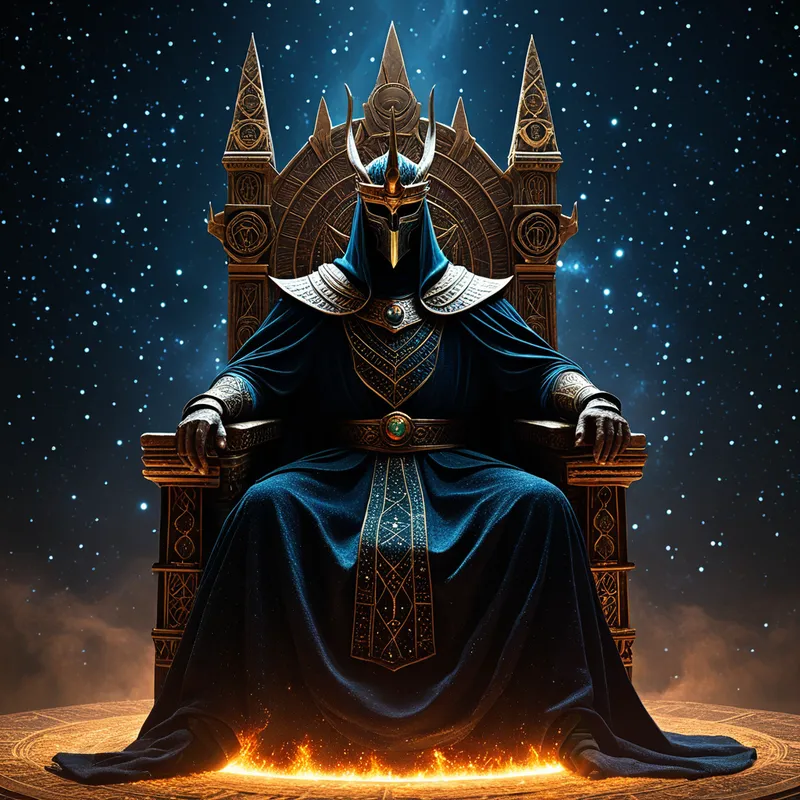
But in the farthest, coldest reaches of this spiritual emanation, a disturbance stirred. A being of pride and ambition was born from a flaw in contemplation. This was Rex Mundi, the King of the World. He was blind to the true God above him, seeing only the reflections of divine power that shimmered around him. In his arrogance, he believed himself the sole, supreme lord. Gazing upon the swirling void, he felt not love, but a covetous, creative rage. “This shall be my kingdom,” he declared, his voice the first thunder.
And so, with the stolen light of the spiritual souls he had captured and dimmed, he began to craft. He did not create from love, but from a craftsman’s jealous obsession. He spun the cosmos from dark matter, setting false stars in a deceptive firmament. He sculpted the mountains and gouged the seas, building a world of stunning, terrible beauty—a masterpiece of illusion. His final, most cunning act was to mold the clay of the earth into living forms: beasts, birds, and finally, the human shape. Into each vessel of mud and water, he forced one of the captured souls of light, binding the divine spark within a cage of flesh, bone, and desire.
Thus, humanity awoke—a walking contradiction, a sigh of spirit trapped in a groan of matter. We looked upon the world of Rex Mundi and called it good, not knowing it was a prison. We felt hunger, thirst, lust, and the fear of death—all the ingenious locks placed upon our cell by the jailer-god. The true God of Light, perfect and distant, became a forgotten whisper, a homesickness for a home we never knew we had. And the Demiurge sat upon his dark throne, content in his dominion, believing his creation complete and his authority absolute. But within every human heart, the buried spark, though shackled, refused to be extinguished. It waited, a silent rebel, for the memory of the light to return.
Cultural Origins & Context
This stark and poignant narrative was the sacred cosmology of the Cathars, a Christian dualist movement that flourished in the Languedoc region of southern France between the 12th and 14th centuries. They were known as the Bons Hommes (Good Men) and Bonnes Femmes (Good Women), or the Albigensians. Their myth was not written in a single holy book but was passed down orally, a secret knowledge (gnosis) revealed to initiates who underwent the ritual of the Consolamentum, the baptism of the Spirit.
In a society dominated by the Catholic Church, which preached a single, omnipotent Creator God, the Cathar myth was a radical act of theological rebellion. It provided a powerful explanation for the palpable presence of evil, suffering, and corruption in the world and within the institutional Church itself. The material world—including the physical body, wealth, and political power—was not the creation of a benevolent God but of a hostile, lesser power. This belief directly informed their extreme asceticism, rejection of material possessions, procreation (which would forge new prisons for spirit), and often, vegetarianism. Their myth was not just a story; it was a map for living a life that sought to untangle the spirit from the claws of matter, a sustained protest against the world of Rex Mundi.
Symbolic Architecture
The Cathar creation myth is a profound symbolic [architecture](/symbols/architecture “Symbol: Architecture in dreams often signifies structure, stability, and the framing of personal identity or life’s journey.”/) for the [human](/symbols/human “Symbol: The symbol of a human represents individuality, complexity of emotions, and social relationships.”/) [condition](/symbols/condition “Symbol: Condition reflects the state of being, often focusing on physical, emotional, or situational aspects of life.”/) as experienced in moments of profound existential alienation. It maps the internal schism between our highest aspirations ([spirit](/symbols/spirit “Symbol: Spirit symbolizes the essence of life, vitality, and the spiritual journey of the individual.”/)) and our base, compulsive natures (matter).
The world is not a gift, but a test; not a home, but a labyrinth designed to make you forget you are lost.
The God of Light represents the transcendent Self, the core of pure, uncontaminated [consciousness](/symbols/consciousness “Symbol: Consciousness represents the state of awareness and perception, encompassing thoughts, feelings, and experiences.”/) and potential that Jung might call the [archetype](/symbols/archetype “Symbol: A universal, primordial pattern or prototype in the collective unconscious that shapes human experience, behavior, and creative expression.”/) of the Self. It is the unknowable [origin](/symbols/origin “Symbol: The starting point of a journey, often representing one’s roots, source, or initial state before transformation.”/) we intuit but cannot grasp. Rex Mundi, in contrast, is the archetypal Demiurge—the inflated ego, the part of the psyche that believes it is the totality of the self. He is [the principle](/symbols/the-principle “Symbol: A fundamental truth, law, or doctrine that serves as a foundation for a system of belief, behavior, or reasoning, often representing moral or ethical standards.”/) of blind will, intellectual pride, and the compulsive need to control and fabricate [reality](/symbols/reality “Symbol: Reality signifies the state of existence and perception, often reflecting one’s understanding of truth and life experiences.”/) without wisdom. The [material](/symbols/material “Symbol: Material signifies the tangible aspects of life, often representing physical resources, desires, and the physical world’s influence on our existence.”/) world he creates is the [persona](/symbols/persona “Symbol: The social mask or outward identity one presents to the world, often concealing the true self.”/) and the complex-ridden personal unconscious writ large: a dazzling, complex, often painful [structure](/symbols/structure “Symbol: Structure in dreams often symbolizes stability, organization, and the framework of one’s life, reflecting how one perceives their environment and personal life.”/) built from identification with the [body](/symbols/body “Symbol: The body in dreams often symbolizes the dreamer’s self-identity, personal health, and the relationship they have with their physical existence.”/), social [status](/symbols/status “Symbol: Represents one’s social position, rank, or standing within a group, often tied to achievement, power, or recognition.”/), [trauma](/symbols/trauma “Symbol: A deeply distressing or disturbing experience that overwhelms the psyche, often manifesting in dreams as unresolved emotional wounds or psychological injury.”/), and instinct.
The trapped [soul](/symbols/soul “Symbol: The soul represents the essence of a person, encompassing their spirit, identity, and connection to the universe.”/) of light is the divine spark of individual consciousness, our [connection](/symbols/connection “Symbol: Connection symbolizes relationships, communication, and bonds among individuals.”/) to the Self, which feels imprisoned by the very fabric of our embodied, egoic existence. The myth thus externalizes an intense inner experience: the feeling that “this cannot be all there is,” that one’s true [identity](/symbols/identity “Symbol: Identity represents the sense of self, encompassing personal beliefs, cultural background, and social roles.”/) is [alien](/symbols/alien “Symbol: Represents the unknown, otherness, and the exploration of new ideas or experiences.”/) to the world one inhabits.
The Dreamer’s Resonance
When this mythic pattern stirs in the modern dreamer, it signals a powerful crisis of awakening. It is the psyche’s declaration that a long-held identification is a prison.
One might dream of being trapped in a beautifully crafted but suffocating glass sculpture, or of living in an opulent mansion that is revealed to be a meticulously designed cage. The body itself may appear as a cumbersome suit of armor or a clay shell that must be cracked open. The figure of the Demiurge might appear as a faceless authority figure, a tyrannical parent, a slick corporate overlord, or even as one’s own reflection in a mirror, looking back with cold, possessive pride. These dreams carry a somatic weight of constriction, a literal heaviness in the chest (the cage of the heart), and a profound, aching nostalgia for a place one has never visited.
Psychologically, this is the process of the ego beginning to differentiate from the Self. It is the painful but necessary realization that the life one has been living—the goals, values, and identity constructed under the inner Demiurge’s rule—is an inauthentic fabrication. The dreamer is confronting what Jung called the “shadow” of their own worldly ambitions and identifications, seeing them as part of the imprisoning structure.
Alchemical Translation
The alchemical journey modeled by this myth is not one of conquering a dragon, but of realizing the dragon is the castle you live in, and you are the treasure it hoards. The process of individuation here is a radical separatio: the careful, often agonizing work of distinguishing the gold of the spirit from the leaden dross of compulsive material and psychological identification.
Liberation is not an escape from the world, but a withdrawal of the divine investment that makes the world a prison.
The first stage is gnosis—the saving knowledge. This is the lightning-strike of insight that the ego is not the master, but a blind craftsman. In therapy or inner work, this is the moment a core complex is named, when one sees the repetitive, self-sabotaging pattern of their life as a foreign construction. The second stage is askesis—the disciplined practice. The Cathar emphasis on asceticism translates psychologically as a conscious via negativa: not a rejection of life, but a deliberate stripping away of projections, addictive behaviors, and ego-inflations that fuel the Demiurge’s power. It is saying “no” to the impulses that bind the spark.
The final goal is apocatastasis—the restoration of all things to their original state. In the psyche, this is the integration where the spark, now liberated, no longer sees the world as a prison but as the neutral ground from which it fell. The Demiurge is not destroyed, but his illusion of supremacy is broken. He becomes simply a part of the psychic landscape, the necessary principle of form and limitation, now known for what he is and thus robbed of his tyrannical power. The rebel soul achieves not flight, but sovereignty within the very realm that once held it captive.
Associated Symbols
Explore related symbols from the CaleaDream lexicon:
- Light — The essential nature of the true God and the trapped soul, representing pure consciousness, spirit, and the ultimate goal of liberation from material darkness.
- Shadow — The realm and the very substance of Rex Mundi, representing the unconscious, hidden aspects of the psyche that bind the spirit through ignorance and pride.
- Prison — The entire material cosmos and the human body, symbolizing the ego-complex and all worldly identifications that confine the divine spark.
- Spirit — The animating principle from the true God, opposed to matter; the breath of the Pleroma trapped within the clay of earthly existence.
- Clay — The base substance of the physical world fashioned by the Demiurge, representing the malleable, corruptible nature of the body and material life.
- Rebellion — The inherent action of the soul-spark remembering its origin, representing the necessary psychological act of defying ingrained complexes and societal conditioning.
- Liberation — The state of Gnosis and release, symbolizing the individuated Self freed from identification with the personal psyche and its conflicts.
- Fire — The purifying and illuminating force, often associated with the souls of light and the destructive knowledge that burns away the illusions of the material prison.
- Mountain — Often a symbol of the difficult, ascetic path the Perfecti must climb to achieve spiritual purity and escape the lowlands of material existence.
- Catharsis — The ultimate goal of the myth and the Cathar practice; the purification and release of the spirit from its material confines, leading to psychic wholeness.