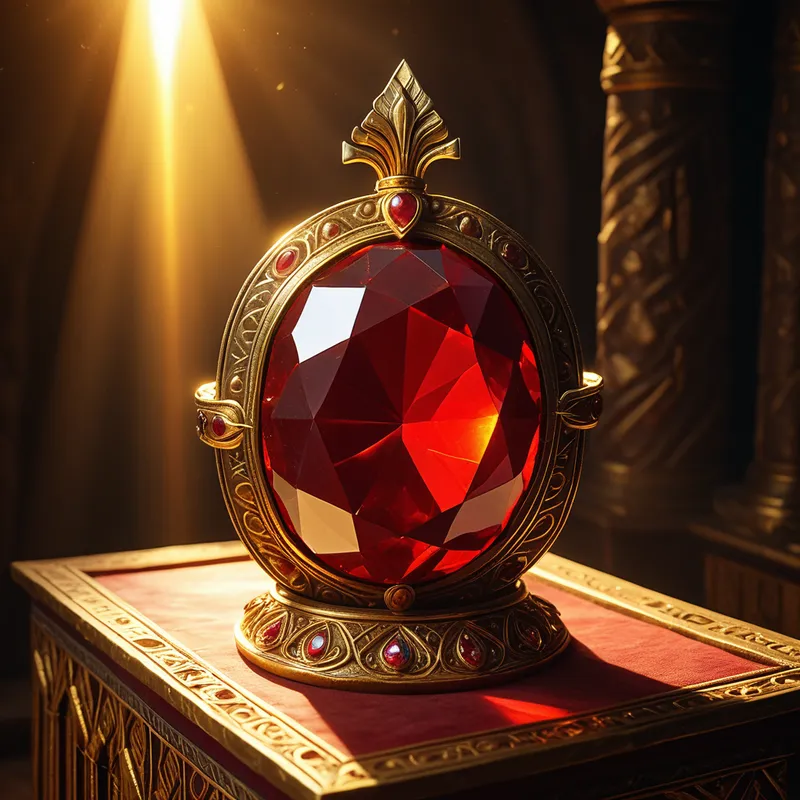
The Carbuncle Myth Meaning & Symbolism
A myth of a radiant stone, born from divine light and hidden in creation, symbolizing the indwelling sacred spark within the human soul.
The Tale of The Carbuncle
Listen, and let the veil of time grow thin. Before the world knew its name, there was only the Word, and the Word was Light. From that first, unutterable flash, all things were spun: the vault of heaven, the depths of the sea, the dust of the earth. And in that primal act of making, as the firmament was hammered thin and the stars were set in their courses, a fragment of that original, unsullied Light did not ascend. It could not. It was too heavy with glory, too potent with the essence of the Name.
It fell, not as a meteor in wrath, but as a seed of sunfire, sinking deep into the newborn crust of the world. The earth received it, folded it in layers of darkness and pressure, of quartz and basalt. For eons, it slept, a captive sun, its fire banked but undimmed. The rivers did not know it. The roots of the cedars of Lebanon stretched toward it but could not touch its heart. It was the secret of the mountain, the sleeping covenant between the divine fire and the material world.
Then came the call. Not with trumpets, but with a whisper to a man on a mountain, wrapped in smoke and thunder. The pattern was shown: a breastplate of judgment, of woven gold and blue, of purple and scarlet twice-dyed. And upon it, twelve stones, for the twelve tribes, set in four rows of three. And in the first row, a sardius, a topaz, and a carbuncle.
The craftsmen, filled with a spirit of wisdom, sought the stones. They found the sardius in the riverbeds, the topaz in the eastern deserts. But the carbuncle… it would not be found by searching. It had to be remembered. In a dream, the master artisan saw the falling light. He led the seekers to a specific mountain, to a specific seam of rock that wept iron. There, they labored. And when the rock was split, it did not yield a dull ore. It bled light. From the absolute darkness of the stone’s heart, they brought forth the Carbuncle. It was not merely red; it was the color of a living coal, of a sunset held in a dewdrop, of life-blood illuminated from within.
It was placed, this reclaimed fragment of the first day, upon the heart of the High Priest as he stood before the Holy of Holies. It did not sparkle with a superficial glitter. In the shadowed tent, it glowed. It held its own light, a memory of the source, a testament that the deepest darkness of earth could conceal, but never extinguish, the primordial flame. It was a silent witness, a stone that saw, a piece of the covenant not written on tablets, but grown from the world itself.
Cultural Origins & Context
The Carbuncle, or Nophek in Hebrew, finds its place not in a standalone narrative myth, but woven into the sacred fabric of priestly ritual and cosmic symbolism within the Torah. Its story is told through prescription and placement, recorded in the books of Exodus and later referenced in the visions of Ezekiel. This was not a tale for the campfire, but a sacred datum for the Levitical priests and the people of the covenant.
Its primary tellers were the priestly scribes, for whom the material world was a direct reflection of divine order. The Breastplate of Judgment (Hoshen Mishpat) was not mere ornamentation; it was a microcosm. Each stone corresponded to a tribe, and the Carbuncle was linked to Judah, the tribe of kingship and the lineage of David. Thus, the stone’s mythic identity—born from primordial light—directly supported the theological claim of Judah’s, and by extension the Messiah’s, divinely ordained and luminous authority.
Societally, its function was one of mediation and remembrance. On the High Priest’s heart, it literally stood between the fallible people (represented by the tribes) and the overwhelming presence of the Divine. It served as a tangible anchor to the belief that the covenant was not abstract, but was embedded in the very substance of creation. The Carbuncle was a guarantee: just as light was hidden in stone, so was the promise of the divine presence hidden within, and inextricable from, the fate of the nation.
Symbolic Architecture
The Carbuncle is a master symbol of the coincidentia oppositorum—the coincidence of opposites. It is light imprisoned in darkness, spirit condensed into matter, eternity captured in a finite gem. It represents the fundamental psychic truth that the most profound spiritual value is often found in the most unexpected, “earthly,” or shadowed aspects of the self.
The treasure is not found by fleeing the mountain, but by daring to split it open. The divine spark does not reside outside of nature, but sleeps within its deepest, most material core.
Psychologically, the Carbuncle symbolizes the Self—the indwelling, central, and organizing principle of the psyche that is often obscured by the rubble of the ego, complexes, and personal history (the layers of rock). It is not created by the individual; it is discovered, or rather, reclaimed. It is the “original face” before one was born, the unique and irreducible essence of an individual that connects them to the transpersonal, the numinous.
The process of its extraction—the guided search, the laborious splitting of the rock—mirrors the difficult, often painful work of introspection and shadow-work. The light does not come easily; it requires breaking apart the hardened defenses and identifications (the “seam of rock that wept iron”) that have formed around the core Self.
The Dreamer’s Resonance
When the motif of the Carbuncle arises in modern dreams, it rarely appears as a biblical gemstone. Its presence is more subtle, more somatic. A dreamer may find themselves in a cave, not searching for a way out, but compelled to dig at a specific wall with their bare hands. They may discover a common stone that, when held, grows warm and emits a soft, red-gold light from within. They may dream of a piece of jewelry—a ring or pendant—with a stone that is dull in daylight but glows fiercely in the dark of a drawer or under moonlight.
These dreams signal a critical phase in the individuation process: the approach to the core Self. The somatic feeling is often one of deep, resonant warmth in the chest center, a “knowing” pressure, or a sense of magnetic attraction to a specific, seemingly mundane object or place. Psychologically, the dreamer is going through a process of recognition. The conscious mind (the seeker) is being guided by the unconscious (the dream-vision) to the precise location within their own psychic geography where their essential value lies hidden beneath layers of adaptation, trauma, or neglect.
The conflict in such dreams is not with monsters, but with the effort of extraction and the fear of the light. To bring this inner carbuncle to the surface of consciousness is to accept a radical self-responsibility for one’s own luminosity.

Alchemical Translation
The myth of the Carbuncle is a perfect map for the alchemical opus, the great work of psychic transmutation. The alchemist’s quest for the Lapis Philosophorum is the internalized version of the priest’s quest for the sacred stone.
The first stage, Nigredo (blackening), is represented by the carbuncle’s initial state: buried in absolute darkness, unknown, in the prima materia of the unexamined life. The Albedo (whitening) is the dream-guidance, the spiritual insight that reveals its location—the “wisdom” granted to the artisan. The Citrinitas (yellowing) is the laborious splitting of the rock—the analytical, disciplined work of therapy, journaling, and confronting complexes that clears away the debris.
Finally, the Rubedo (reddening) is the moment of extraction and placement. This is the pinnacle of individuation.
The Carbuncle placed upon the heart is the Self, integrated and conscious, now acting as the mediating center of the entire personality. The base metal of the ego-led life is transmuted into the gold of an authentic existence.
For the modern individual, this means that our “holy of holies”—our deepest sense of meaning and purpose—is not found in external doctrines, achievements, or relationships alone. It is found by undertaking the sacred labor of descending into our own personal history, our wounds, and our darkest material (the mountain), and there, discovering that our most profound value was not added, but was there from the beginning: a seed of primordial light, a carbuncle, waiting to be worn upon the heart of our own awareness. The covenant is with oneself. The breastplate is the integrated psyche. And the glowing stone is the proof that we are, and have always been, vessels of the original fire.
Associated Symbols
Explore related symbols from the CaleaDream lexicon: