The Canals of the Duat Myth Meaning & Symbolism
The perilous journey of the sun god Ra through the dark, watery canals of the Duat, a myth mapping the soul's nightly death and dawn rebirth.
The Tale of The Canals of the Duat
Listen, and hear the tale of the sun’s other journey. Not the blazing arc across the lapis lazuli sky, but the secret, silent passage beneath the world. This is the journey through the Duat, a land not of dust, but of dark, winding water.
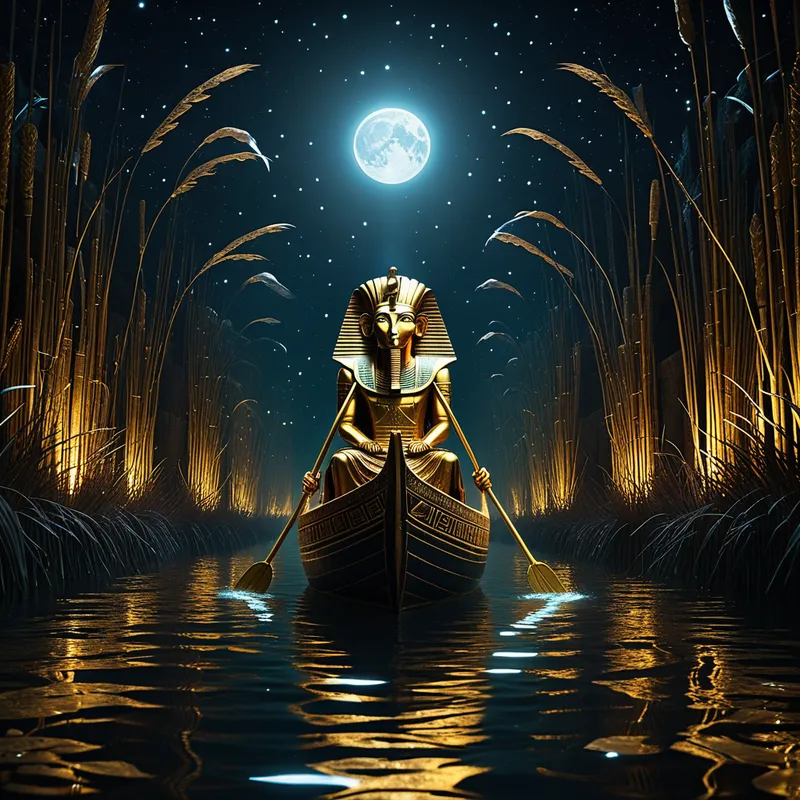
As the last crimson light of Ra bleeds from the western horizon, a great change occurs. The sun disc does not die; it is transformed. The solar barque, the Mandjet, now becomes the Mesektet. Its golden timbers grow dark, its light turns inward, a contained and secret flame. At the prow stands Ra, no longer in his falcon-headed glory, but in the form of a ram-headed man, a god of the deep hours. With him are silent, powerful companions: Thoth, the recorder, whose ibis head is bent over a scroll of stars; and Osiris, the lord of this very realm, a green-skinned king who is both the judge and the judged.
The barque slips into the mouth of the western mountain, and the world of light is swallowed. Ahead lies not a desert, but a network of black, sluggish canals. The air is thick, smelling of damp earth and lotus roots. The only sound is the lap of water against the hull and the distant, echoing cries of beings unseen. This is the First Hour, and the gates are guarded.
Through twelve perilous gates, one for each hour of the night, the barque must sail. Each gate is a monstrous maw, each portal guarded by a demon whose name is a curse and a password. Fire-spitters, knife-wielders, serpent-necked sentinels demand the true name of Ra. Thoth speaks the words, the barque passes, and the waters grow darker.
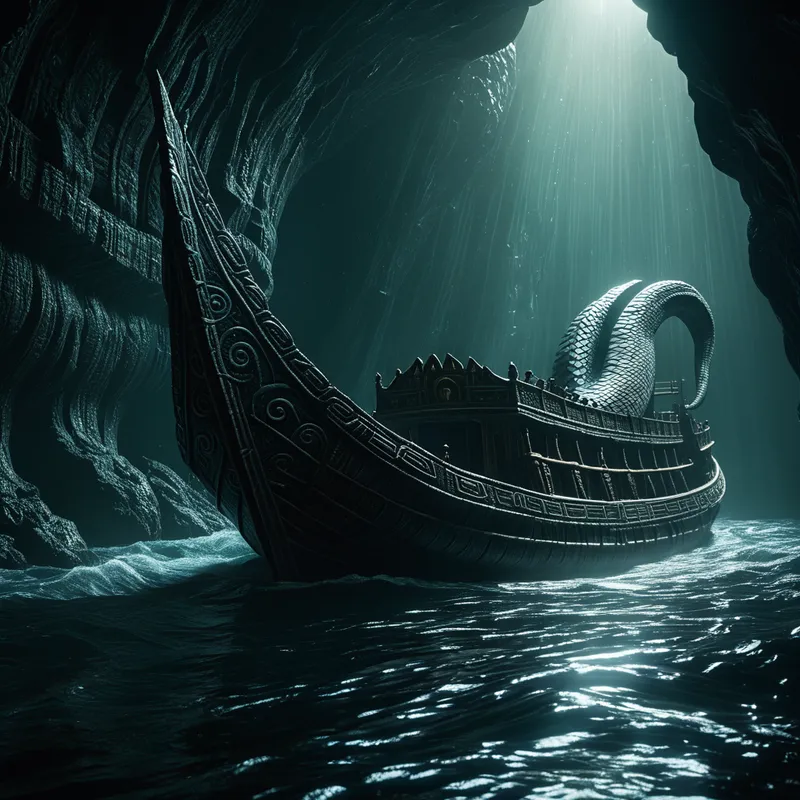
But the true terror is not at the gates. It coils in the depths of the seventh and most treacherous canal: Apep, the great serpent of chaos, the enemy of Maat. As the barque enters the narrowest passage, the waters boil. Apep rises, a mountain of scaled malevolence, its body blocking the entire waterway, its intent to swallow the sun and plunge creation into endless, formless night. The crew is thrown into panic. But Ra stands firm. With spears of light and spells of binding, with the aid of Serket and the magic of Isis, the serpent is held back, stabbed, subdued—but never destroyed. It sinks back, wounded, to plot again for the next night’s passage.
Wounded but victorious, the barque sails on. In the deepest hour, it approaches the silent, still mound at the heart of the Duat. Here lies the corpse of Osiris, and here, the barque touches the bank. In a mystery beyond telling, the sun god and the lord of the dead merge. Ra’s fading light enters the still form of Osiris, and in that union of the dying sun and the resurrecting god, a new spark is kindled. The light is reborn.
The barque, now glowing with a fresh, tender light, enters the final canals. It approaches the eastern mountain. The waters begin to quicken, touched by the promise of dawn. The scarab god, Khepri, pushes the solar disc from within the barque. And as the Mesektet passes the last gate, it transforms once more. It is the Mandjet again, bursting forth over the eastern horizon, not as it set, but renewed, triumphant, scattering the dew of the Duat upon the waking world. The sun is born again, because it first dared to die.
Cultural Origins & Context
The myth of the nocturnal journey was not a single story told around a fire, but a sacred, functional map inscribed on the walls of royal tombs, most completely in the Amduat and the Book of Gates. These were not for the living populace, but for the pharaoh—and later, for nobles deemed worthy—to serve as a literal guidebook for their own posthumous voyage. The priests who composed and transscribed these texts were not merely storytellers, but cartographers of the soul’s geography.
Its societal function was profound and dualistic. On a cosmic level, it explained the most fundamental mystery: why the sun returns each morning. It framed this not as a mechanical certainty, but as a nightly victory of order over chaos, won anew each twilight. On a personal level, it provided a template for the individual soul’s journey. The deceased, identified with Osiris and aided by the knowledge of the gates and passwords, would navigate their own Duat, overcome their own Apep, and achieve rebirth in the Field of Reeds. The myth was thus both a cosmological doctrine and the ultimate self-help manual for eternity.
Symbolic Architecture
The Canals of the Duat are the ultimate symbol of the transformative journey through the unconscious. This is not a journey of action, but of endurance, navigation, and integration.
The underworld is not a place of punishment, but a dark womb of necessary dissolution. To be reborn, one must first consent to be unmade.
The solar barque represents the conscious self, the ego, embarking into realms it does not control. The twelve gates are the sequential stages of this deep psychological process, each requiring the surrender of a previous identity or defense (the “password”). The demonic gatekeepers are the terrifying but necessary aspects of the shadow that must be faced and named to proceed.
The central struggle with Apep symbolizes the confrontation with pure, formless chaos—the psychological abyss, the threat of madness, meaninglessness, or total psychic disintegration. Its eternal recurrence reminds us that chaos is never finally vanquished, only temporarily held at bay by the ongoing work of consciousness (Maat).
Most crucially, the union of Ra and Osiris at the midpoint is the alchemical coniunctio, the sacred marriage of opposites. Ra is the dynamic, living principle of light and consciousness; Osiris is the static, dead/reborn principle of structure and memory. Their merger signifies that renewal comes not from avoiding the “dead” parts of ourselves, but from allowing our conscious light to fully illuminate and unite with them.
The Dreamer’s Resonance
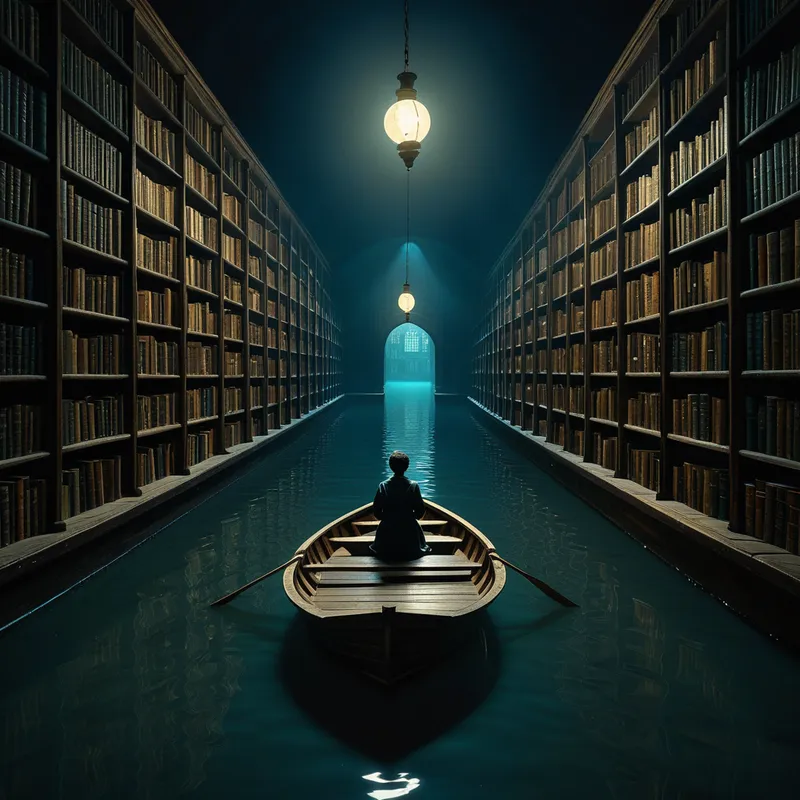
When a modern dreamer finds themselves navigating dark waterways, silent canals, or underground rivers, the myth of the Duat is resonating. This is not a dream of adventure, but of solemn transit. The somatic feeling is often one of weight, slow movement, and profound solitude, coupled with acute vigilance.
Psychologically, this dream pattern signals a passage through a major life transition that requires a “death”—the end of a career, a relationship, an identity, or a long-held belief. The dream-ego is in the Mesektet barque: its familiar daytime energy is subdued, forced to move by currents deeper than its own will. The banks of the dream-canal, often vague or populated with silent watchers (the gatekeepers), represent the forgotten or repressed contents of the psyche now being passed in review. To dream of a serpent rising from such waters is to encounter the raw, anarchic fear that this transition might lead not to renewal, but to annihilation. The dream is mapping the nervous system’s journey through dissolution toward a reorganization not yet visible.
Alchemical Translation
For the individual, the Duat’s canals model the process of individuation in its most profound phase: the nigredo, or dark night of the soul. This is the alchemical putrefaction, where the old, outworn structures of the personality must break down in the “waters” of the unconscious.
The goal of the journey is not to escape the dark, but to learn its navigation; to find that the source of renewal flows from the very heart of the apparent wasteland.
The modern seeker embarks on this journey not in a tomb, but in the silent hours of introspection, in therapy, in creative block, or in grief. Each “gate” is a painful insight, a surrendered illusion, a forgiven fault. The confrontation with one’s personal Apep is the terrifying encounter with the meaninglessness that can arise when all former certainties have dissolved.
The alchemical gold, the renewed “sun” that emerges, is a transformed consciousness. It is an ego that has faced its own underworld and integrated its shadows. It is no longer the bright, naive sun of day, but the wiser, deeper light that contains the knowledge of the dark within it. One becomes, in a psychological sense, both Ra and Osiris: the dynamic agent of one’s own life, now rooted in and nourished by all that one has been, even that which was “dead” and buried. The journey through the canals teaches that to live authentically, one must first learn the sacred art of nightly navigation.
Associated Symbols
Explore related symbols from the CaleaDream lexicon: