The Camel Rider Who Sees the Ka'ba Myth Meaning & Symbolism
A rider on a distant dune sees the Ka'ba not with his eyes, but with his heart, embodying the Sufi quest for inner pilgrimage and true sight.
The Tale of The Camel Rider Who Sees the Ka’ba
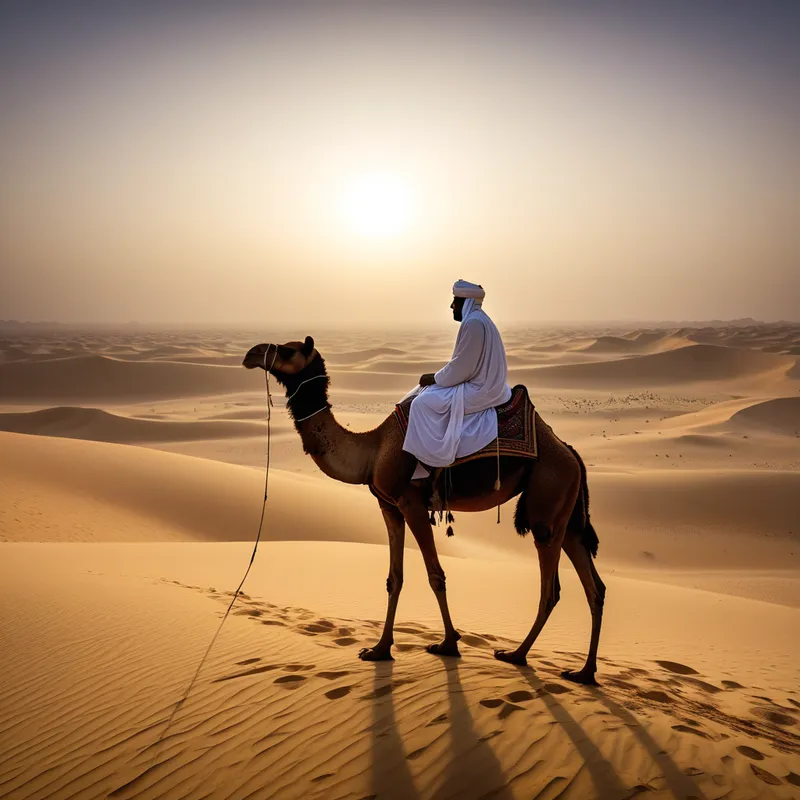
Listen, and let the silence of the desert speak. There was a man, a traveler of the soul, whose home was the saddle and whose map was written in the stars. For years, for lifetimes it seemed, he had journeyed across the Empty Quarter of his own longing. The sun was his clock, the wind his companion, and the patient beast beneath him—a creature of endurance and grace—his only vessel.
One evening, as the sun bled its last gold into the violet west, he urged his camel up the crest of a dune so high it seemed to scrape the belly of the sky. The climb was a prayer of effort, each labored breath of the animal a syllable in a forgotten tongue. At the summit, the world fell away into an ocean of shadow and stillness. The wind died. The last crickets held their breath.
And there, on the far, far horizon, a pinprick of light emerged. Not the light of a campfire or a star, but a steady, profound luminescence. It was the Ka’ba, the House of Allah. He saw it. Not with the eyes that scan for mirages, but with the eye that dwells in the center of the chest. The distance was immense, uncrossable in a hundred marches, yet in that moment of seeing, it vanished. The space between his soul and the sacred goal was not sand and sky, but a single, transparent breath.
He did not cry out in triumph. He did not spur his camel forward in a frantic race. A deep, quiet peace settled upon him, heavier than any desert cloak. He simply sat, and saw. The camel, sensing the shift, knelt with a soft groan, and the rider dismounted. He stood beside his faithful companion, and together they kept vigil through the deepening night, bathed in that distant, unwavering glow. The journey was not over, but its meaning had been fulfilled in the seeing. He had arrived by having truly set out.
Cultural Origins & Context
This tale is not found in a single, canonical text but is woven into the oral teaching traditions of Sufism. It is a hikayat, passed from master (shaykh) to disciple (murid) by the light of a lamp in a khanqah. Its function is not historical record but existential orientation.
It emerges from the core Sufi practice of suluk and the doctrine of Wahdat al-Wujud. The physical pilgrimage to Mecca (Hajj) is the outer form; this story speaks of the greater, inner Hajj. It was told to recalibrate the seeker’s understanding of goal and path. The society it served was one that valued the exterior rituals of faith; the story quietly insists on the primacy of the interior reality. The teller is often anonymous, for the story belongs to every heart that has yearned.
Symbolic Architecture
The myth is a perfect map of the [soul](/symbols/soul “Symbol: The soul represents the essence of a person, encompassing their spirit, identity, and connection to the universe.”/)‘s topography. The Ka’ba is not merely a building, but the Sirr, the secret core of the self where the Divine resides. It is the center that is both the [destination](/symbols/destination “Symbol: Signifies goals, aspirations, and the journey one is on in life.”/) and the [origin](/symbols/origin “Symbol: The starting point of a journey, often representing one’s roots, source, or initial state before transformation.”/).
The [Camel](/symbols/camel “Symbol: A symbol of endurance, survival, and journey through harsh conditions, representing the ability to carry burdens across difficult terrain.”/) is the [body](/symbols/body “Symbol: The body in dreams often symbolizes the dreamer’s self-identity, personal health, and the relationship they have with their physical existence.”/), the lower self (nafs), and earthly existence itself—stubborn, patient, and essential for the [journey](/symbols/journey “Symbol: A journey in dreams typically signifies adventure, growth, or a significant life transition.”/). It is the [vehicle](/symbols/vehicle “Symbol: Vehicles in dreams often symbolize the direction in life and the control one has over their journey, reflecting personal agency and decision-making.”/) of transformation, carrying the rider across the desert of illusion.
The vast Desert is the realm of separation, the testing ground of the ego where all familiar landmarks are erased. It represents the necessary aridity and solitude where the soul is stripped bare.
The act of Seeing is the pivotal [alchemy](/symbols/alchemy “Symbol: A transformative process of purification and creation, often symbolizing personal or spiritual evolution through difficult stages.”/). It is not optical [sight](/symbols/sight “Symbol: Sight symbolizes perception, awareness, and insight, representing both physical and inner vision.”/) but basirah—[vision](/symbols/vision “Symbol: Vision reflects perception, insight, and clarity — often signifying the ability to foresee or understand deeper truths.”/) of the [heart](/symbols/heart “Symbol: The heart symbolizes love, emotion, and the core of one’s existence, representing deep connections with others and self.”/). This seeing collapses metaphysical [distance](/symbols/distance “Symbol: Distance in dreams often symbolizes emotional separation, unattainable goals, or the need for personal space and reflection.”/). The rider does not possess the Ka’ba; he is united with it through the faculty of true [perception](/symbols/perception “Symbol: The process of becoming aware of something through the senses. In dreams, it often represents how one interprets reality or internal states.”/). The journey’s [purpose](/symbols/purpose “Symbol: Purpose signifies direction, meaning, and intention in life, often reflecting personal ambitions and core values.”/) was to arrive at this mode of seeing, not at a geographical coordinate.
The Dreamer’s Resonance
When this myth stirs in modern dreams, it often manifests not as a desert rider, but as the dreamer standing at a great height—a cliff, a skyscraper, a mountain—gazing at a distant, luminous city or a singular, perfect house that emanates profound peace and belonging. The somatic feeling is one of simultaneous awe and heartbreaking distance, coupled with a deep, cellular certainty: That is my home.
Psychologically, this dream pattern signals a critical moment of orientation. The dreamer is confronting the true object of their deepest longing, which is often obscured by life’s clutter—career goals, relationship ideals, fantasies of success. The “Ka’ba” in the dream is the symbol of the integrated Self, the core around which a meaningful life must be organized. The vast space between represents the work of shedding inauthentic identities (the desert crossing). The dream is a gift of vision, showing the seeker their true north, often at a point of exhaustion or disillusionment with worldly pursuits. It confirms the longing itself is valid and maps its object.
Alchemical Translation
The myth models the entire process of individuation as a pilgrimage of perception. First, one must mount the “camel”—fully engage with the embodied, practical reality of one’s life and psychology. One must traverse the “desert”—endure the necessary periods of depression, aridity, and purification where the old ego-structures (the false oases) prove illusory.
The climb up the final dune is the crisis of insight, the moment where conscious effort meets grace. It is the painful, focused push towards self-honesty that precedes a breakthrough.
The vision of the “Ka’ba” is the emergence of the Self archetype into conscious awareness. It is not the end of the work, but the revelation of its purpose. The subsequent peace and lack of frantic movement signify a profound psychic reorientation. The energy previously spent in searching is now channeled into abiding in the certainty of the goal. The outer journey continues—the rider will still have to descend the dune and travel—but it is now informed by an inner attainment. The struggle for achievement transmutes into the practice of presence. The ego’s ambition to “get there” is alchemized into the soul’s capacity to “see from here.”
Associated Symbols
Explore related symbols from the CaleaDream lexicon:
- Camel — The enduring vessel of the journey, representing the physical body, the disciplined lower self (nafs), and the practical patience required to cross the desert of the psyche.
- Journey — The central narrative and spiritual imperative of the myth, symbolizing the lifelong path of seeking, purification, and movement toward the divine center.
- Vision — The transformative act of heart-sight (basirah) that redefines distance and relationship, representing enlightened perception or the moment of mystical union.
- Desert — The vast, purifying emptiness that strips away all illusion and comfort, forcing a confrontation with the essential self and the reality of the path.
- Mountain — The towering dune represents the final, arduous ascent toward revelation, a place of ordeal, perspective, and proximity to the sacred.
- Heart — The true organ of perception in the myth; the Ka’ba is seen with the heart, symbolizing the seat of spiritual intelligence and divine connection.
- Light — The luminous emanation of the distant Ka’ba, representing divine guidance, truth, and the visible presence of the sacred goal in the darkness of separation.
- Star — A celestial guide like the Ka’ba’s light, often reflected in the camel’s eye, symbolizing hope, navigation by higher principles, and the spark of the divine within the mundane.
- Distance — The immense, symbolic space between rider and goal, representing the psychological and spiritual gulf between the ego-consciousness and the integrated Self.
- Silence — The profound stillness that accompanies the vision, representing the cessation of the mind’s chatter and the peaceful acceptance of a truth received, not achieved.