The Calling of Samuel Myth Meaning & Symbolism
A young boy, sleeping in a sacred temple, hears a voice calling his name in the night, beginning a journey of prophetic destiny.
The Tale of The Calling of Samuel
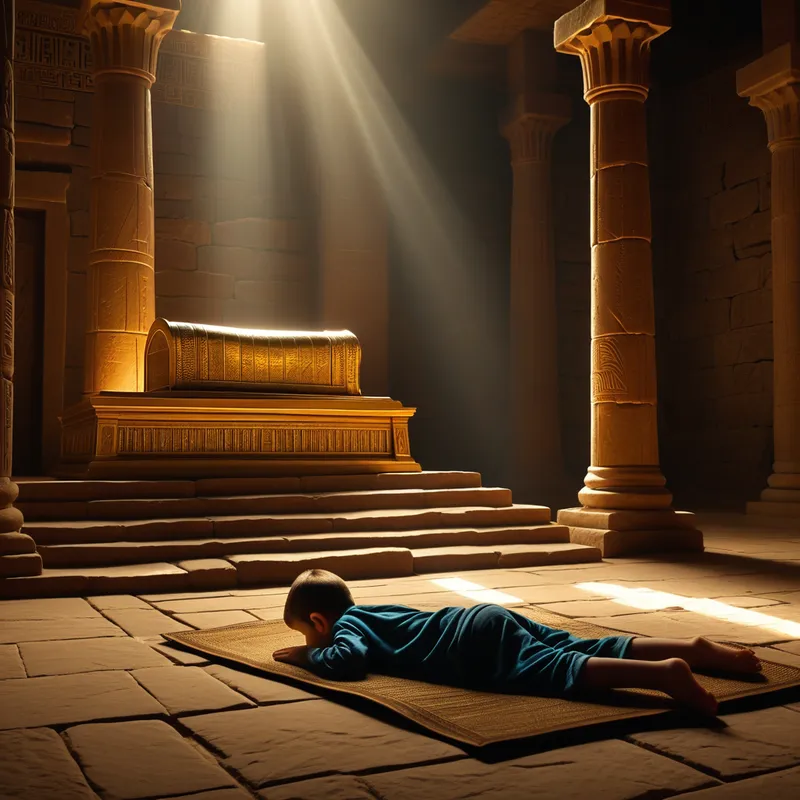
In the deep, silent hours when the world belongs to owls and spirits, in the place called Shiloh, a boy slept. His name was Samuel, given by a grateful mother, and his bed was a simple mat upon the stone floor of the house of the LORD. The air was thick with the scent of old incense and lamp oil. The only light was the faint, flickering glow from the lamp of God, which had not yet gone out. Beside him, in the inner chamber, rested the sacred Ark of the Covenant, a presence so potent the very stones seemed to hum with its memory.
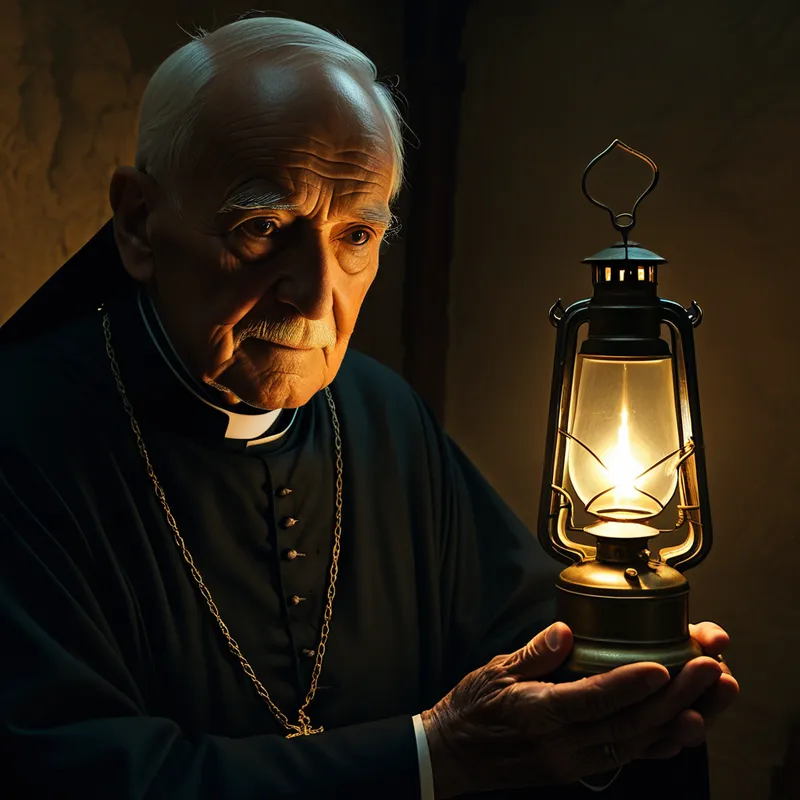
The priest, Eli, was old, his eyes dim not just with years but with a weight of sorrow. His own sons, who should have tended the sacred fires, had let the flame gutter into disgrace. So the holy watch fell to this child, this lent-life, sleeping in the shadow of the divine.
Then—a voice. “Samuel.”
It pierced the veil of sleep, clear as a bell cast from silver. The boy stirred, his young mind still tangled in dreams. He sat up, the rough wool of his blanket falling away. Thinking it was Eli, whose frail body often needed tending in the night, Samuel rose and padded softly to the old priest’s side. “Here I am, for you called me.”
Eli, roused from his own troubled rest, murmured, “I did not call; lie down again, my son.”
Samuel returned to his mat, the silence now feeling different—charged, expectant. He lay down, but sleep was a distant country. And again, the voice. “Samuel.” Not a shout, but a summons that vibrated in the marrow of his bones. Again, he went to Eli. “Here I am, for you called me.”
And Eli, patience worn thin by the hour, said, “I did not call, my son; lie down.”
A third time. The voice came, undeniable, a hook in the soul. “Samuel.” This time, the boy rose with a certainty that was not his own. He stood once more before the old priest. “Here I am, for you called me.”
And in that moment, Eli’s dim eyes saw. They saw not a boy confused by dreams, but a vessel being tapped by a hand unseen. The weight of his own failures, the silence from the divine that had lain heavy over the land, suddenly crystallized into this terrifying, glorious possibility. His voice dropped to a whisper, heavy with awe and instruction. “Go, lie down. And if you are called again, you shall say, ‘Speak, LORD, for your servant is listening.’”
Samuel returned, his heart a drum against his ribs. He lay in the dark, waiting. The temple held its breath. The lamp flame seemed to still.
And the voice of the LORD came, and stood, as a man stands, and called as before. “Samuel! Samuel!”
And the boy, gathering the words like sacred tools given by the old sage, whispered into the waiting dark, “Speak, for your servant is listening.”
And the voice spoke. It spoke of a judgment so final it would make ears tingle. It spoke of the end of a priestly line, of promises shattered. It was a terrible, first prophecy for a child to bear—a burden of divine truth placed upon small shoulders. He lay until morning, afraid to tell the vision to Eli.
But with dawn came courage, or perhaps duty. When Eli pressed him, saying, “What was it that he told you? Do not hide it from me,” Samuel told him everything. And Eli, hearing the doom of his own house pronounced by this child-prophet, accepted it with a resignation that was itself a kind of holiness. “It is the LORD. Let him do what seems good to him.”
And Samuel grew. And the LORD was with him. And not one of his words fell to the ground.
Cultural Origins & Context
This narrative is nestled within the First Book of Samuel, a text that marks the fraught transition for ancient Israel from the period of the charismatic Judges to the establishment of the monarchy. It is a foundational “call narrative,” a literary and theological pattern seen in the commissioning of prophets like Moses, Isaiah, and Jeremiah. The story likely originated within priestly and prophetic circles, preserved and refined as oral tradition before being codified during the monarchic or later exilic periods as a powerful etiological tale—explaining how Samuel, a figure not of priestly birth, became the authoritative prophet and judge for the nation.
Its societal function was multifaceted. For a community grappling with political instability and perceived spiritual silence, it served as a reminder that divine communication had not ceased; it merely required the right vessel—one of innocence and obedience. It validated the prophetic office over and above a hereditary priesthood that could become corrupt (as exemplified by Eli’s sons). Furthermore, it established a model for divine-human interaction: the call is persistent, recognition often requires guidance from tradition (Eli), and the response must be one of attentive surrender.
Symbolic Architecture
At its heart, this is a myth of metamorphosis. The boy Samuel symbolizes the nascent, unformed consciousness, the potential self sleeping in the precincts of the sacred but not yet awakened to its own purpose. The temple at night represents the liminal space where the conscious world sleeps and the unconscious, the numinous, becomes active and articulate.
The voice that calls in the night is not an external interruption, but the eruption of the Self—the central, organizing archetype of the psyche—into the realm of the ego.
Eli, the failing priest with dim eyes, embodies the fading old order, a conscious attitude or religious dogma that has grown weak and can no longer perceive the divine directly. Yet, crucially, he retains the wisdom to interpret. He is the bridge, the necessary mentor who provides the form for the encounter. His instruction—“Say, ‘Speak, LORD, for your servant is listening’“—is the sacred formula that transforms a frightening, ambiguous noise into a dialogue with destiny. The threefold call signifies the insistence and inevitability of this awakening; the psyche will not be ignored.
The terrifying content of the first message—the judgment against Eli’s house—is profoundly symbolic. The birth of the new consciousness (the prophetic self) necessitates the de-structuring of the old, familiar container. The personal destiny announced to Samuel is inextricably linked to the dismantling of the structure that raised him. One cannot truly hear one’s own calling without accepting the end of something that came before.

The Dreamer’s Resonance
When this mythic pattern stirs in the modern dreamscape, it often manifests as a series of unsettling nocturnal visitations. The dreamer may hear their name called by an unseen voice, repeatedly, pulling them from sleep. They may dream of searching an empty, institutional building (a school, a hospital, a church) for a source of sound. The figure of Eli may appear as an older, respected but somewhat disappointing authority figure—a former teacher, a parent, a therapist—who, in the dream, points the dreamer back toward the mystery.
Somatically, this is the psyche signaling a critical threshold. The process is one of listening being activated at a depth far below ordinary attention. It is often accompanied by a feeling of anxiety, a sense of being “on the cusp” of something that feels both destined and disruptive. The dreamer is in the position of Samuel on his mat: their established identity (their “sleep”) is being interrupted by a summons from the core of their being. The psychological work is to resist the initial, ego-centric interpretation (“This is just Eli needing something”) and to move toward the terrifying, awe-filled posture of receptive witness.

Alchemical Translation
The alchemy modeled here is the transmutation of hearing into listening, and listening into vocation. The base metal is the sleeping ego, comfortable in its assigned role (acolyte, servant). The first call is the nigredo, the blackening, the disturbing intrusion that begins the work. The confusion and repeated misdirection represent the necessary friction and fermentation of the alchemical process.
Eli’s crucial guidance is the albedo, the whitening, the providing of the philosophical stone—the correct attitude. “Speak, for your servant is listening” is the sacred mantra of surrender. It is the ego consciously submitting its agenda to the larger intelligence of the Self. This submission is not passivity; it is the most active stance possible—a focused, willed openness.
The ultimate product of this psychic operation is not simply a message received, but the creation of the Vessel of the Voice—the individuated self who can bear the weight of its own truth and speak it into the world.
The terrifying first prophecy is the rubedo, the reddening, the fiery ordeal. To become oneself, one must internalize the death of the old dependencies, the old gods, the parental complexes (symbolized by Eli’s house) that have hitherto defined one’s reality. Samuel’s growth, and the assurance that “not one of his words fell to the ground,” signifies the stabilized lapis philosophorum: the integrated personality where inner truth and outer expression are in congruent alignment. The calling is complete when the voice from the night becomes the guiding voice of one’s days.
Associated Symbols
Explore related symbols from the CaleaDream lexicon: