The Calcination Process Myth Meaning & Symbolism
The myth of the alchemist's first ordeal, where base matter is subjected to a purifying, all-consuming fire to reveal its hidden, essential nature.
The Tale of The Calcination Process
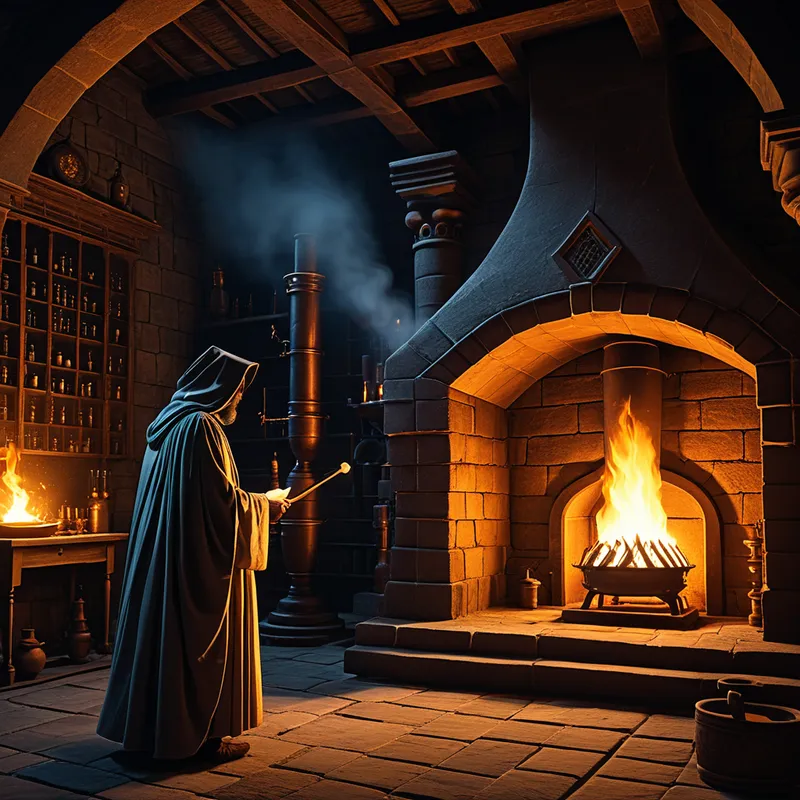
In the silent, smoke-stained vault of the world’s beginning, where shadow clings to substance, the First Matter slept. It was the Prima Materia, a dense, dreaming chaos of all that was and all that could be—heavy with potential, yet bound by its own formless weight.
The Opifex, the Great Artificer, beheld this slumbering mass. Not with eyes, but with a knowing that was fire itself. A profound discontent stirred in the heart of creation. This was not enough. To be everything was to be nothing. The Opifex knew the secret: wholeness is not found in accumulation, but in essential reduction. To find the true thing, the false thing must be unmade.
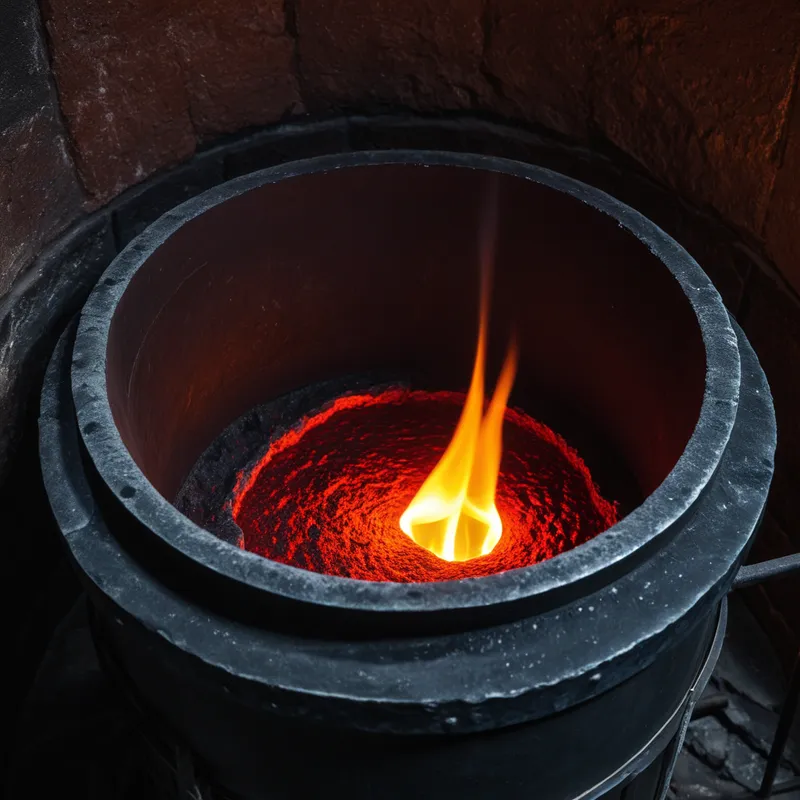
And so, the Opifex called forth the Fire of Separation. It did not roar from a forge, but rose from the very ground of being—a silent, white-hot presence that consumed sound before it could be born. The air did not heat; it vanished, replaced by a searing clarity that felt like truth. The Opifex placed the dreaming Prima Materia into the heart of this fire, into the Vas Hermeticum.
There was no explosion, only a terrible, slow acceptance. The Matter did not burn; it opened. Its dark, oily surface began to sweat—not water, but a bitter, acrid smoke that coiled like regret. The substance groaned, a low, tectonic sound of resistance. It blackened, its form cracking into a thousand fissures. From these cracks wept the Spiritus Mundi, the trapped spirits of moisture, vanity, and fleeting identity. They rose as shimmering phantoms, wailing their dissolution before being scoured into nothingness by the relentless flame.
This was the long night of the soul of matter. All that was non-essential—the dross of accident, the pride of form, the illusion of solidity—was given to the fire. The Opifex watched, unmoving, a figure of terrible compassion. The fire was not punishment, but the most intimate of questions, asked with an intensity that allowed for no lie.
Finally, the groaning ceased. The weeping smoke thinned and died. The roaring flame subsided, not to darkness, but to a steady, radiant glow. Within the Vas, where there had been a chaotic mass, now lay a residue. A fine, grey-white powder, utterly still. It was fragile, porous, and infinitely receptive. It was the Calx. It held no memory of its former shape, only the quiet, potent truth of its essential nature. The First Work was complete. The Opifex gathered the Calx, this ghost of substance, and the laboratory of the cosmos waited, breathless, for what would come next.
Cultural Origins & Context
The myth of Calcination is not a single story with a named hero, but the foundational narrative embedded within the practice and literature of Western alchemy, which flourished from Hellenistic Egypt through the Islamic Golden Age and into the European Renaissance. It was passed down not by bards, but by adepts through encrypted texts, symbolic illustrations (the Mutus Liber or “silent books”), and oral initiation.
Its primary societal function was dual. Exoterically, it was a technical manual for the early stage of the Magnum Opus, describing the literal process of roasting a substance (often lead ore or antimony) to drive off volatile components and reduce it to a calx (oxide). Esoterically, and more profoundly, it served as a psycho-spiritual map for the initiate. The myth provided a sacred container for the terrifying, inevitable experience of breakdown—whether of a flawed theory, a cherished identity, or a worldly fortune. It taught that such destruction was not failure, but the first and most necessary step on the path to wisdom. In a culture where the boundaries between matter and spirit were porous, this myth gave meaning to suffering by framing it as a sacred, purgatorial fire.
Symbolic Architecture
At its core, Calcination symbolizes the confrontation with the Ego by a force greater than itself. The Prima Materia represents the undifferentiated, unconscious psyche, laden with complexes, inherited patterns, and inflated self-images. The Opifex is the archetypal drive toward wholeness, the Self, which initiates the process of individuation. The Fire of Separation is the heat of reality itself—the shock of a life crisis, the intensity of deep analysis, or the burning friction of a truth one can no longer avoid.
The fire does not destroy the self; it incinerates the costume the self mistakes for its skin.
The acrid smoke and weeping spirits are the release of psychic contents that are volatile and false: repressed emotions, defensive pride, and brittle personas. The groaning resistance is the psyche’s natural terror of annihilation. The resulting Calx is the purified, humbled core of being—the ego stripped of its pretensions, rendered porous and receptive to the influences of the deeper Self. It is a state of conscious vulnerability, the “ashes” from which new life can genuinely grow. This is not enlightenment, but the essential precondition for it: the creation of psychic space.

The Dreamer’s Resonance
When the archetype of Calcination stirs in the modern unconscious, it manifests in dreams of profound, often alarming, transformation. The dreamer may find themselves in a house consumed by a clean, white fire that burns but does not consume the structure, only purges it of objects and memories. They may dream of their own body turning to ash or dust, only to find a small, indestructible seed or gem at the center. Dreams of catastrophic weather—walls of flame, scorching winds—or of being in a crucible or furnace are common.
Somatically, this process correlates with periods of intense stress, burnout, or illness that feel “purifying”—a fever that breaks a long-held pattern, an exhaustion that forces a total stop. Psychologically, it is the experience of a foundational identity being dismantled. The dreamer is going through a process where old adaptations, coping mechanisms, and self-concepts are being revealed as inadequate and are being “burned away” by the demands of life or the call of the soul. The dominant feeling is not of pain, but of a terrifying, necessary exposure. The ego’s defenses are down, and the raw, authentic psyche is laid bare.

Alchemical Translation
For the modern individual seeking psychic wholeness, the myth of Calcination models the first, non-negotiable phase of transmutation. We cannot integrate what we have not first acknowledged and released. The “base metal” of our conditioned personality—our neuroses, our ancestral burdens, our inflated self-importance—must be subjected to the fire of honest self-reflection and unavoidable life experience.
This is the ordeal of the Nigredo, the blackening. It feels like a descent into depression, meaninglessness, or crisis. Yet, the myth instructs us that this is not a wrong turn, but the path itself. The Opifex within does not rescue us from the fire; it is the intelligence of the fire. The goal is not to escape the heat, but to learn what it seeks to remove.
The triumph of Calcination is not survival, but surrender. The victory is in becoming ash, for only ash can be mingled with the divine dew to begin the next work.
To engage this process consciously is to ask, “What in my life needs to be reduced to its essentials? What illusions am I clinging to that reality is currently burning away?” It is to stop fighting the breakdown and instead tend to the humble, receptive Calx that remains—the quiet, authentic voice beneath the noise of personality. This porous, ash-state is the fertile ground for all that follows: the dissolution, illumination, and ultimately, the unification of the conscious and unconscious mind. The myth assures us that the fire is not an enemy, but the first and most faithful agent of our own becoming.
Associated Symbols
Explore related symbols from the CaleaDream lexicon: