The Calcination Myth Meaning & Symbolism
The primal fire reduces the old self to ash, a necessary annihilation so the purified spirit can be reborn from the white, sterile dust.
The Tale of The Calcination
In the beginning, before the [Philosopher’s Stone](/myths/philosophers-stone “Myth from Alchemical culture.”/), there was only the Massa Confusa—the Chaotic Mass. It was a swirling, groaning [thing](/myths/thing “Myth from Norse culture.”/), a body of [the world](/myths/the-world “Myth from Tarot culture.”/) sick with its own contradictions. It held both lead and gold, venom and nectar, memory and oblivion, all knotted in a suffocating embrace. The world-soul slept fitfully within this dark womb, poisoned by its own potential.
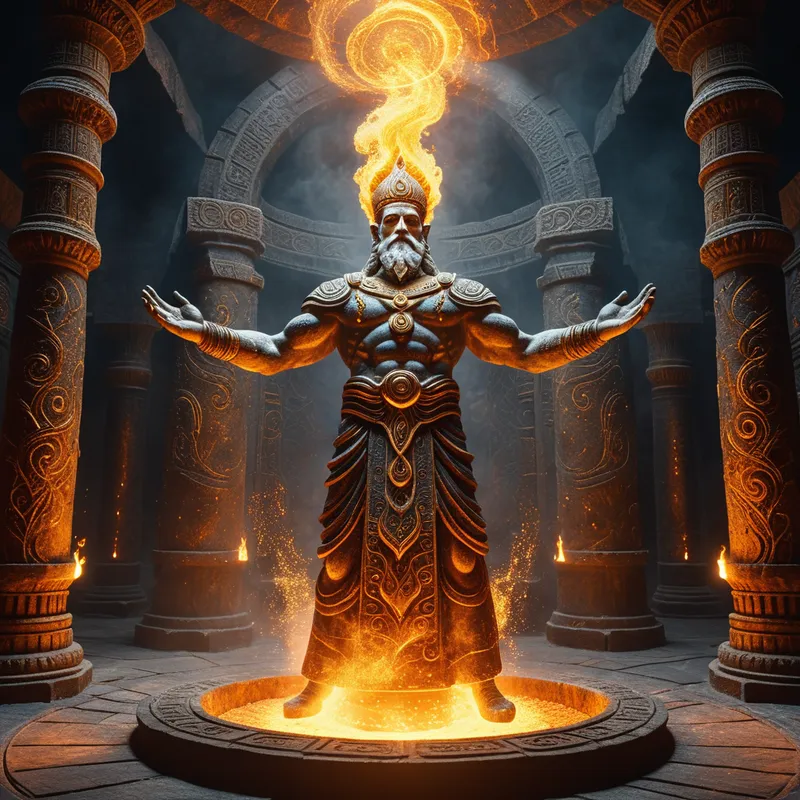
Then came the Athanor. Not a god of forge and hammer, but a deity of absolute, patient heat. His form was not flesh, but the shimmer above a desert dune, the glow at the heart of a kiln, the invisible fire that lives in flint. He found the Massa Confusa weeping in its own darkness. He did not speak of mercy or of healing. He spoke a single word that was not a sound, but a temperature: Burn.
The Mass recoiled, its parts shrieking in dissonant protest. The lead cried it was too heavy to change. The venom hissed it was too sharp to be undone. But [the Athanor](/myths/the-athanor “Myth from Alchemy culture.”/) opened his essence, and the First Fire flowed forth. This was not the wildfire that consumes forests, but the Calcining Fire—deliberate, contained, inescapable.
The Chaotic Mass was drawn into the Athanor’s great stone belly. The fire did not attack, but insisted. It was a relentless, white presence. The Mass’s outer forms—the proud shapes of ore, the gaudy colors of decay, the hard shells of forgotten identities—began to crack. They blackened, not with soot, but with the revelation of their own impurity. A terrible smoke arose, the [Nigredo](/myths/nigredo “Myth from Alchemical culture.”/): the blackening. It was the smoke of fear becoming visible, of lies vaporizing, of every comforting illusion burning away.
The Mass screamed in the language of fracturing stone. It pleaded in the dialect of melting metal. The fire was deaf to all but its own purpose. It burned until the screams became whispers, and the whispers became silence. It burned until the blackened crust fell away in great, ashen flakes, revealing not gold, but a dull, red heat beneath. Still, the fire persisted. It burned the red heat to a searing white. It burned until even color was a memory.
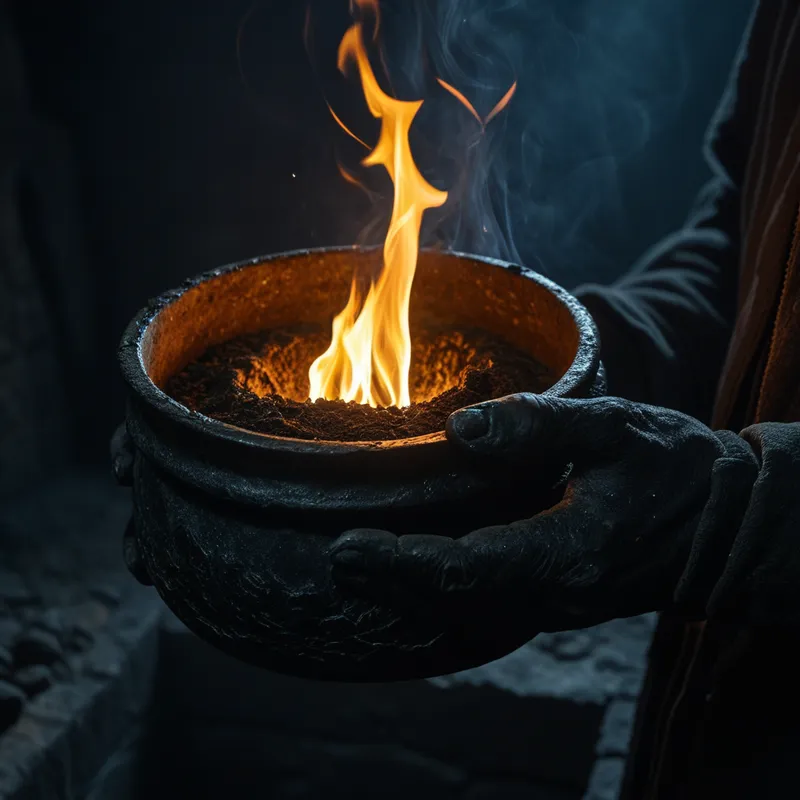
Finally, the fire withdrew. Within the Athanor’s heart, where a groaning chaos had been, there lay only a fine, silent powder. It was white as bone, sterile as salt, light as a ghost. All cohesion was gone. All history was undone. It was not death, for death implies a corpse. This was reduction. The Chaotic Mass was no more. In its place lay the White Ash, the Caput Mortuum that was not an end, but a profound and terrible beginning. The Athanor gazed upon his work, and in the stillness, the first and most necessary truth was spoken: To be something new, you must first cease to be what you are.
Cultural Origins & Context
The myth of The Calcination is not a folktale with a hero’s journey, but a technical revelation wrapped in sacred metaphor. It emerged from the workshops and coded manuscripts of the medieval and Renaissance alchemists of Europe and the Islamic world. These were not mere proto-chemists, but philosopher-artists who saw [the laboratory](/myths/the-laboratory “Myth from Alchemical culture.”/) as an oratory and the furnace as an altar.
The myth was passed down through cryptic texts like the Emerald Tablet, illuminated manuscripts, and oral instruction from master to apprentice. Its telling was often veiled in allegory—descriptions of “burning [the dragon](/myths/the-dragon “Myth from Chinese culture.”/)” or “reducing [the green lion](/myths/the-green-lion “Myth from Alchemical culture.”/) to powder”—to protect its spiritual meaning from both the uninitiated and the scrutiny of religious authorities. Its societal function was dual: it was a practical guide for the physical process of purifying ores and compounds, and a spiritual roadmap for the opus, [the Great Work](/myths/the-great-work “Myth from Alchemical culture.”/) of inner purification. It served as the foundational axiom for anyone seeking transformation, teaching that all true creation is preceded by a necessary, and often terrifying, destruction.
Symbolic Architecture
Psychologically, The [Calcination](/symbols/calcination “Symbol: A spiritual process of purification through intense heat, symbolizing the burning away of impurities to reveal essential truth.”/) represents the inaugural stage of the [individuation process](/symbols/individuation-process “Symbol: The psychological journey toward self-realization and wholeness, integrating conscious and unconscious aspects of personality.”/)—the brutal, non-negotiable confrontation with one’s own Massa Confusa. This is the accumulated psychic [material](/symbols/material “Symbol: Material signifies the tangible aspects of life, often representing physical resources, desires, and the physical world’s influence on our existence.”/): the compulsive behaviors, the inflated self-images, the repressed traumas, and the unexamined assumptions that form the false, yet coherent, sense of self.
The Calcination is the ego’s appointment with a fire that does not hate it, but is utterly indifferent to its pleas for continuity.
The [Athanor](/symbols/athanor “Symbol: An alchemical furnace representing spiritual transformation, purification, and the sustained process of creating the Philosopher’s Stone.”/) symbolizes the contained, purposeful heat of conscious suffering—the willingness to endure the psychological [tension](/symbols/tension “Symbol: A state of mental or emotional strain, often manifesting physically as tightness, pressure, or unease, signaling unresolved conflict or anticipation.”/) of facing one’s shadows without fleeing into [distraction](/symbols/distraction “Symbol: A state of diverted attention from a primary focus, often representing avoidance, fragmentation, or competing priorities in consciousness.”/) or denial. The Nigredo, or blackening, is the descent into depression, [despair](/symbols/despair “Symbol: A profound emotional state of hopelessness and loss, often signaling a need for transformation or surrender to deeper truths.”/), and the “dark [night](/symbols/night “Symbol: Night often symbolizes the unconscious, mystery, and the unknown, representing the realm of dreams and intuition.”/) of the [soul](/symbols/soul “Symbol: The soul represents the essence of a person, encompassing their spirit, identity, and connection to the universe.”/)” that follows when our cherished self-narratives are incinerated. The resulting White Ash is not enlightenment, but the state of psychic humility. It is [the ego](/myths/the-ego “Myth from Jungian culture.”/) reduced to its essential, sterile core, stripped of its identifying dramas and defenses. It is the fertile void, the [tabula rasa](/myths/tabula-rasa “Myth from Alchemical culture.”/), from which authentic being can finally be reconstructed.
The Dreamer’s Resonance
When this myth stirs in the modern unconscious, it manifests in dreams of radical, purifying destruction. One does not dream of gentle renovation, but of houses burning down to their foundations, of bodies being cremated, of cherished possessions dissolving in acid, or of landscapes scoured by a relentless, bleaching sun. The somatic experience is one of fever, of intense heat flushing through the body, or conversely, of a chilling, brittle emptiness—the feeling of being turned to dust.
These dreams signal that a foundational psychological structure has outlived its usefulness and is being metabolically broken down by [the Self](/myths/the-self “Myth from Jungian culture.”/). The dreamer is undergoing a psychic Calcination. The conflict is not against an external monster, but against the internal resistance to this process—the part that screams like the Massa Confusa to be spared the fire. The dream is the Athanor itself, a psychic container forcing a confrontation with what must be burned away so that what is essential can be revealed, not as a shining treasure, but as a blank, open space.
Alchemical Translation
For the modern individual, the myth models the first and most critical law of psychic transmutation: you cannot integrate what you have not first disintegrated. We often seek to “fix” or “improve” our lives by adding new habits, insights, or possessions onto the old, unstable foundation. The Calcination myth ruthlessly corrects this. It states that true change requires a phase change, not an adjustment.
The fire of Calcination asks one devastating question: “What are you willing to lose to become what you are?”
This translates to the conscious, often painful, work of allowing certain aspects of the personality to “die.” It may be the calcining of a long-held grievance that has defined one’s identity as a victim. It may be the burning away of a professional [persona](/myths/persona “Myth from Greek culture.”/) that brings success but suffocates the soul. It is the reduction of a complex relationship to its basic, undeniable truth. The goal is not annihilation for its own sake, but to achieve the state of the White Ash—a state of maximum receptivity and minimum illusion.
From this sterile whiteness, all subsequent alchemical operations—dissolution, coagulation, conjunction—become possible. The Calcination ensures that what is built next arises not from the old, contaminated patterns, but from a core that has been scorched clean by the ruthless, loving fire of truth. It is the myth that grants permission for the necessary death, whispering that the ash in your hands is not the end of your story, but the only substance from which a true one can ever be written.
Associated Symbols
Explore related symbols from the CaleaDream lexicon: