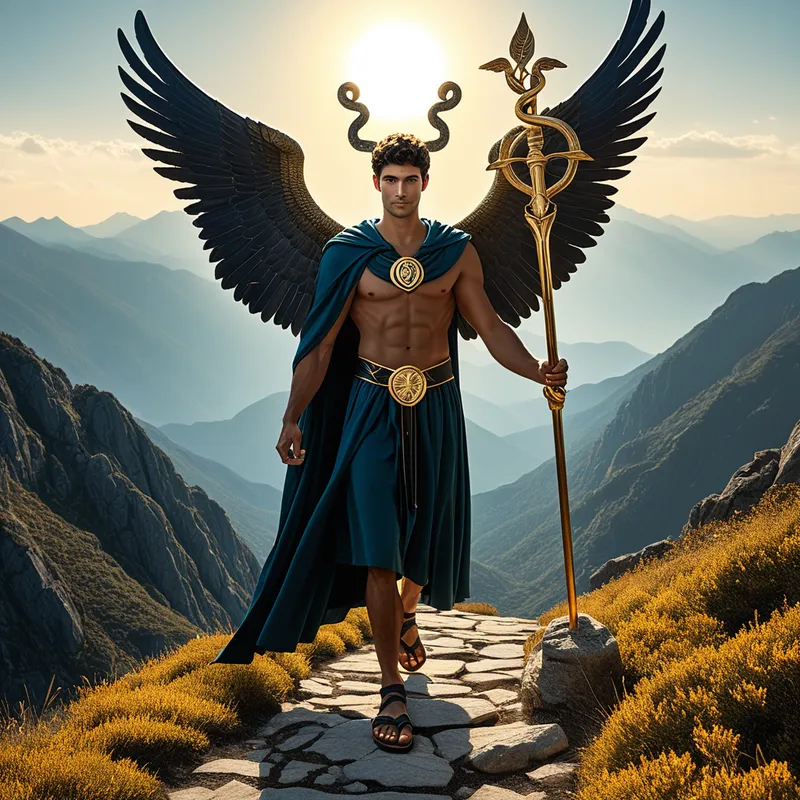
The Caduceus of Hermes Myth Meaning & Symbolism
The messenger god Hermes receives a magical staff that pacifies warring serpents, transforming conflict into a symbol of transcendent unity and healing.
The Tale of The Caduceus of Hermes
Hear now a tale from the shimmering borderlands, where the road of the living meets the path of the dead. In the time when gods walked with the lightness of thought, there was a youth born of cunning and dawn. Hermes, they named him, the fleet-footed one, whose laughter was the sound of the wind in the reeds and whose mind moved faster than the sun’s rays.
From his first breath, he was a thief and a maker, a bringer of dreams and a guide of souls. But his true nature was that of the connector, the one who runs between the high, cold halls of Olympus and the dark, whispering depths of the mortal world. To aid his endless journeys, the great smith Hephaestus, at the behest of Zeus, forged for him a wonder: a rod of the finest gold, slender yet unbreakable. At its crown, a pair of wings, delicate as a sparrow’s but imbued with the power of flight, and at its base, a point to plant firmly in the uncertain earth.
This staff was his sceptre of office, but its true power was yet to be revealed. The revelation came not in a godly court, but on a dusty, sun-baked path far below. Hermes, ever walking, came upon a sight of primal fury. Two great serpents, one dark as a starless midnight, the other gleaming like burnished copper, were locked in a death struggle. Their bodies were a knotted coil of rage, hissing and striking, a vortex of pure opposition that poisoned the very air. It was the battle of polarities made flesh: dark against light, earth against instinct, one force seeking only to annihilate the other.
Hermes did not flee. Nor did he raise a weapon in violence. He felt the discord in his own swift soul. With the intuition of the boundary-walker, he stepped forward and thrust his golden staff directly into the heart of the tumult, into the seething knot where the two adversaries were most fiercely joined.
A silence fell, deeper than any sound. The staff began to hum with a resonant frequency, a note older than conflict. The serpents’ strikes ceased. Their jewel-like eyes, fixed a moment before on mutual destruction, turned instead to the gleaming rod that now separated them. Drawn by a force wiser than hunger or fear, they began to unwind. Not in defeat, but in a slow, deliberate dance. Up the staff they spiraled, their powerful bodies weaving a living lattice around the central axis. They climbed past the winged crown, and there, at the apex, they halted. Their heads faced each other, not to strike, but in a state of alert, mirrored calm. The war was over. In its place was a dynamic, living symbol of reconciled opposition. The Caduceus was born, not from peace, but from the sacred pacification of war.
Cultural Origins & Context
The symbol of the entwined serpents is ancient, predating its specific attachment to Mercury in the classical world. Its roots may tap into Mesopotamian sources, where serpent deities were associated with healing and wisdom. However, within the Greek and later Roman context, the myth became firmly tied to the figure of the divine messenger. This was not a story preserved in a single, canonical text like the Iliad, but rather a pervasive explanatory myth that grew around a pre-existing icon. It was told by poets and philosophers to explain the strange, powerful symbol carried by the god of thresholds.
Its societal function was multifaceted. For the traveler, it was a talisman of safe passage, a sign that the god who could calm primal beasts could also protect from bandits and bad roads. For the merchant, it symbolized the harmonious exchange and negotiation Hermes oversaw. For the city-state, it represented the ideal of diplomacy—the transformation of potential conflict into balanced agreement. The myth taught that true power lies not in taking one side, but in introducing a third, transcendent principle that allows opposites to find a new, cooperative form.
Symbolic Architecture
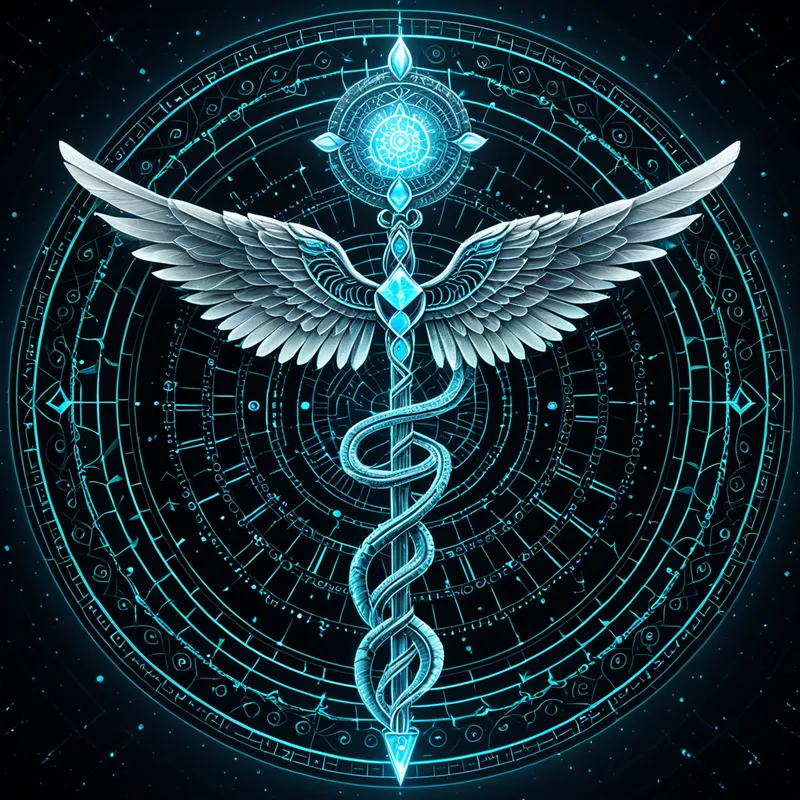
At its core, the Caduceus is a map of consciousness reconciling its own inherent dualities. The staff itself is the axis mundi, the world-axis, representing the spine of the individual or the central, unwavering principle of consciousness. It is the path of the mediating mind.
The staff is not a weapon, but a conductor. It does not destroy one force to elevate the other; it provides a channel through which both can be transformed.
The two serpents are the raw, instinctual polarities of the psyche: conscious and unconscious, light and shadow, reason and instinct, life drive and death drive. Their initial battle represents the inner and outer conflicts that tear the soul apart. Their final, entwined state symbolizes integration. They are not fused into one bland thing; they retain their distinct identities but are now organized around a central, unifying purpose. The wings at the top signify the liberation, the transcendent insight, or the “higher consciousness” that results from this integration. The entire symbol is alchemical, depicting the coniunctio oppositorum—the sacred marriage of opposites that generates something entirely new.
The Dreamer’s Resonance
When the pattern of the Caduceus stirs in the modern dreamscape, it often signals a critical moment of inner mediation. The dreamer may not see the staff itself, but feel its pattern: being torn between two powerful, opposing choices (career paths, relationships, aspects of self); witnessing two animals in conflict that then become calm; or finding oneself in a role of peacemaking in a chaotic dream scenario.
Somatically, this can feel like a tension in the spine—a literal feeling of being “of two minds” pulling the body apart. Psychologically, it marks the process where the ego, which typically identifies with one “side” (the “good” serpent), is being compelled by the Self (the central, Hermetic principle) to acknowledge and engage with its opposite. The dream is an enactment of the psyche’s innate drive toward wholeness, pushing the dreamer to stop the internal civil war and find the “staff” — the core value, perspective, or truth — around which their contradictions can creatively organize.

Alchemical Translation
The myth of the Caduceus provides a precise model for the Jungian process of individuation, or psychic transmutation. The initial state is one of nigredo—the blackening, represented by the chaotic, murderous conflict of the serpents. This is the suffering of inner contradiction, the neurosis, the feeling of being at war with oneself.
Hermes’s act of thrusting the staff into the center is the crucial intervention of the transcendent function. This is not the ego’s effort, but the arrival of a symbolic, mediating third from the deeper Self. It is the moment of insight, the therapeutic interpretation, the creative idea, or the spiritual realization that reframes the entire conflict.
Individuation is not about choosing a side, but about building a capacity to hold the tension of opposites until a new, reconciling symbol emerges from the depths.
The spiraling ascent of the serpents is the albedo (whitening) and citrinitas (yellowing)—the stages of clarification and integration. Opposing traits are consciously examined, related to, and woven into the fabric of the personality. Finally, the winged crown symbolizes the rubedo (reddening)—the attainment of a more complete, liberated state of being. The integrated individual gains the “wings” of broader perspective, moving with the agility of Hermes between realms of thought and feeling, inner and outer, no longer paralyzed by conflict but empowered by a dynamic, internal harmony. The Caduceus thus becomes an internal compass, guiding the modern soul through its own labyrinthine conflicts toward a state of authentic, embodied wholeness.
Associated Symbols
Explore related symbols from the CaleaDream lexicon: