The Buddha's Lotus Position Myth Meaning & Symbolism
The story of Siddhartha's unshakeable posture beneath the Bodhi tree, a mythic image of conquering inner chaos to find absolute stillness and enlightenment.
The Tale of The Buddha’s Lotus Position
[The world](/myths/the-world “Myth from Tarot culture.”/) was heavy. Not with the weight of stone or mountain, but with the thick, clinging substance of suffering—dukkha. It hung in the air like monsoon humidity before the break. In this world walked a prince who had shed his silks, a seeker named [Siddhartha Gautama](/myths/siddhartha-gautama “Myth from Buddhist culture.”/). His quest was not for gold or kingdom, but for an end to the great ache at the heart of all things.
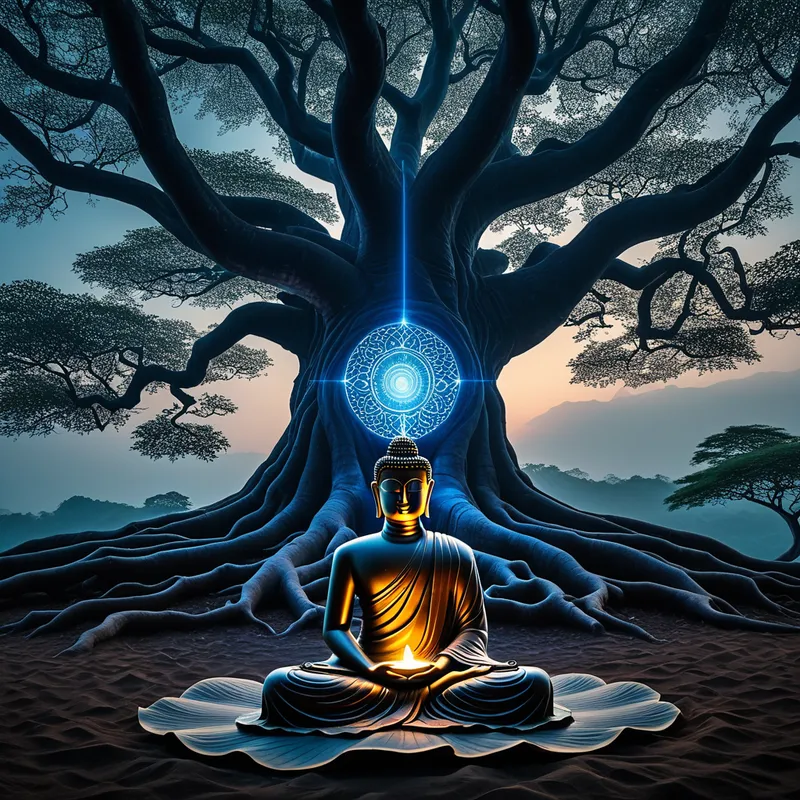
His journey brought him, bone-thin and resolute, to the banks of the Niranjana River. There, beneath the ancient, heart-shaped leaves of a pipal tree, he spread a mat of kusha grass. He folded his legs, right foot upon left thigh, left foot upon right thigh, his spine a straight channel from earth to sky. His hands rested in his lap, a vessel of receptivity. This was not merely sitting; it was the assuming of a throne—the vajrasana, the diamond seat. He made a vow to the very earth: “Though my skin, my nerves, my bones should wither, though my blood should dry up, I will not move from this spot until I have seen the end of birth and death.”
Then, the cosmos tested his posture.
Mara, the Lord of Illusion and Desire, felt the foundations of his realm tremble. A being was about to slip the net. First, Mara sent his army—a horrifying legion of demons, monsters of fear, doubt, and craving. They hurled flaming rocks, loosed torrents of rain and wind, and screamed terrors into the night. The grass around Siddhartha was torn, the great tree thrashed. Yet, [the lotus](/myths/the-lotus “Myth from Hindu culture.”/) position held. The seeker’s posture was a fortress; his stillness, an unmoved mountain. The projectiles turned to flower petals; the storms became a cooling mist.
Enraged, Mara mounted his war elephant and challenged Siddhartha directly. “By what right do you claim this seat of enlightenment?” he thundered. “Your merits are yours alone! Who will bear witness for you?”
In that moment, Siddhartha did not speak. He simply reached down with his right hand and touched [the earth](/myths/the-earth “Myth from Hindu culture.”/). The ground itself roared in response. The Earth Goddess, Vasundhara, emerged, wringing from her hair a torrent of [water](/myths/water “Myth from Chinese culture.”/)—the accumulated merit of Siddhartha’s countless compassionate acts. It was a flood that washed away Mara’s armies and his claims. The witness was not a single being, but the totality of reality he had engaged with fully and selflessly.
With Mara vanquished, the real work began in the profound silence. Through the long night, Siddhartha’s [lotus](/myths/lotus “Myth from Hindu culture.”/) posture became [the crucible](/myths/the-crucible “Myth from Alchemical culture.”/). In that absolute physical stability, his mind turned inward, journeying through all his past lives, seeing the ceaseless chain of cause and effect—pratityasamutpada. He saw the arising of suffering and, at last, the path to its cessation. As dawn’s first light touched the leaves of [the Bodhi tree](/myths/the-bodhi-tree “Myth from Buddhist culture.”/), the [lotus](/myths/lotus “Myth from Hindu culture.”/) was no longer just a posture of the body. It was the flowering of his entire being. Siddhartha was no more. The Buddha had arisen.

Cultural Origins & Context
This myth is the foundational narrative of Buddhism, preserved and elaborated in texts like the Pali Canon and the Lalitavistara [Sutra](/myths/sutra “Myth from Hindu culture.”/). Its origins are not in a distant, impersonal [pantheon](/myths/pantheon “Myth from Roman culture.”/) but in a historical event—or the mythologized memory of one—that occurred in Bodh Gaya, India, around the 5th century BCE. It was passed down orally for centuries by monastic communities ([sangha](/myths/sangha “Myth from Buddhist culture.”/)) before being committed to text.
The story functioned as the ultimate paradigm of spiritual victory. For monks, nuns, and lay followers, it was not just a tale about [the Buddha](/myths/the-buddha “Myth from Buddhist culture.”/); it was a template for their own practice. The lotus position (padmasana) became the supreme asana, the physical echo of [the Buddha](/myths/the-buddha “Myth from Buddhist culture.”/)’s unwavering resolve. The myth served to sacralize the act of meditation itself, transforming a simple cross-legged sit into a re-enactment of the cosmic battle between awakening and ignorance. It provided the faithful with a powerful image of invincibility rooted not in violence, but in profound inner stability and truth.
Symbolic Architecture
The myth is a perfect symbolic map of the [psyche](/myths/psyche “Myth from Greek culture.”/)’s [journey](/symbols/journey “Symbol: A journey in dreams typically signifies adventure, growth, or a significant life transition.”/) from [fragmentation](/symbols/fragmentation “Symbol: The experience of breaking apart, losing cohesion, or being separated into pieces. Often represents disintegration of self, relationships, or reality.”/) to wholeness. Every element is an archetypal coordinate.
The Lotus Position itself is the central [symbol](/symbols/symbol “Symbol: A symbol can represent an idea, concept, or belief, serving as a powerful tool for communication and understanding.”/). The lotus grows from muddy [water](/symbols/water “Symbol: Water symbolizes the subconscious mind, emotions, and the flow of life, representing both cleansing and creation.”/) to [bloom](/symbols/bloom “Symbol: Represents growth, vitality, and the flourishing of potential, often tied to emotional awakening or physical health.”/) immaculate above the surface. The [posture](/symbols/posture “Symbol: Posture in dreams represents one’s stance in life, social presentation, and inner confidence or submission. It reflects how one carries themselves through challenges and relationships.”/), with [feet](/symbols/feet “Symbol: Feet symbolize our foundation, stability, and the way we connect with the world around us, often reflecting our sense of direction and purpose.”/) hidden, represents the rooting of [consciousness](/symbols/consciousness “Symbol: Consciousness represents the state of awareness and perception, encompassing thoughts, feelings, and experiences.”/) in the murky, instinctual [depths](/symbols/depths “Symbol: Represents the subconscious, hidden emotions, or foundational aspects of the self, often linked to primal fears or profound truths.”/) of the unconscious (the mud), while the erect [spine](/symbols/spine “Symbol: The spine symbolizes strength, support, and the foundational structure of one’s life and identity.”/) and calm head signify the flowering of [awareness](/symbols/awareness “Symbol: Conscious perception of self, surroundings, or internal states. Often signifies awakening, insight, or heightened sensitivity.”/) into the [clarity](/symbols/clarity “Symbol: A state of mental transparency and sharp focus, often representing resolution of confusion or attainment of insight.”/) of enlightenment. It is the [integration](/symbols/integration “Symbol: The process of unifying disparate parts of the self or experience into a cohesive whole, often representing psychological wholeness or resolution of internal conflict.”/) of below and above, instinct and [spirit](/symbols/spirit “Symbol: Spirit symbolizes the essence of life, vitality, and the spiritual journey of the individual.”/).
The body in lotus is a living mandala: a stable, centered geometry that contains and orders the chaos of the world.
Mara is not an external devil but the personified totality of the personal and collective [shadow](/symbols/shadow “Symbol: The ‘shadow’ embodies the unconscious, repressed aspects of the self and often represents fears or hidden emotions.”/). His armies are our own neuroses: fear, desire, doubt, pride, and attachment. The [Earth](/symbols/earth “Symbol: The symbol of Earth often represents grounding, stability, and the physical realm, embodying a connection to nature and the innate support it provides.”/) Touch (bhumisparsha [mudra](/symbols/mudra “Symbol: A symbolic hand gesture used in Hindu and Buddhist traditions to channel spiritual energy, express teachings, and focus meditation.”/)) is the pivotal [gesture](/symbols/gesture “Symbol: A non-verbal bodily movement conveying meaning, emotion, or intention, often symbolic in communication and artistic expression.”/). It symbolizes grounding consciousness in [reality](/symbols/reality “Symbol: Reality signifies the state of existence and perception, often reflecting one’s understanding of truth and life experiences.”/), in the tangible, sensory world. It is the [rejection](/symbols/rejection “Symbol: The experience of being refused, excluded, or dismissed by others, often representing fears of inadequacy or social belonging.”/) of spiritual bypassing. Enlightenment is not an escape from the world but a deeper, more responsible [connection](/symbols/connection “Symbol: Connection symbolizes relationships, communication, and bonds among individuals.”/) to it. The [Earth](/symbols/earth “Symbol: The symbol of Earth often represents grounding, stability, and the physical realm, embodying a connection to nature and the innate support it provides.”/) [Goddess](/symbols/goddess “Symbol: The goddess symbolizes feminine power, divinity, and the nurturing aspects of life, embodying creation and wisdom.”/)’s witness affirms that true [authority](/symbols/authority “Symbol: A symbol representing power structures, rules, and control, often reflecting one’s relationship with societal or personal governance.”/) comes from embodied experience and compassionate [action](/symbols/action “Symbol: Action in dreams represents the drive for agency, motivation, and the ability to take control of situations in waking life.”/), not from abstract claims.
The [Bodhi Tree](/symbols/bodhi-tree “Symbol: The sacred fig tree under which Siddhartha Gautama attained enlightenment, symbolizing awakening, wisdom, and the interconnectedness of all life.”/) is the [axis](/symbols/axis “Symbol: A central line or principle around which things revolve, representing stability, orientation, and the fundamental structure of reality or consciousness.”/) mundi, the still point at the center of the turning world. Sitting beneath it, one aligns with the cosmic center.
The Dreamer’s Resonance
When this myth appears in modern dreams, it rarely comes as a literal image of the Buddha. Instead, one may dream of being forced into a seated position during a storm, of feeling an unshakeable calm while chaos erupts around them, or of touching the ground and feeling a surge of solid certainty.
Such dreams often signal a critical phase of individuation. The dreamer is in a “Bodh Gaya” moment—a point of intense psychological pressure where old patterns (Mara’s armies) are launching a final assault to prevent a fundamental shift in consciousness. The somatic feeling in the dream—of being locked in place, yet profoundly secure—points to [the ego](/myths/the-ego “Myth from Jungian culture.”/)’s necessary surrender. It is not a paralysis of fear, but the stability of containment. The psyche is forcing the ego to “sit with” what it has avoided: a truth, a memory, a feeling. The lotus posture in the dream is [the Self](/myths/the-self “Myth from Jungian culture.”/)’s instruction to create a vessel sturdy enough to hold the alchemical process of transformation without fleeing into distraction or dissociation.
Alchemical Translation
For the modern individual, the myth models the alchemy of psychic transmutation in a world of perpetual distraction and fragmentation. The first step is assuming the “posture”—making a conscious, unwavering commitment to face oneself. This is the vow beneath the tree. It is setting the intention for therapy, meditation, or any deep introspective work.
The ensuing “attack of Mara” is the inevitable backlash from the unconscious. As one sits with intention, all that was repressed surges up: anxiety about the future (raga), regrets about the past (dvesha), and a fog of existential uncertainty (avidya). The modern Mara’s armies are emails, notifications, old resentments, and waves of anxiety about productivity and worth.
The alchemical fire is not the dramatic battle, but the sustained, patient heat of remaining present to the contents of one’s own mind without identification or reaction.
The “Earth Touch” is the crucial transmuting agent. It is the act of grounding this process in the body and in concrete reality. It is feeling the breath, sensing the weight of the body on the chair, engaging in simple, physical tasks. It is the recognition that transformation happens not by escaping one’s personal history or environment, but by fully acknowledging it and taking responsibility for one’s place within it. The “witness” that arises is not an external deity, but the emergent, integrated Self—the part of the psyche that can observe the storm without being the storm.
The final “dawn” is not a permanent state of bliss, but the moment of insight (prajna) where a core pattern is seen, understood, and dissolved. The lotus then is the symbol of the individuated Self: rooted in the mud of personal and collective history, yet no longer defined by it; open, balanced, and radiating from a center that cannot be shaken.
Associated Symbols
Explore related symbols from the CaleaDream lexicon: