The Buddha's Footprints Myth Meaning & Symbolism
A sacred myth where the Buddha's physical absence leaves an enduring imprint, guiding seekers toward the path he walked but cannot walk for them.
The Tale of The Buddha’s Footprints
Listen. The story begins not with a presence, but with a departure.
The air was thick with the scent of champaka flowers and the silent weight of a profound farewell. Shakyamuni Buddha had walked among the people for decades, a living embodiment of the path he had found. His voice was the Dharma, his form a compassionate guide. But all conditioned things are impermanent. The time of his final Parinirvana drew near.
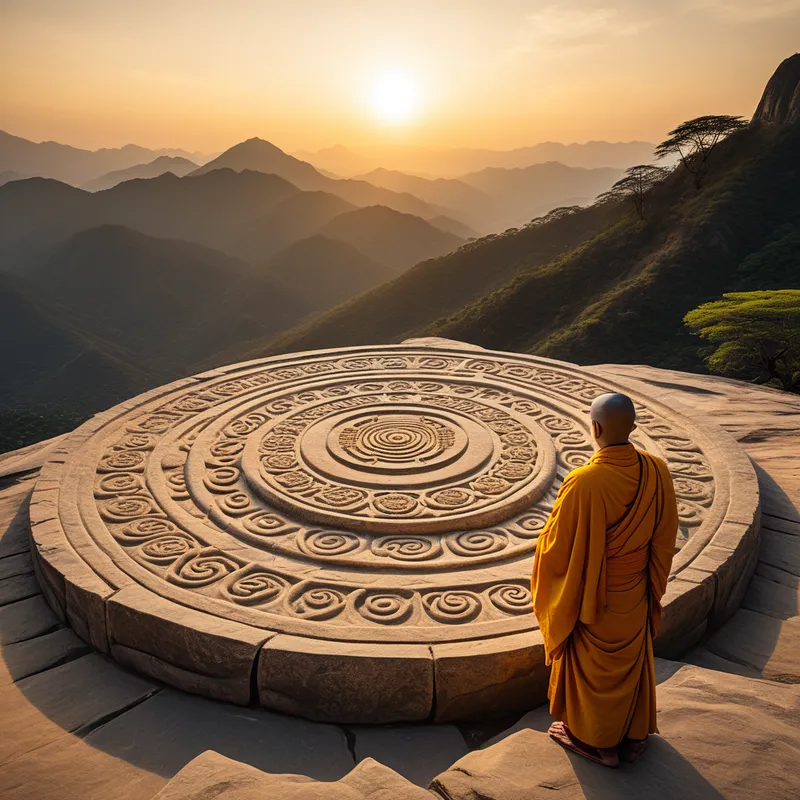
As the story is told, in the moments before his final departure from this world, [the Buddha](/myths/the-buddha “Myth from Buddhist culture.”/) stood upon a great stone at [the summit](/myths/the-summit “Myth from Taoist culture.”/) of Mount Sumanakūta, or upon the banks of the Narmada. He did not speak of grand final doctrines. Instead, he turned, and with a final, compassionate glance at [the world](/myths/the-world “Myth from Tarot culture.”/) of suffering, he pressed his foot into the solid rock. Not with force, but with the natural authority of truth meeting matter.
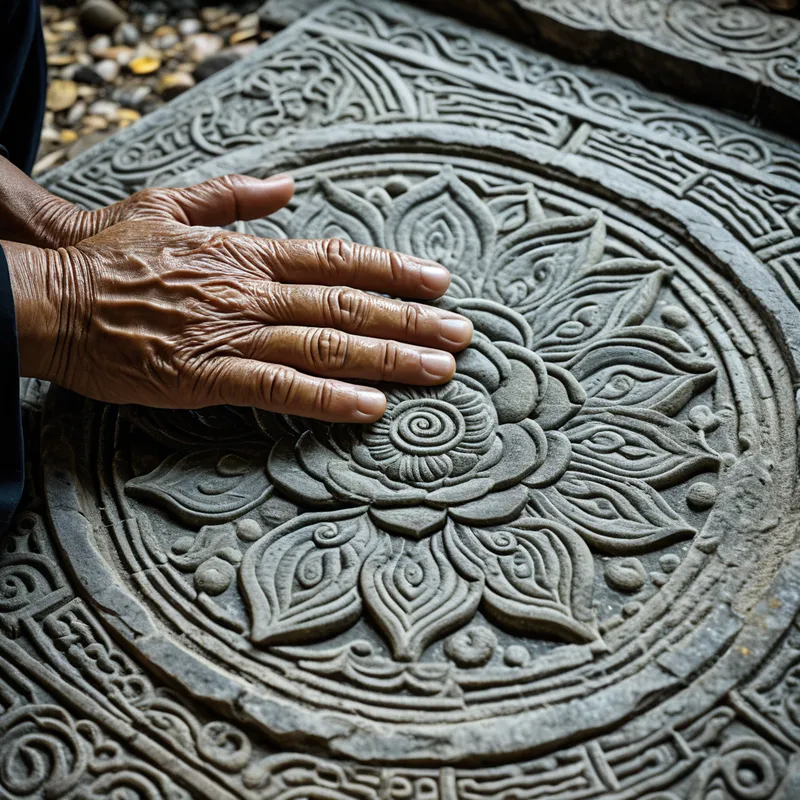
The stone did not crack in protest. It yielded like soft clay, accepting the impression of his sole. Into that impression flowed not just the shape of a foot, but the entire cosmos of his realization. The 108 auspicious marks manifested: the Dharmacakra, the wheel of teaching, spun at the center of the heel. The radiant [lotus](/myths/lotus “Myth from Hindu culture.”/), symbol of purity rising from mud, bloomed upon the ball of the foot. The svastika, the hook of compassion, the conch of the Dharma’s sound—all appeared, etched by no human hand.
Then, he was gone. The physical teacher departed. But he left behind this silent sermon in stone. Where his body would not remain to be venerated, his footprint remained. It was a bridge. Pilgrims would come, for centuries untold, to stand where he last stood. They would not see him, but they would see where he had been. They would pour [water](/myths/water “Myth from Chinese culture.”/) into the print, an offering that filled the shape of his absence, and drink of it, taking his path into their very bodies. The footprint did not speak, but it said everything: Walk here. This is [the way](/myths/the-way “Myth from Taoist culture.”/). I have gone before you, but the path is under your own feet.
Cultural Origins & Context
The veneration of the Buddha’s footprints, or Buddhapada, is an ancient tradition spanning the Theravada and Mahayana Buddhist worlds, from India and Sri [Lanka](/myths/lanka “Myth from Hindu culture.”/) to Thailand, Laos, and Japan. It emerged from a profound theological and devotional need. Early Buddhism discouraged iconic representation of the Buddha himself. How, then, to honor the absent Teacher? How to make tangible a philosophy that culminates in formlessness?
The footprint became the perfect aniconic symbol. It pointed to the Buddha without confining him to an idol. It represented his historical passage through the world—his “footprint” on [the sands of time](/myths/the-sands-of-time “Myth from Greek culture.”/)—while simultaneously symbolizing the path (magga) he prescribed. These were not merely memorials; they were maps and guides. Often placed at symbolic crossroads, mountain summits, or riverbanks, they marked not just where the Buddha had been, but where the seeker’s own journey must continue. The intricate symbols within the prints served as a visual catechism, encoding the core teachings for illiterate and learned alike. They were objects of pilgrimage, yes, but more importantly, they were objects of contemplation, a focal point for realizing that the goal is not to find the Buddha out there, but to follow the path he revealed, which leads in here.
Symbolic Architecture
The myth of the footprints is an elegant [paradox](/symbols/paradox “Symbol: A contradictory yet true concept that challenges logic and perception, often representing unresolved tensions or profound truths.”/) built on the twin pillars of [Presence](/symbols/presence “Symbol: Presence in dreams often signifies awareness or acknowledgment of something significant in one’s life.”/) and [Absence](/symbols/absence “Symbol: The state of something missing, void, or not present. Often signifies loss, potential, or existential questioning.”/). The [footprint](/symbols/footprint “Symbol: A footprint symbolizes a journey, the impact of one’s actions, and the legacy left behind.”/) is the shape of what is not there. It is a negative [space](/symbols/space “Symbol: Dreaming of ‘Space’ often symbolizes the vastness of potential, personal freedom, or feelings of isolation and exploration in one’s life.”/) that defines a positive [path](/symbols/path “Symbol: The ‘path’ symbolizes a journey, choices, and the direction one’s life is taking, often representing individual growth and exploration.”/).
The most profound guidance is often found in the shape of a wise absence. The teacher points the way, then steps aside, leaving only the impression of the path in the substance of your world.
Psychologically, the footprint represents the archetypal imprint. It is the lasting [mark](/symbols/mark “Symbol: A ‘mark’ often symbolizes identity, achievement, or a defining characteristic in dreams.”/) left by a transformative encounter, a [moment](/symbols/moment “Symbol: The symbol of a ‘moment’ embodies the significance of transient experiences that encapsulate emotional depth or pivotal transformations in life.”/) of [insight](/symbols/insight “Symbol: A sudden, deep understanding of a complex situation or truth, often arriving unexpectedly and illuminating hidden connections.”/), or a guiding influence that has since departed—a [parent](/symbols/parent “Symbol: The symbol of a parent often represents authority, nurturing, and protection, reflecting one’s inner relationship with figures of authority or their own parental figures.”/), a mentor, an experience of [truth](/symbols/truth “Symbol: Truth represents authenticity, honesty, and the quest for knowledge beyond mere appearances.”/). The [Buddha](/symbols/buddha “Symbol: The image of Buddha embodies spiritual enlightenment, peace, and a quest for inner truth.”/)’s physical [body](/symbols/body “Symbol: The body in dreams often symbolizes the dreamer’s self-identity, personal health, and the relationship they have with their physical existence.”/) is gone (Absence), but the [structure](/symbols/structure “Symbol: Structure in dreams often symbolizes stability, organization, and the framework of one’s life, reflecting how one perceives their environment and personal life.”/), the [pattern](/symbols/pattern “Symbol: A ‘Pattern’ in dreams often signifies the underlying structure of experiences and thoughts, representing both order and the repetitiveness of life’s situations.”/), the “way” of his awakening remains imprinted on [reality](/symbols/reality “Symbol: Reality signifies the state of existence and perception, often reflecting one’s understanding of truth and life experiences.”/) (Presence). The 108 marks are the detailed [architecture](/symbols/architecture “Symbol: Architecture in dreams often signifies structure, stability, and the framing of personal identity or life’s journey.”/) of an enlightened [consciousness](/symbols/consciousness “Symbol: Consciousness represents the state of awareness and perception, encompassing thoughts, feelings, and experiences.”/), a [blueprint](/symbols/blueprint “Symbol: A blueprint represents the foundational plan or design for something, often symbolizing potential, structure, and the mapping of one’s inner self or future.”/) of the [psyche](/myths/psyche “Myth from Greek culture.”/) that has achieved [integration](/symbols/integration “Symbol: The process of unifying disparate parts of the self or experience into a cohesive whole, often representing psychological wholeness or resolution of internal conflict.”/). The [Nirvana](/symbols/nirvana “Symbol: A state of ultimate liberation, enlightenment, and cessation of suffering, representing the end of the spiritual journey.”/) he attained is not depicted; instead, the tools and landmarks for reaching it are cataloged on the sole.
The act of [the pilgrim](/myths/the-pilgrim “Myth from Christian culture.”/) [pouring water](/symbols/pouring-water “Symbol: Pouring water often represents the flow of emotions, cleansing, or the release of pent-up feelings.”/) into the print is deeply alchemical. The [water](/symbols/water “Symbol: Water symbolizes the subconscious mind, emotions, and the flow of life, representing both cleansing and creation.”/)—fluid, [life](/symbols/life “Symbol: The symbol of ‘Life’ represents a journey of growth, interconnectedness, and existential meaning, encompassing both the joys and challenges that define human experience.”/)-giving, reflective—represents [the pilgrim](/myths/the-pilgrim “Myth from Christian culture.”/)’s own mind and life. By pouring it into the sacred form, they symbolically pour their own subjective experience into the objective, timeless pattern of wisdom. They seek to mold their chaotic, flowing consciousness into the enlightened form left behind.
The Dreamer’s Resonance
When this myth stirs in the modern unconscious, it often manifests in dreams of finding a path or a guide that is no longer physically present. One might dream of discovering a set of luminous footprints on a beach, only to have them vanish under the next wave. Or of standing before a door marked with a familiar, comforting symbol, but the person who owned that symbol is gone. The dreamer is left with the imprint, the instruction manual, but not the instructor.
Somatically, this can feel like a poignant ache of guidance-longing mixed with the sobering thrill of responsibility. It is the psyche working through the necessary death of external authority. The dream signals a transition: the phase of looking outward for a savior is ending. The blueprint has been received. Now, the much harder, more intimate work of building according to that blueprint must begin. The dream of the footprint is an invitation to stop searching for the foot that made it, and to instead place your own foot within its outline and start walking.

Alchemical Translation
The alchemical process modeled here is the transmutation of dependence into embodied wisdom. In the individuation journey, we all encounter figures—therapists, teachers, authors, ideals—who serve as temporary Buddhas. They show us the path out of our suffering. The crucial, often painful, stage comes when we must internalize the teaching and let the teacher go. If we cling to the physical or psychological presence of the guide, we remain eternal pilgrims at a footprint, never embarking on our own journey.
The final gift of the true master is their deliberate absence, forcing the student to incarnate the teaching within their own being.
The “footprint” is the internalized structure. It is the disciplined daily practice, the ethical framework, the cognitive pattern we have learned. The myth instructs us to venerate the imprint, not by mere worship, but by enactment. The alchemical work is to pour the mercurial waters of our own lived experience—our emotions, relationships, failures, and triumphs—into that sacred mold. We are not trying to become the Buddha; we are trying to walk so precisely in his footsteps that the path becomes our own, and eventually, we leave it to find our unique ground. The footprint is [the crucible](/myths/the-crucible “Myth from Alchemical culture.”/) where the lead of our seeking is transformed into the gold of our own authentic journey. The absence of the Buddha is not a void; it is the very space required for our own awakening to occur.
Associated Symbols
Explore related symbols from the CaleaDream lexicon: