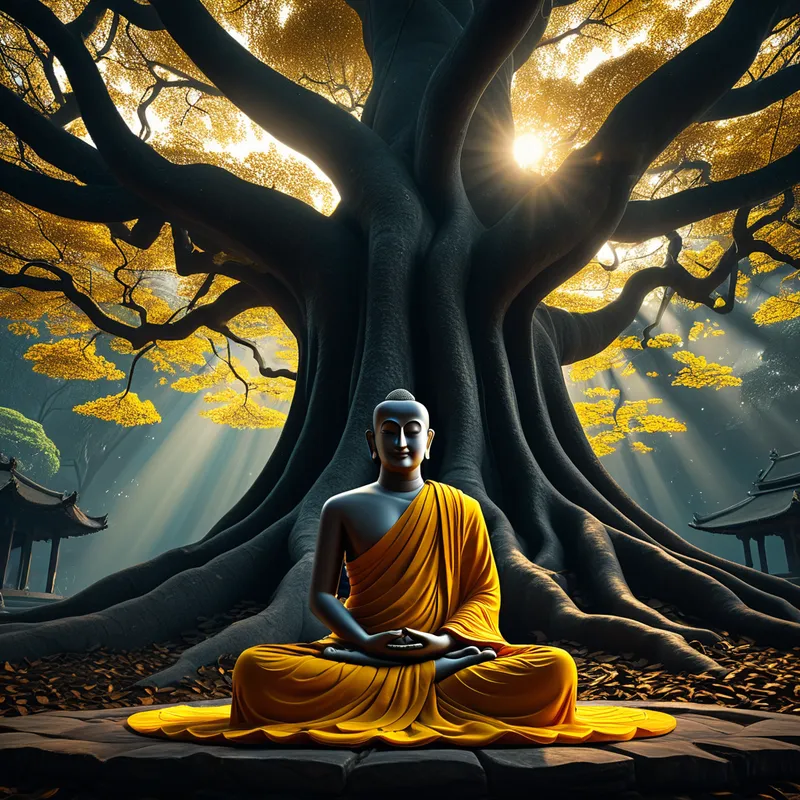
The Buddha's Enlightenment Myth Meaning & Symbolism
A prince abandons his throne, confronts cosmic forces of desire and fear, and awakens to the true nature of reality beneath a sacred tree.
The Tale of The Buddha’s Enlightenment
[The world](/myths/the-world “Myth from Tarot culture.”/) was heavy with sleep. In the kingdom of Kapilavastu, a prince named Siddhartha stirred from a dream of palaces and perfumes. A deep, unanswerable ache had taken root in his heart, a thorn of knowing amidst the roses of his privilege. He had seen the specters that haunt all flesh: age, sickness, death. The echo of a holy man’s peace was the only answer. So, in the dead of night, he left it all—the silken sheets, the adoring wife, the infant son, the destiny of a crown—and walked into the ragged cloak of the forest.
For six years, he walked the path of the ascetics. He sat by rivers whose names he forgot, his body becoming a map of bones, his breath a thin thread in [the wind](/myths/the-wind “Myth from Various culture.”/). He mastered meditations that stilled the ripples on a pond, yet the ocean of suffering within remained tumultuous. Realizing the futility of extremes, he accepted a simple meal of milk-rice from a village woman named Sujata. Strength returned, not as brute force, but as a steady, unwavering resolve. He came to the bank of the Nairañjanā River, bathed, and then walked to the foot of a mighty Bodhi Tree. He spread a mat of kusha grass, sat facing east, and made a vow that shook the foundations of the cosmos: “Though only my skin, sinews, and bones remain, and my blood and flesh dry up and wither away, I will not stir from this seat until I have attained the supreme and final wisdom.”
[The earth](/myths/the-earth “Myth from Hindu culture.”/) itself became his witness. As dusk fell, the final assault began. Mara, the lord of illusion and desire, the keeper of the wheel of death and rebirth, rose in fury. This was not a monster of scales and fire, but the master of the mind’s own theater. First, he sent his beautiful daughters, Desire, Discontent, and Lust, to dance with promises of sensual delight. Siddhartha’s concentration was a mountain; their allure broke against it like mist. Enraged, Mara summoned his army—a horrific host of demons, monsters, and wrathful deities. They hurled mountains of flaming rock, loosed torrents of boiling blood, and screamed with the voices of a thousand fears. Yet every weapon turned into a shower of flowers upon touching the sphere of the meditator’s compassion.
Defeated in open combat, Mara made his final, insidious claim. “By what right do you seek this seat of enlightenment? Who is your witness?” The demon pointed to his vast army, each soldier shouting testimony for their lord. Silently, Siddhartha reached down and touched the earth with the fingertips of his right hand. “This solid earth,” he said, “is my witness.” The goddess Bhūmi emerged from the ground, and with a great tremor, she wrung a torrent of [water](/myths/water “Myth from Chinese culture.”/) from her hair—[the flood](/myths/the-flood “Myth from Biblical culture.”/) of [the Buddha](/myths/the-buddha “Myth from Buddhist culture.”/)’s countless acts of virtue over lifetimes. Mara and his legions were swept away.
Alone in the profound silence of the conquered night, Siddhartha turned his attention inward. Through the three watches of the night, his insight deepened. He saw his own countless past lives, the endless cycle of [samsara](/myths/samsara “Myth from Buddhist culture.”/). He perceived [the law](/myths/the-law “Myth from Biblical culture.”/) of paticca-samuppada, how suffering arises and how it ceases. Finally, as [the morning star](/myths/the-morning-star “Myth from Astrological culture.”/) glittered in the pre-dawn sky, his mind pierced the last veil. He understood suffering, its origin, its cessation, and the path to its end. Ignorance was uprooted. Knowledge arose. Light dawned. He was awake. The Buddha had come into the world.

Cultural Origins & Context
This narrative is the foundational myth of Buddhism, emerging from the Pali Canon several centuries after the historical event, which scholars place around the 5th century BCE in the Gangetic plain of India. It was not a single author’s creation but a story woven by the early [Sangha](/myths/sangha “Myth from Buddhist culture.”/), passed down orally for generations before being committed to text. Its primary function was paradigmatic: to establish the authority of the Buddha as a world-transcending figure and to provide a template for the spiritual journey. The tale served as a powerful didactic tool, illustrating that enlightenment is not a divine gift but the result of unimaginable human effort, a conquest of the inner world that mirrors and surpasses any external battle. It anchored the Buddhist community in the awe-inspiring reality of their founder’s achievement, making the seemingly impossible goal of [Nirvana](/myths/nirvana “Myth from Buddhist culture.”/) tangibly real through epic symbolism.
Symbolic Architecture
The myth is a perfect map of the [psyche](/myths/psyche “Myth from Greek culture.”/)’s [journey](/symbols/journey “Symbol: A journey in dreams typically signifies adventure, growth, or a significant life transition.”/) from identification with the personal to realization of the transcendental. Siddhartha represents [the ego](/myths/the-ego “Myth from Jungian culture.”/)-[consciousness](/symbols/consciousness “Symbol: Consciousness represents the state of awareness and perception, encompassing thoughts, feelings, and experiences.”/), initially trapped in the [palace](/symbols/palace “Symbol: A palace symbolizes grandeur, authority, and the pursuit of one’s ambitions or dreams, often embodying a desire for stability and wealth.”/) of conditioned existence—the world of sensory pleasure, social [role](/symbols/role “Symbol: The concept of ‘role’ in dreams often reflects one’s identity or how individuals perceive their place within various social structures.”/), and inherited [identity](/symbols/identity “Symbol: Identity represents the sense of self, encompassing personal beliefs, cultural background, and social roles.”/). His [departure](/symbols/departure “Symbol: A transition from one state to another, often representing change, growth, or leaving behind the familiar.”/) is the necessary [rupture](/symbols/rupture “Symbol: A sudden break or tear in continuity, often representing abrupt change, separation, or the shattering of established patterns.”/), [the ego](/myths/the-ego “Myth from Jungian culture.”/)’s painful but vital [decision](/symbols/decision “Symbol: A decision in a dream reflects the choices one faces in waking life and can symbolize the pursuit of clarity and resolution.”/) to seek meaning beyond the [persona](/symbols/persona “Symbol: The social mask or outward identity one presents to the world, often concealing the true self.”/).
The Bodhi Tree is not merely a location; it is the Axis Mundi, the still point of the turning world, where the seeker becomes the center of the universe.
[The ascetic](/myths/the-ascetic “Myth from Christian culture.”/) years symbolize the ego’s struggle with the super-ego, the harsh, puritanical voice that believes [truth](/symbols/truth “Symbol: Truth represents authenticity, honesty, and the quest for knowledge beyond mere appearances.”/) must be purchased with suffering. Sujata’s offering represents the [integration](/symbols/integration “Symbol: The process of unifying disparate parts of the self or experience into a cohesive whole, often representing psychological wholeness or resolution of internal conflict.”/) of [the middle way](/myths/the-middle-way “Myth from Buddhist culture.”/), the [rejection](/symbols/rejection “Symbol: The experience of being refused, excluded, or dismissed by others, often representing fears of inadequacy or social belonging.”/) of all one-sidedness, and the [acceptance](/symbols/acceptance “Symbol: The experience of being welcomed, approved, or integrated into a group or situation, often involving validation of one’s identity or actions.”/) of nourishing grace. Then comes the confrontation with Mara, who is the ultimate [symbol](/symbols/symbol “Symbol: A symbol can represent an idea, concept, or belief, serving as a powerful tool for communication and understanding.”/) of the psyche’s own [resistance](/symbols/resistance “Symbol: An object or tool representing opposition, struggle, or the act of pushing back against external forces or internal changes.”/). Mara is not an external devil but the totality of the unconscious—our repressed desires (his daughters), our projected fears and aggressions (his army), and our deepest sense of existential inadequacy (“Who is your witness?”). The defeat of Mara is the [dissolution](/symbols/dissolution “Symbol: The process of breaking down, dispersing, or losing form, often representing transformation, release, or the end of a state of being.”/) of the ego’s belief that it is the author of its own being. The touch of the [earth](/symbols/earth “Symbol: The symbol of Earth often represents grounding, stability, and the physical realm, embodying a connection to nature and the innate support it provides.”/) is the supreme [gesture](/symbols/gesture “Symbol: A non-verbal bodily movement conveying meaning, emotion, or intention, often symbolic in communication and artistic expression.”/) of grounding, of calling upon the deep, impersonal [truth](/symbols/truth “Symbol: Truth represents authenticity, honesty, and the quest for knowledge beyond mere appearances.”/) of one’s own authentic experience, beyond narrative and justification.
The Dreamer’s Resonance
When this myth stirs in modern dreams, it signals a profound crisis and potential turning point in the individuation process. One may dream of being relentlessly pursued by shadowy figures (Mara’s army) in a corporate office or a childhood home. One may dream of finding a serene, unshakeable spot in the midst of chaotic urban decay (the seat under [the Bodhi Tree](/myths/the-bodhi-tree “Myth from Buddhist culture.”/)). The dreamer is not literally becoming the Buddha but is encountering the archetype of awakening within their own psyche.
Somatically, this can feel like a period of intense anxiety or “dark night of the soul,” often preceding a breakthrough. Psychologically, it is the process where the conscious mind, having exhausted its known strategies, sits in unwavering commitment to a deeper truth. The dream figures of temptation and terror are personifications of psychic complexes—addictive patterns, inherited traumas, and core fears—making their final, desperate bid for control. To dream of this myth is to be in [the crucible](/myths/the-crucible “Myth from Alchemical culture.”/) where the old self-structure is being dismantled so a more authentic consciousness can be born.

Alchemical Translation
The alchemy here is the transmutation of leaden, suffering-bound consciousness into the gold of liberating wisdom. The process follows the classic stages: [Nigredo](/myths/nigredo “Myth from Alchemical culture.”/) (the blackening) is Siddhartha’s confrontation with sickness, old age, and death, and his subsequent ascetic despair—the dissolution of worldly identity. Albedo (the whitening) is the cleansing acceptance of the middle way and the firm resolve under the Bodhi Tree—a purification of intention.
Enlightenment is not an acquisition of something new, but the recognition of what has always been present, once the obscuring clouds of personal narrative are dispelled.
The battle with Mara is the Citrinitas (the yellowing), the fierce engagement with the soul’s shadows, where the light of consciousness struggles to differentiate itself from the contents of the unconscious. The final awakening at dawn is the [Rubedo](/myths/rubedo “Myth from Alchemical culture.”/) (the reddening), the culmination where the philosopher’s stone is realized. This stone is not an object, but a state of being: the integrated Self that has faced and included the totality of the psyche. For the modern individual, this models the journey from being a victim of one’s history and impulses (the palace, the army) to becoming the sovereign witness of one’s own experience (the awakened one). It teaches that liberation is found not by fleeing the world or [the self](/myths/the-self “Myth from Jungian culture.”/), but by sitting utterly still at the very center of the storm, touching the ground of one’s own being, and allowing the illusory self to be seen through, until only reality remains.
Associated Symbols
Explore related symbols from the CaleaDream lexicon: