The Buddha under the Bodhi Tree Myth Meaning & Symbolism
A prince renounces his throne, faces the armies of illusion, and awakens to the nature of reality beneath a sacred fig tree.
The Tale of The Buddha under the Bodhi Tree
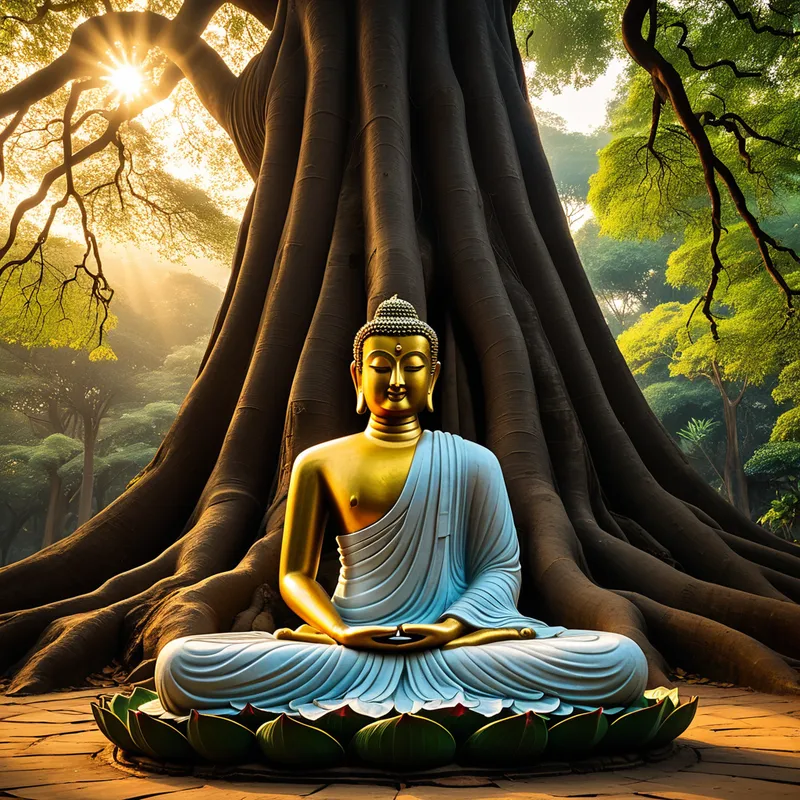
[The world](/myths/the-world “Myth from Tarot culture.”/) held its breath. For six years, the prince who had forsaken his palaces had wandered, a hollowed-out vessel seeking a truth that would not break. His name was [Siddhartha Gautama](/myths/siddhartha-gautama “Myth from Buddhist culture.”/), and his quest had brought him to the banks of the Niranjana River, to a place of quiet earth. Exhaustion was a stone in his belly, but a deeper resolve, diamond-hard, had settled in his bones. He accepted a simple offering of milk-rice from a village woman, Sujata, and his body, long tormented by ascetic extremes, remembered its strength.
He walked to a grove, and there it stood: an ancient Bodhi Tree, its heart-shaped leaves whispering secrets to [the wind](/myths/the-wind “Myth from Various culture.”/). He spread a mat of kusha grass at its base, facing east. A vow crystallized in the air around him, unspoken yet absolute: “Though my skin, my nerves, and my bones should wither, though my life’s blood dry up, I will not move from this seat until I have attained the supreme and final wisdom.”
[The earth](/myths/the-earth “Myth from Hindu culture.”/) trembled in witness.
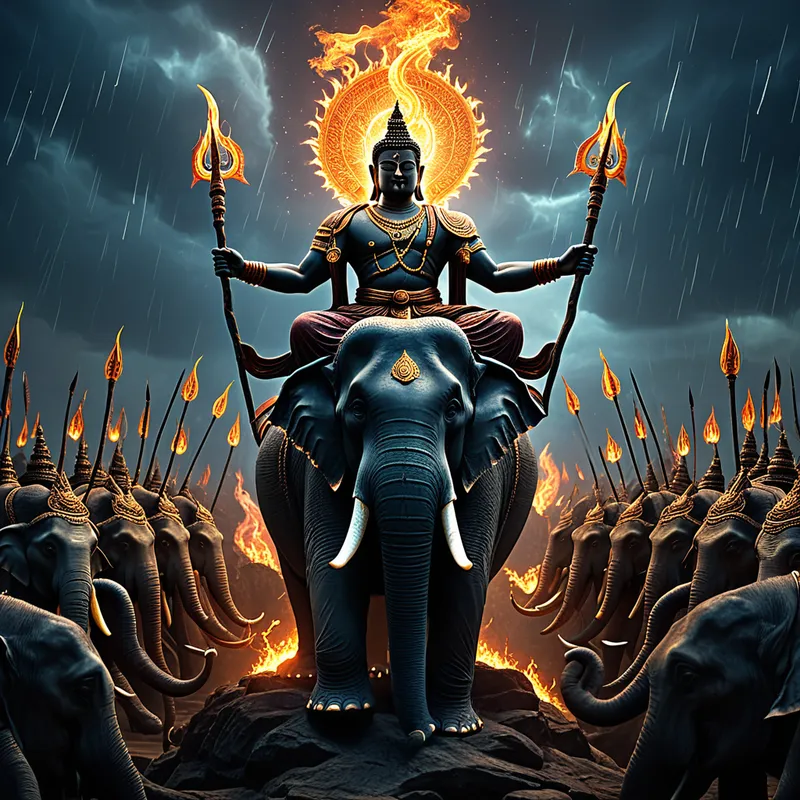
Then came the assault. Not of men, but of the mind’s own phantoms. Mara, the Lord of Illusion, the great Deceiver, felt his domain threatened. He came first with his army—a horrific legion of demons, monsters of fear, doubt, and craving. They hurled mountains of flaming rock, loosed torrents of boiling blood, and shrieked with the voices of a thousand forgotten nightmares. The missiles turned to flower petals as they touched the sphere of Siddhartha’s unwavering mindfulness.
Enraged, Mara mounted his great war elephant, Girimekhala, and challenged the seated figure directly. “By what right do you claim this seat of enlightenment? Who will bear witness to your merit?”
Siddhartha did not raise his voice. He slowly reached down and touched the earth with the fingertips of his right hand. “This solid earth,” he said, “has witnessed my countless lifetimes of generosity, patience, and virtue. Let her be my witness.”
The earth goddess, Sthavara, emerged, wringing from her hair a torrent of [water](/myths/water “Myth from Chinese culture.”/) from the sacred rivers, a flood that washed away Mara’s spectral armies. Defeated, Mara retreated.
Alone now, in the profound silence that follows a great storm, Siddhartha turned his attention inward. Through the long watch of the night, his consciousness pierced the veils of existence. He saw, with terrifying and liberating clarity, the endless cycle of his own past lives. He perceived [the law](/myths/the-law “Myth from Biblical culture.”/) of [karma](/myths/karma “Myth from Hindu culture.”/), the ceaseless chain of cause and effect. Finally, as [the morning star](/myths/the-morning-star “Myth from Astrological culture.”/) glittered in the pre-dawn sky, he understood the root of suffering and the path to its cessation. Ignorance was shattered. He was awake. He was the Buddha.
Cultural Origins & Context
This narrative is the foundational myth of Buddhism, emerging from the historical context of 5th-6th century BCE North India, a time of intense philosophical and ascetic [ferment](/myths/ferment “Myth from Alchemical culture.”/). It was not initially written but orally transmitted by the monastic community, the [Sangha](/myths/sangha “Myth from Buddhist culture.”/), as part of the canonical texts known as the Sutta Pitaka. Its primary function was paradigmatic: to establish the authority of [the Buddha](/myths/the-buddha “Myth from Buddhist culture.”/)’s teaching by dramatizing the ultimate validation of direct experience over scriptural or ritual authority. It served as a template for the spiritual journey, a map showing that enlightenment is not a gift but a hard-won achievement, possible only after confronting and mastering the totality of one’s inner world. The story was recounted to inspire renunciants, to provide a symbolic structure for meditation, and to embed the core doctrine of [the Middle Way](/myths/the-middle-way “Myth from Buddhist culture.”/)—between sensual indulgence and self-mortification—into the heart of the tradition.
Symbolic Architecture
The myth is a perfect [mandala](/symbols/mandala “Symbol: A sacred geometric circle representing wholeness, the cosmos, and the journey toward spiritual integration.”/) of psychological transformation. The [Bodhi Tree](/symbols/bodhi-tree “Symbol: The sacred fig tree under which Siddhartha Gautama attained enlightenment, symbolizing awakening, wisdom, and the interconnectedness of all life.”/) is the [axis](/symbols/axis “Symbol: A central line or principle around which things revolve, representing stability, orientation, and the fundamental structure of reality or consciousness.”/) mundi, the world pillar where [heaven](/symbols/heaven “Symbol: A symbolic journey toward ultimate fulfillment, spiritual transcendence, or connection with the divine, often representing life’s highest aspirations.”/) and [earth](/symbols/earth “Symbol: The symbol of Earth often represents grounding, stability, and the physical realm, embodying a connection to nature and the innate support it provides.”/), the conscious and unconscious, meet. It represents the grounded, embodied seat of [consciousness](/symbols/consciousness “Symbol: Consciousness represents the state of awareness and perception, encompassing thoughts, feelings, and experiences.”/) itself.
The true battle is never against the world, but for the sovereignty of attention within it.
Siddhartha’s “seat of awakening” is the immutable core of [the Self](/myths/the-self “Myth from Jungian culture.”/), the observing consciousness that can witness all phenomena without being identified with them. Mara is not an external devil but the personified totality of the [psyche](/myths/psyche “Myth from Greek culture.”/)’s [resistance](/symbols/resistance “Symbol: An object or tool representing opposition, struggle, or the act of pushing back against external forces or internal changes.”/) to transformation—our addictive patterns, our deepest fears, our narcissistic narratives, and the sheer inertia of the known. His armies are the somatic and emotional manifestations of this resistance: [anxiety](/symbols/anxiety “Symbol: Anxiety in dreams reflects internal conflicts, fears of the unknown, or stress from waking life, often demonstrating the subconscious mind’s struggle for peace.”/), craving, pride, and existential doubt. The “touching of the earth” is the critical symbolic act. It represents the [hero](/symbols/hero “Symbol: A hero embodies strength, courage, and the ability to overcome significant challenges.”/)’s grounding in [reality](/symbols/reality “Symbol: Reality signifies the state of existence and perception, often reflecting one’s understanding of truth and life experiences.”/), his appeal to the [testimony](/symbols/testimony “Symbol: A formal statement of truth, often given under oath, representing personal truth, accountability, and the act of bearing witness.”/) of lived experience and embodied [truth](/symbols/truth “Symbol: Truth represents authenticity, honesty, and the quest for knowledge beyond mere appearances.”/) over the airy claims of the inflated ego or abstract dogma. It is the [moment](/symbols/moment “Symbol: The symbol of a ‘moment’ embodies the significance of transient experiences that encapsulate emotional depth or pivotal transformations in life.”/) the individual [psyche](/myths/psyche “Myth from Greek culture.”/) aligns itself with the objective [reality](/symbols/reality “Symbol: Reality signifies the state of existence and perception, often reflecting one’s understanding of truth and life experiences.”/) of the [cosmos](/symbols/cosmos “Symbol: The entire universe as an ordered, harmonious system, often representing the totality of existence, spiritual connection, and the unknown.”/).
The Dreamer’s Resonance
When this myth stirs in the modern dreamer, it signals a profound interior crossroads. To dream of sitting steadfast while chaos erupts—be it in a storm, a warzone, or a crumbling building—points to a nascent capacity for witnessing. The dream ego is learning to hold space for intense psychic material without being consumed by it. Dreams of being assailed by shadowy figures or seductive temptations while trying to focus on a central task mirror Mara’s assault. Somatic sensations in the dream—a feeling of immense weight, of being pinned, or conversely, a sudden, solid calm—often correlate with the “earth-touching” moment. This dream pattern suggests the psyche is engaged in a critical process of dis-identification: separating the sense of “I” from the passing content of thoughts and emotions, a prerequisite for any deep psychological integration.

Alchemical Translation
The alchemical process modeled here is the opus contra naturam—the work against the ingrained nature of the psyche. [The prima materia](/myths/the-prima-materia “Myth from Alchemical culture.”/) is the distracted, suffering human mind, identified with its cravings and aversions. The first stages—the renunciation of the palace (comfortable illusions) and the failed extreme of asceticism (self-punishment)—represent the necessary failures that teach the Middle Way.
Enlightenment is not the acquisition of light, but the dissolution of everything that obscures it. The alchemical fire is unwavering attention.
The vigil under the tree is the supreme operation of meditatio and [separatio](/myths/separatio “Myth from Alchemical culture.”/). The practitioner, like [the alchemist](/myths/the-alchemist “Myth from Various culture.”/) at [the athanor](/myths/the-athanor “Myth from Alchemy culture.”/), must maintain a consistent, gentle heat (mindfulness) to separate the subtle from the coarse. Mara’s assaults are the boiling off of impurities: volatile emotions, fixed ideas, and psychic complexes that rise to the surface when the heat of sustained awareness is applied. The “earth witness” is the culmination, the [rubedo](/myths/rubedo “Myth from Alchemical culture.”/) or reddening, where the Self is grounded in its own indestructible reality, no longer projected onto external roles, possessions, or opinions. The dawn realization is the production of the [lapis philosophorum](/myths/lapis-philosophorum “Myth from Alchemical culture.”/), the philosopher’s stone—which in psychological terms is the integrated, awakened consciousness, capable of transforming the base lead of suffering into the gold of liberating wisdom. For the modern individual, this translates to the daily, moment-to-moment practice of returning to the “seat,” of touching the earth of present-moment reality, and refusing to be drafted into the armies of Mara that live within our own reactive minds.
Associated Symbols
Explore related symbols from the CaleaDream lexicon: