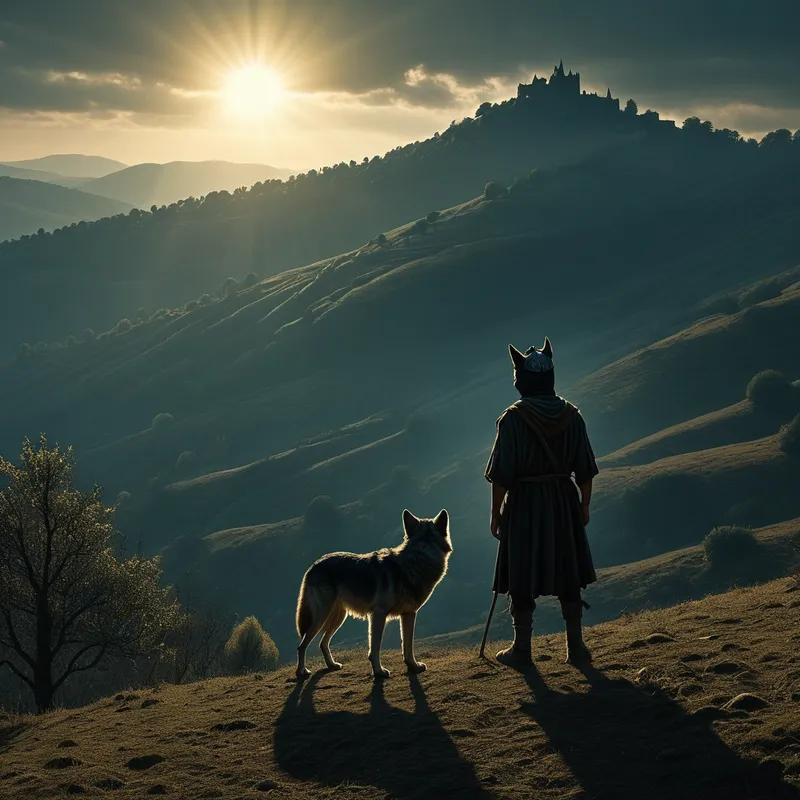
The Boy Who Cried Wolf Myth Meaning & Symbolism
A shepherd boy's lies for amusement erode communal trust, leaving him defenseless when a real predator arrives, a parable of integrity's sacred currency.
The Tale of The Boy Who Cried Wolf
Hear now a tale from the rolling, green-breasted hills, where [the wind](/myths/the-wind “Myth from Various culture.”/) carries the scent of [thyme](/myths/thyme “Myth from Greek culture.”/) and the lonely sound of a bell. There was a boy, given the sacred charge of the flock. His world was the wide sky, the patient sheep like clouds grazing [the earth](/myths/the-earth “Myth from Hindu culture.”/), and the long, slow river of the day. But the boy’s spirit was not made for such solemn stillness. Boredom, that sly serpent, coiled in his heart.
One afternoon, as the sun hung heavy, a wicked idea bloomed. He filled his lungs with the hill air and cried out, not in song, but in manufactured terror: “Wolf! Wolf! The wolf is among the sheep!”
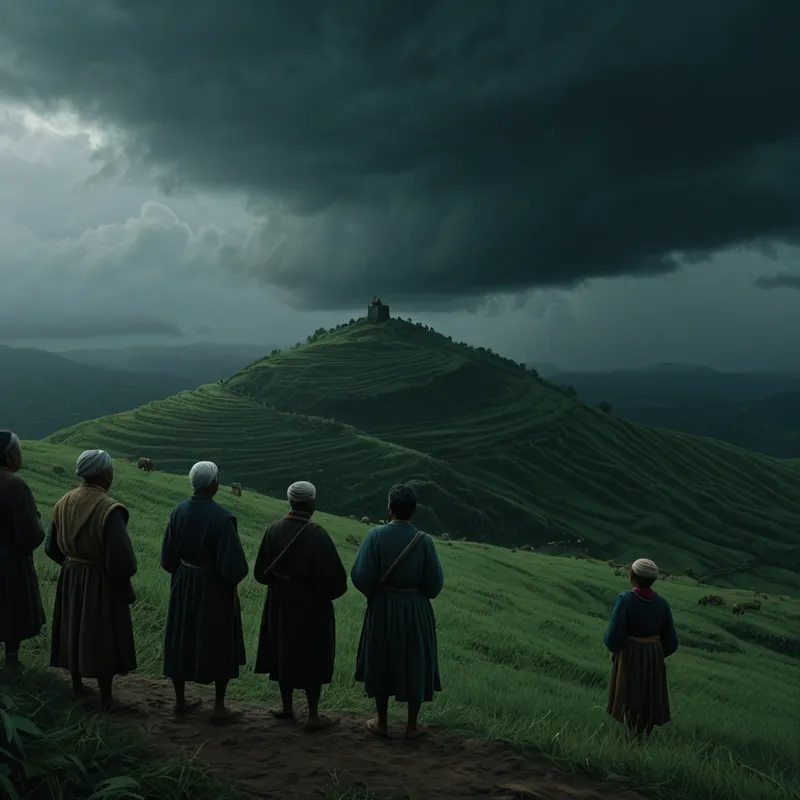
From the valley below, a clamor arose. The village—the blacksmith with his hammer, the baker with flour-dusted arms, the weaver with her shuttle—all dropped their sacred tasks. They came running, hearts pounding with the ancient duty of protection, tools becoming weapons in their strong hands. They found the boy, not in peril, but shaking with laughter beside his peaceful flock. “It was only sport,” he said, his eyes bright with mischief. The villagers’ faces, first flushed with effort, then cooled with confusion, finally settled into hard lines of displeasure. They returned to their valley in a silent, reproachful line.
The serpent of boredom, fed by the thrill of disruption, grew. Again, when the shadows grew long, the boy raised the false alarm. “Wolf! Wolf!” Once more, the communal heart of the village was pierced. Once more, they charged up the hill, their breath ragged with urgency. And once more, they were met with the boy’s gleeful deceit. This time, no words were wasted. Their looks were stones. The trust, that invisible thread that binds the shepherd to the village, had been frayed to a single, fragile strand.
Then came the day the wind changed. A true shadow fell across the flock—a shadow with yellow eyes and a silent, lethal grace. The wolf was real. Terror, pure and cold, seized the boy’s throat. He screamed with the entirety of his being, “WOLF! WOLF! Please! He is here!”
His cry echoed over the hills. In the valley, the villagers heard it. The blacksmith paused at his forge, the baker listened by her oven. They looked at one another, and in their eyes was the memory of the lie. They heard the desperation, but they could no longer distinguish its truth from the echo of falsehood they had already housed in their spirits. They shook their heads. “He will not make fools of us again,” they murmured, and returned to their work.
On the hill, under the indifferent sky, the boy learned the final, terrible meaning of his cry. Alone.
Cultural Origins & Context
This stark parable originates not from a single author, but from the collective hearth of European folk wisdom, most famously codified in Aesop’s Fables. Its tellers were not court bards, but grandparents, nurses, and elders—the custodians of social glue. It was told not in grand halls, but in cottages and by firesides, a tool as practical as a spoon.
Its primary function was didactic, aimed squarely at the young. In pre-industrial communities where survival depended on reliable communication and mutual aid—whether watching flocks, bringing in harvests, or defending walls—the integrity of one’s word was not a moral abstraction but a matter of life and death. The tale served as a psychic inoculation, a memorable narrative vaccine against the poison of frivolous deceit. It taught that belonging to the social body came with the solemn responsibility of truthful speech, for the community’s ears, once calloused by falsehood, may become deaf to genuine need.
Symbolic Architecture
Beneath its simple surface, the myth constructs a profound [architecture](/symbols/architecture “Symbol: Architecture in dreams often signifies structure, stability, and the framing of personal identity or life’s journey.”/) of symbolic meaning. The Boy represents the immature ego, the part of the [psyche](/myths/psyche “Myth from Greek culture.”/) that has not yet integrated its social [responsibility](/symbols/responsibility “Symbol: Responsibility in dreams often signifies the weight of duties and the expectations placed upon the dreamer.”/). He is pure potential, charged with a duty (the Flock) but seduced by the thrill of chaotic power.
The lie is not merely a false statement; it is a spell cast upon reality, attempting to reshape the world for a moment’s amusement. But reality is a stubborn medium, and the spell always rebounds upon the caster.
The [Wolf](/symbols/wolf “Symbol: Wolves in dreams symbolize instinct, intelligence, freedom, and a deep connection to the wilderness and primal instincts.”/) is the ultimate [symbol](/symbols/symbol “Symbol: A symbol can represent an idea, concept, or belief, serving as a powerful tool for communication and understanding.”/) of the denied real. It is the consequence that patiently waits in the [forest](/symbols/forest “Symbol: The forest symbolizes a complex domain of the unconscious mind, representing both mystery and potential for personal growth.”/) of the unconscious until the defenses of credibility are utterly depleted. It is not evil; it is amoral, natural law. The Villagers symbolize the ego’s [reality](/symbols/reality “Symbol: Reality signifies the state of existence and perception, often reflecting one’s understanding of truth and life experiences.”/) principle and the [social contract](/symbols/social-contract “Symbol: An implicit agreement among individuals to cooperate for social benefits, sacrificing some personal freedoms for societal order and protection.”/). Their gradual withdrawal is not cruelty, but the psyche’s necessary [defense](/symbols/defense “Symbol: A protective mechanism or barrier against perceived threats, representing boundaries, security, and resistance to external or internal challenges.”/) against the [toxin](/symbols/toxin “Symbol: A substance that causes harm or death to living organisms, often representing internal or external poisons affecting the body, mind, or spirit.”/) of unreliability. When the inner [truth](/symbols/truth “Symbol: Truth represents authenticity, honesty, and the quest for knowledge beyond mere appearances.”/)-teller is corrupted, the entire internal [system](/symbols/system “Symbol: A system represents structure, organization, and interrelated components functioning together, often reflecting personal or social order.”/) must quarantine it to survive, even if it means sacrificing a part of itself.
The Dreamer’s Resonance
When this myth pattern erupts in modern dreams, it signals a critical moment of psychic accountability. You may dream of screaming warnings to deaf ears, of pressing a silent alarm button, or of your voice producing only hollow echoes. Somatically, this often accompanies a tightness in the throat—the Vishuddha chakra constricting.
Psychologically, you are likely living out a scenario where you have, perhaps unconsciously, “cried wolf.” This isn’t necessarily about overt lies. It can manifest as habitual exaggeration, constant complaints without action, perpetual crisis-mongering, or using urgent demands to manipulate attention. The dream is the psyche’s stark revelation: your credibility reservoir is empty. The internal “villagers”—your self-trust, your discipline, your supportive inner figures—are no longer heeding your calls. The dream forces a confrontation with the shadow aspect of the Jester—not the life-giving humorist, but the destructive, credibility-burning trickster.
Alchemical Translation
The alchemical process modeled here is the transmutation of the Puer (the eternal, irresponsible boy) into a figure of grounded integrity. It is the individuation journey of [the word](/myths/the-word “Myth from Biblical culture.”/).
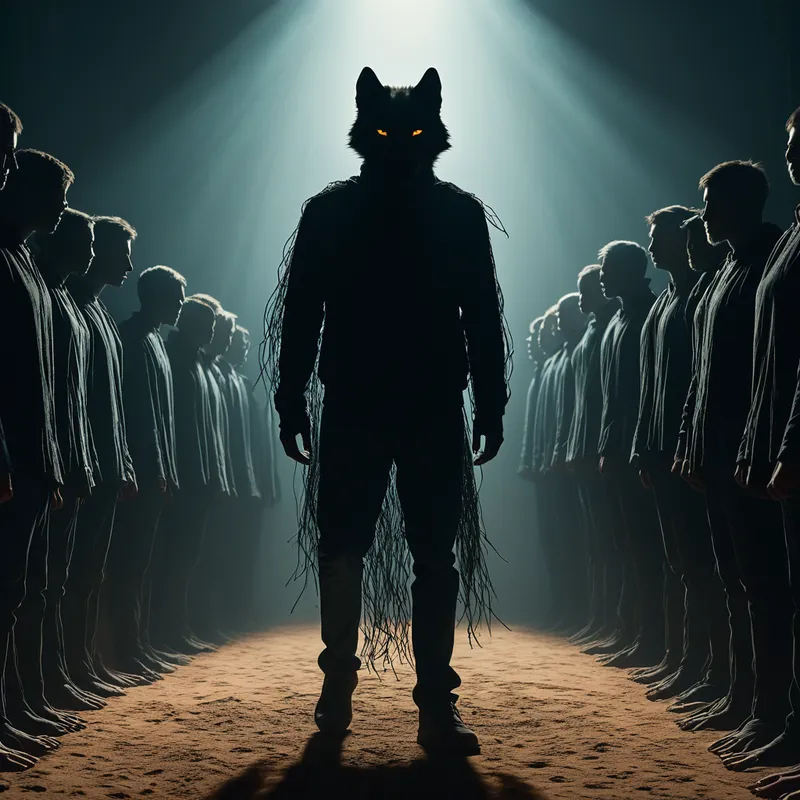
The initial state is [Nigredo](/myths/nigredo “Myth from Alchemical culture.”/), the blackening. The boy’s lies are the base lead of the personality—the selfish, reality-denying impulse. The first two false alarms represent failed, incomplete operations that only produce the ash of distrust. The arrival of the real wolf is the crucial Mortificatio, the death of the old mode. The boy’s ego, built on the shaky ground of deceptive control, is utterly devoured by the consequences he invoked.
The true wolf is not the predator from the forest, but the full, embodied realization of one’s own carelessness. It is the moment the joke ceases to be funny, forever.
From this dissolution, however, arises the possibility of Albedo, the whitening. The myth ends at the crisis point, but the alchemical translation demands we imagine what follows. To survive—psychically or literally—the boy must be reborn. He must integrate the wolf. This means accepting the predatory truth of cause and effect into his own being. He must become the shepherd who speaks only when the threat is real, whose voice is therefore one with the protective function itself. His word becomes gold, not because it is always heard, but because it is always true. The transformed individual no longer cries wolf; they have learned to see in the dark, to sense the true shadow before it strikes, and to speak with a voice that carries the weight of a life lived in accord with the real. The jester’s frivolous magic is transmuted into the sage’s discerning silence and timely speech.
Associated Symbols
Explore related symbols from the CaleaDream lexicon: