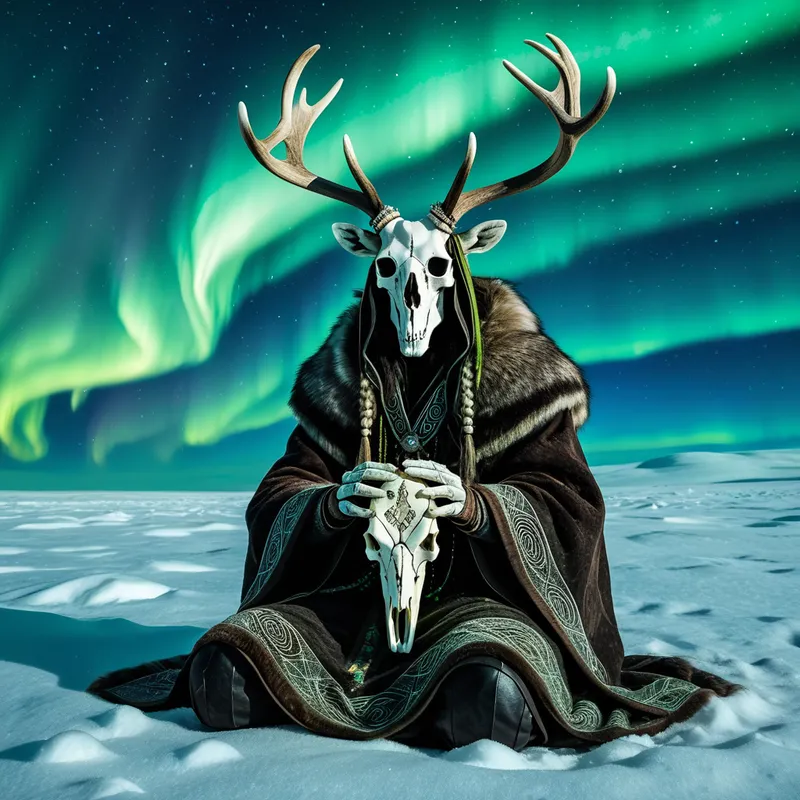
The Bone Diviner Myth Meaning & Symbolism
A mythic figure who reads the future and the soul's truth in the scattered bones of the dead, revealing the hidden architecture of fate.
The Tale of The Bone Diviner
Listen. The wind does not just blow across the tundra; it carries the whispers of those who walked here when the ice was young. In the time when animals were people and people were dreams in the mind of the earth, there was one who listened to a deeper silence. They were called Isan’ti, the One Who Hears the Bones.
The world was sick. The caribou herds had turned away, their trails vanishing into mist. The children grew quiet, their laughter stolen by a creeping cold that lived in the marrow. The people huddled in their chum, and the drum songs of the healers fell flat, their rhythms unanswered by the spirits.
Isan’ti walked away from the circle of firelight, into the embrace of the long blue twilight. For three days and three nights, they walked, following the trail of a great white wolf that was both there and not there. They came to a high, barren place, a ovo built by forgotten hands. Here, the wolf turned, its eyes twin pools of obsidian, and vanished.
Alone under the wheeling stars, Isan’ti felt the hunger and the cold as a single, sharp truth. They built no fire. Instead, they took from their pouch the bones of a ptarmigan, a fox, and a lemming—creatures who had given their lives so the seer might live. With a breath that steamed in the frozen air, they cast the bones upon the flat stone of the ovo.
The bones did not lie still. They chattered like teeth, skittering and turning until they formed a pattern—a pattern that was a map, a story, and a wound all at once. It showed the broken connection. But to mend it required a deeper truth, a more terrible listening.
Isan’ti knew what was asked. They took the flint knife and, with a song of gratitude and sorrow, performed the ancient rite. They laid bare their own forearm, carefully separating muscle from bone. There, in the relentless cold, they held their own radiant bones to the starlight. The pain was a fire that burned away all but essence. They cast their own bones among those of the creatures.
In that moment, the world held its breath. The scattered bones—the animal, the human—leaped from the stone as if alive. They danced in the air, a swirling constellation of ivory and shadow, clicking and singing a song of the unity of all life. They showed Isan’ti the vision: the caribou were not lost, but waiting at the place where three rivers wept, held back by the shadow of a broken taboo. The pattern revealed the forgotten word, the name of the river spirit that needed to be sung.
When the bones fell back to the stone, they were whole again, and Isan’ti’s arm was healed, marked only by a spiraling scar white as birch bark. They returned to the people, their eyes holding the new pattern of the world. They led the camp to the three rivers, sang the recovered name, and the great herd flowed over the land once more, a river of life itself. Isan’ti became the bridge, the one who could read the sacred text written in the skeleton of the world.
Cultural Origins & Context
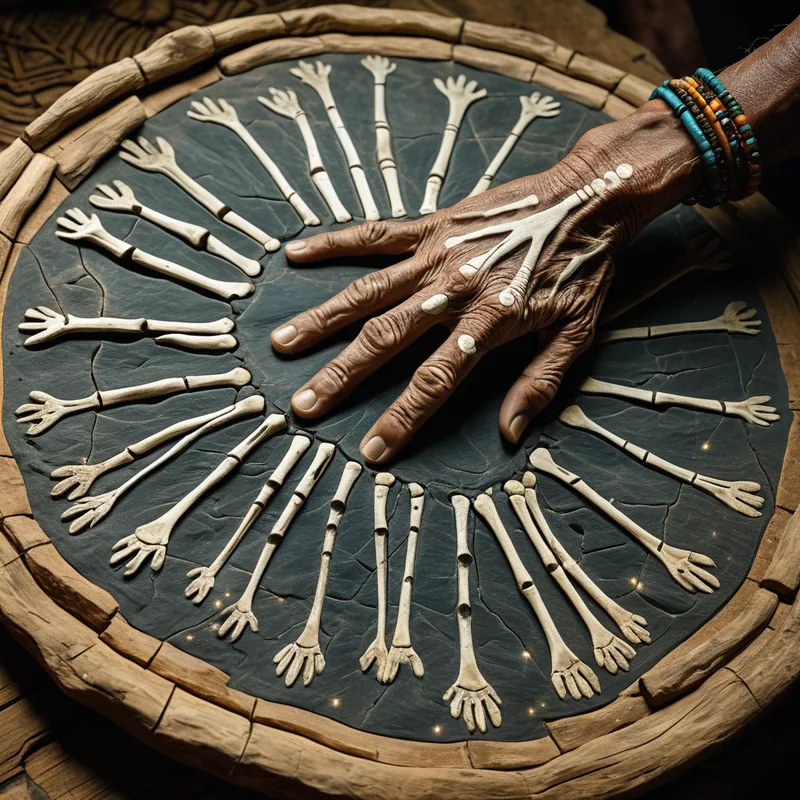
The motif of the Bone Diviner is not the property of a single tribe, but a profound archetype woven through the shamanic traditions of Siberia, Mongolia, and parts of North America. It belongs to the shamanic complex, where the world is seen as an interconnected web of visible and invisible relationships. This myth was not “told” in the manner of a Greek epic around a fire; it was enacted. It was the underlying narrative of the divination ritual itself.
Elders and shamans would pass down the technique—the preparation of the ritual space, the selection and consecration of the bones (often from the shoulder blades of caribou, reindeer, or sheep, a practice known as scapulimancy), the songs to invite the spirits, and the trance state necessary to see. The “story” of Isan’ti was the mythic template that gave the ritual its power and meaning. It served a critical societal function: in times of crisis—famine, illness, conflict—the community’s fate was literally thrown upon the hide. The random fall of the bones was interpreted not as chance, but as the direct language of the spirit world, revealing the hidden causes of imbalance and the path to restoration. It was a technology of meaning, transforming chaos (scattered bones) into cosmos (a readable order).
Symbolic Architecture
At its core, the myth is a map of the psyche’s deepest structures. The bones are the ultimate symbol of what remains when all that is transient—flesh, emotion, identity—has fallen away. They are the hidden, enduring architecture.
The bone is the soul’s blueprint, the immutable pattern beneath the flesh of circumstance.
The act of divination is thus an act of profound re-membering. To scatter the bones is to deconstruct a situation or a soul into its fundamental components. To read them is to perceive the hidden pattern, the anima mundi or world-soul, that connects these components. The self-sacrifice of Isan’ti is the pivotal psychological moment. It represents the utter dissolution of the ego (the personal flesh) required to perceive the objective, transpersonal pattern (the universal skeleton). The pain of the ordeal is the pain of consciousness confronting its own foundational structures, a necessary mortificatio or dying to the old self.
The healed arm with the spiraling scar signifies the integration of this knowledge. The seer is now marked by the pattern they have seen; their very body bears the inscription of the cosmic order. They are no longer just a person, but a living conduit of the pattern-language of reality.
The Dreamer’s Resonance
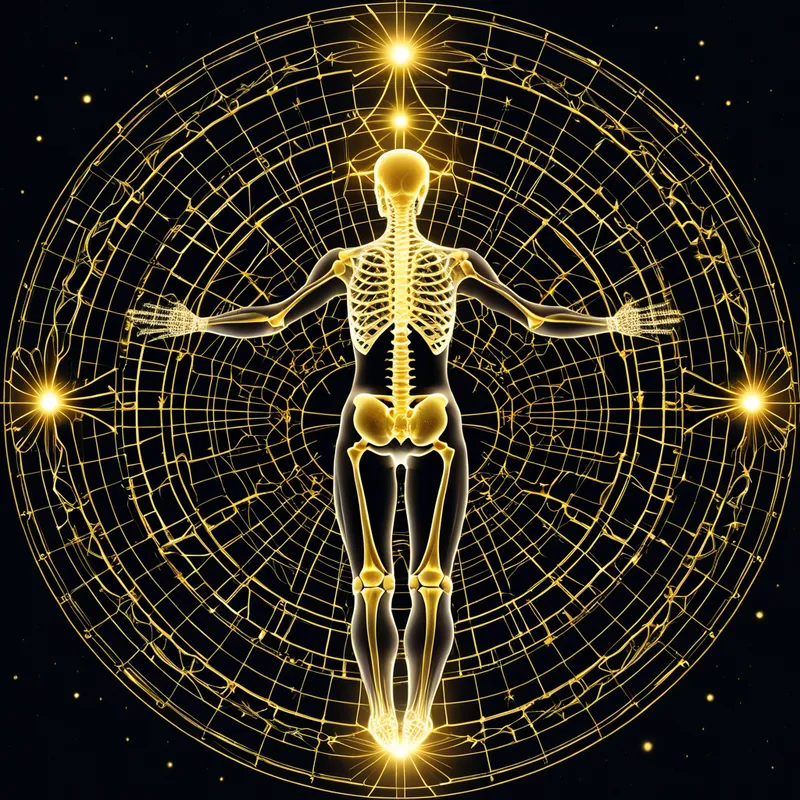
When this myth stirs in the modern dreamer, it often manifests in periods of profound deconstruction or existential crisis. Dreams of finding bones in a basement, sorting through skeletal remains, or seeing the world stripped down to its wireframe architecture are its calling cards.
Somatically, one might feel a literal ache in the bones, a sense of being “stripped to the bone” by life’s demands, or a chilling clarity that feels both ruthless and true. Psychologically, this is the process of the psyche breaking down a complex life situation—a relationship, a career, an identity—into its core components. The dream-ego is being forced to confront the “bare bones” of the matter: What are the non-negotiable truths? What structures (habits, beliefs, commitments) actually support my life, and which are merely decorative flesh that has rotted away? It is a terrifying but necessary process of analysis that precedes any possibility of authentic reconstruction.

Alchemical Translation
The journey of the Bone Diviner is a perfect allegory for the Jungian process of individuation. It models the alchemical solve et coagula: dissolve and coagulate.
First, the solve: the conscious personality (the camp, the known world) is in crisis. The adaptive ego’s solutions fail. This forces a journey into the unconscious (the barren plateau). There, one must willingly deconstruct the very fabric of one’s identity—cast the bones of one’s assumptions, history, and self-image. This is the sacrificial phase, the offering of one’s own “arm” (one’s capacity to act in the old way) to the cold light of truth.
The future is not foretold in the bones; it is remembered. Divination is the recollection of a pattern that already exists, hidden within the scattered fragments of the present.
Then, the miraculous coagula: from the chaotic scatter, a new, more encompassing pattern emerges. This is the transcendent function, the symbol that unites the opposites. The bones dance, revealing the hidden order. For the modern individual, this is the moment of insight where seemingly disconnected life events, traumas, and talents suddenly click into a coherent narrative. One sees the “pattern in one’s madness,” the destiny written not in stars, but in the very architecture of one’s soul.
The return is integration. The healed scar is the conscious acknowledgment and embodiment of this new pattern. One does not just have an insight; one becomes the insight. The individual becomes a “diviner” for their own life, able to read the hidden connections in their daily experiences, understanding that the chaos of the moment is merely bones waiting to be thrown, awaiting the perceiving consciousness that can re-member them into a meaningful whole. One becomes the author and interpreter of one’s own sacred text, written in the enduring bone-language of the Self.
Associated Symbols
Explore related symbols from the CaleaDream lexicon: