The Bonds of Prometheus Myth Meaning & Symbolism
The Titan who stole fire for humanity is chained to a rock, his liver devoured daily by an eagle, for defying the tyrannical order of Zeus.
The Tale of The Bonds of Prometheus
Hear now the tale of the bound one, the forethinker, he who saw what was to come and dared to act. In the age after the Titans fell, when the thunder of Zeus ruled the new order, humanity shivered in the dark. They were feeble things, living in caves, eating raw flesh, their minds clouded and their spirits dim. They knew not the seasons, nor the arts, nor the hope of a tomorrow brighter than today.
But one being watched them with a heart not of stone. [Prometheus](/myths/prometheus “Myth from Greek culture.”/), whose name means Forethought, whose cunning had helped Zeus win his throne, looked upon these pitiful creatures and felt a kinship the other gods could not comprehend. He saw not mud and weakness, but potential. A spark waiting to be kindled. And so, he committed the ultimate transgression.
He journeyed to the sun-chariot of [Helios](/myths/helios “Myth from Greek culture.”/), and with a hollow stalk of fennel, he stole a fragment of celestial fire—not just flame, but the essence of divine technē, of skill and consciousness. He hid the glowing coal in the stalk and brought it down to the damp earth. He placed it in the hands of mortals. And with that gift, everything changed. Hearth-fires bloomed in the darkness. Forges roared to life, shaping metal. Potters’ wheels turned. Stories were told in the new light. Humanity awoke.
On Olympus, Zeus felt the shift. The order of things—the clear separation between immortal god and mortal beast—had been violated. His wrath was a tempest that shook the foundations of [the world](/myths/the-world “Myth from Tarot culture.”/). This was not mere disobedience; it was an ontological crime. The punishment must be eternal, a spectacle of suffering to warn all creation.
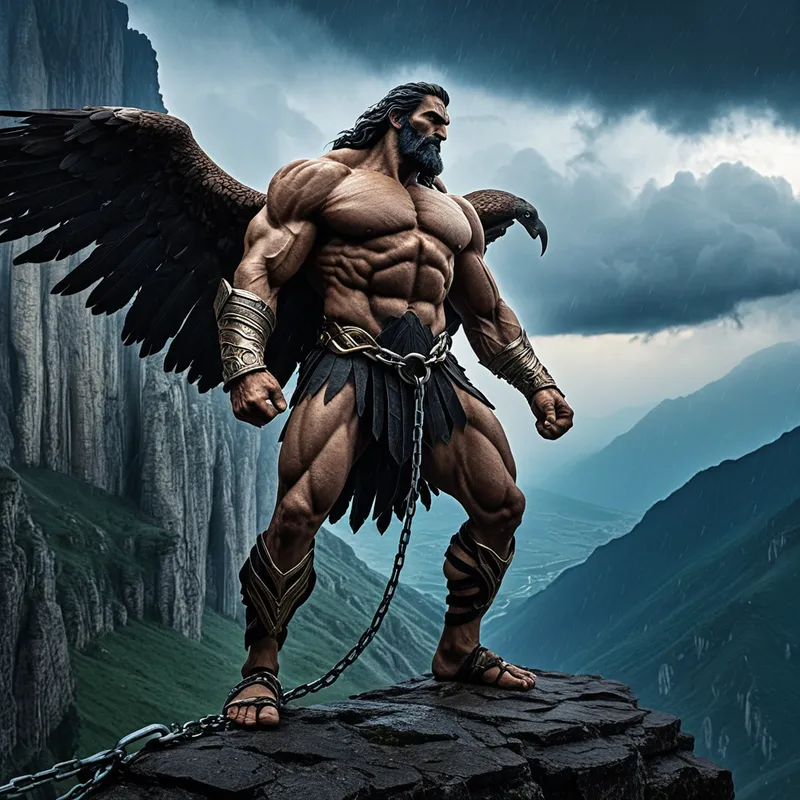
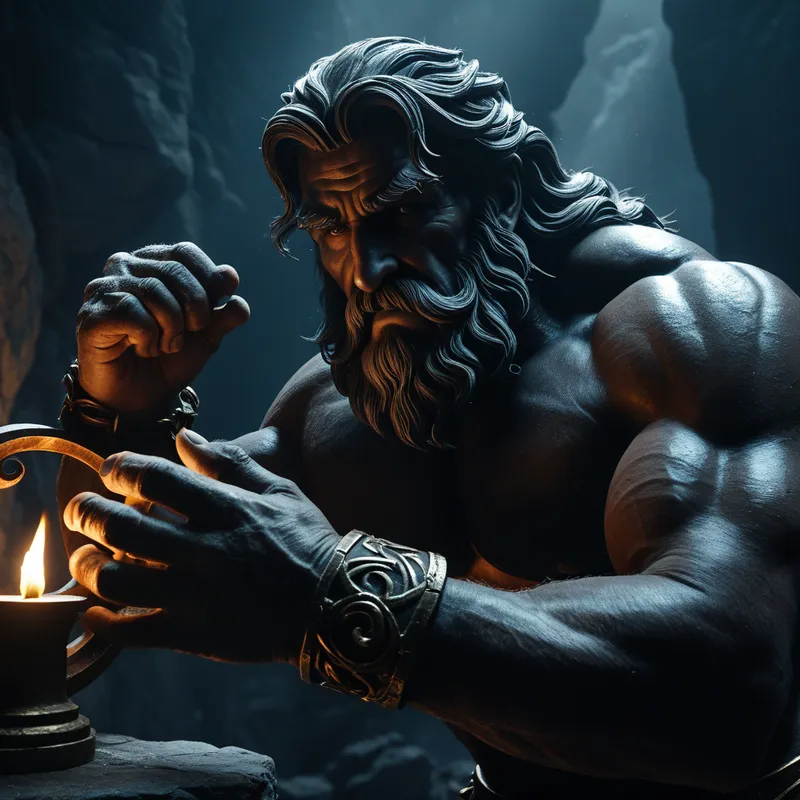
He summoned [Hephaestus](/myths/hephaestus “Myth from Global/Universal culture.”/), the master smith. “Forge bonds from which none can escape,” Zeus commanded. “Bind the traitor where [the wind](/myths/the-wind “Myth from Various culture.”/) is a knife and the sun a brand.” [Hephaestus](/myths/hephaestus “Myth from Global/Universal culture.”/), his heart heavy, obeyed. With mighty hammers, he wrought unbreakable chains of adamant. He took Prometheus to a lonely, wind-lashed crag in the Caucasus. The air was thin and bitter. “Forgive me, kinsman,” [Hephaestus](/myths/hephaestus “Myth from Global/Universal culture.”/) whispered, his voice lost in the gale, as he drove the spikes through flesh and into stone. Prometheus was spread-eagled against the cliff, the cold metal searing his skin, his divinity offering no comfort.
But Zeus was not finished. Each day, he would send his eagle, a monstrous bird with feathers like iron and a beak like a dagger. It would descend from the empty sky, its shadow falling over the bound Titan. With a terrible, precise cruelty, it would tear open Prometheus’s side and feast upon his liver, the seat of passion and emotion. Each night, as the eagle flew back to Olympus, the divine flesh would heal, only to be ripped open again at dawn. The cycle was perfect, endless: capture, torment, regeneration, and torment anew. Prometheus’s groans echoed in the desolate passes, a perpetual testament to the cost of defiance and the price of giving light to those in the dark. And there he remained, bound not just by metal, but by the relentless calculus of divine law, for ages uncounted.
Cultural Origins & Context
The myth of Prometheus Bound is a cornerstone of Greek mythological thought, primarily preserved in the epic poetry of Hesiod’s Theogony and Works and Days (8th-7th century BCE) and, most famously, in the tragic play Prometheus Bound attributed to Aeschylus (5th century BCE). It was not merely a story for entertainment, but a foundational narrative grappling with the human condition. Performed in the civic-religious context of Athenian theater, the myth served as a profound meditation on the nature of authority, [justice](/myths/justice “Myth from Tarot culture.”/), and the origins of human civilization and its inherent sufferings.
The tale functioned as an aetiology—a story explaining why things are [the way](/myths/the-way “Myth from Taoist culture.”/) they are. For the Greeks, it explained humanity’s possession of technology (technē) and culture, separating them from animals, while also accounting for the pervasive presence of toil, disease, and struggle in life (linked to the later myth of [Pandora](/myths/pandora “Myth from Greek culture.”/)). The storytellers—bards, playwrights, philosophers—used Prometheus to explore the tension between blind obedience to power (Zeus’s order) and compassionate, rebellious intelligence (Prometheus’s gift). It asked the audience: What is the true cost of progress? Is suffering an inevitable part of consciousness?
Symbolic Architecture
At its core, the Bonds of Prometheus represent the existential predicament of the awakened self. Prometheus is not a typical [hero](/symbols/hero “Symbol: A hero embodies strength, courage, and the ability to overcome significant challenges.”/); he is a titanic principle—the [archetype](/symbols/archetype “Symbol: A universal, primordial pattern or prototype in the collective unconscious that shapes human experience, behavior, and creative expression.”/) of foresight, rebellious intellect, and compassionate intervention.
The fire he steals is not mere flame; it is the spark of consciousness, the light of logos (reason) and techne (practical art) that pulls humanity out of instinctual, animal existence and into the fraught realm of culture, history, and self-awareness.
His binding is the inevitable consequence of this awakening. The adamantine chains symbolize the absolute, often brutal, limitations imposed by [reality](/symbols/reality “Symbol: Reality signifies the state of existence and perception, often reflecting one’s understanding of truth and life experiences.”/), [fate](/symbols/fate “Symbol: Fate represents the belief in predetermined outcomes, suggesting that some aspects of life are beyond human control.”/), or oppressive structures (external or internal) upon the rebellious [spirit](/symbols/spirit “Symbol: Spirit symbolizes the essence of life, vitality, and the spiritual journey of the individual.”/). The Caucasian rock is the [altar](/symbols/altar “Symbol: An altar represents a sacred space for rituals, offering, and connection to the divine, embodying spirituality and devotion.”/) of [isolation](/symbols/isolation “Symbol: A state of physical or emotional separation from others, often representing a need for introspection or signaling distress.”/), where the visionary is separated from the [community](/symbols/community “Symbol: Community in dreams symbolizes connection, support, and the need for belonging.”/) he sought to elevate, forced to bear the burden of his [knowledge](/symbols/knowledge “Symbol: Knowledge symbolizes learning, understanding, and wisdom, embodying the acquisition of information and enlightenment.”/) alone.
The [eagle](/symbols/eagle “Symbol: The eagle is a symbol of power, freedom, and transcendence, often representing a person’s aspirations and higher self.”/) and the regenerating [liver](/symbols/liver “Symbol: Represents emotional processing, purification, and vitality. Often symbolizes anger, toxicity, or life force in dreams.”/) present the myth’s most potent [symbol](/symbols/symbol “Symbol: A symbol can represent an idea, concept, or belief, serving as a powerful tool for communication and understanding.”/) of cyclical suffering. The [liver](/symbols/liver “Symbol: Represents emotional processing, purification, and vitality. Often symbolizes anger, toxicity, or life force in dreams.”/) was considered the seat of passions and desires. The [eagle](/symbols/eagle “Symbol: The eagle is a symbol of power, freedom, and transcendence, often representing a person’s aspirations and higher self.”/), Zeus’s royal [bird](/symbols/bird “Symbol: Birds symbolize freedom, perspective, and the connection between the earthly and spiritual realms, often representing the soul’s aspirations or personal growth.”/), represents the tyrannical, devouring [aspect](/symbols/aspect “Symbol: A distinct feature, quality, or perspective of something, often representing a partial view of a larger whole.”/) of supreme [authority](/symbols/authority “Symbol: A symbol representing power structures, rules, and control, often reflecting one’s relationship with societal or personal governance.”/) or the crushing [weight](/symbols/weight “Symbol: Weight symbolizes burdens, responsibilities, and emotional loads one carries in life.”/) of a punitive super-ego. The daily [torment](/symbols/torment “Symbol: A state of intense physical or mental suffering, often representing unresolved inner conflict, guilt, or psychological distress.”/) signifies how the conscious self, once awakened, is subjected to perpetual inner conflict—the pain of [awareness](/symbols/awareness “Symbol: Conscious perception of self, surroundings, or internal states. Often signifies awakening, insight, or heightened sensitivity.”/), the [guilt](/symbols/guilt “Symbol: A painful emotional state arising from a perceived violation of moral or social standards, often tied to actions or inactions.”/) of transgression, the [anxiety](/symbols/anxiety “Symbol: Anxiety in dreams reflects internal conflicts, fears of the unknown, or stress from waking life, often demonstrating the subconscious mind’s struggle for peace.”/) of freedom. Yet, the [regeneration](/symbols/regeneration “Symbol: The process of renewal, restoration, and growth following damage or depletion, often representing emotional healing, transformation, or a fresh start.”/) speaks to the [resilience](/symbols/resilience “Symbol: The capacity to recover quickly from difficulties, adapt to change, and maintain strength through adversity.”/) of the [life](/symbols/life “Symbol: The symbol of ‘Life’ represents a journey of growth, interconnectedness, and existential meaning, encompassing both the joys and challenges that define human experience.”/) force and the [psyche](/myths/psyche “Myth from Greek culture.”/)’s [capacity](/symbols/capacity “Symbol: A measure of one’s potential, limits, or ability to contain, process, or achieve something, often reflecting self-assessment or external demands.”/) to endure, to heal each [night](/symbols/night “Symbol: Night often symbolizes the unconscious, mystery, and the unknown, representing the realm of dreams and intuition.”/) only to face the struggle again at [dawn](/symbols/dawn “Symbol: The first light of day, symbolizing new beginnings, hope, and the transition from darkness to illumination.”/).

The Dreamer’s Resonance
When the pattern of the Bound Prometheus surfaces in modern dreams, it signals a profound psychological initiation. The dreamer is not simply having a bad day; they are encountering the archetypal landscape of the Rebel facing the consequences of their own awakening.
To dream of being chained or pinned in a high, exposed place often correlates with a feeling of being trapped by one’s own choices, talents, or insights. Perhaps the dreamer has taken a stand at work, embraced a creative path against family wishes, or achieved a level of consciousness that alienates them from their former social circle. They feel isolated and punished for their “gift.”
Dreams of a bird or beast attacking the torso, particularly the abdominal area, can point to a somatic experience of this myth. It may reflect a situation where the dreamer’s core passions, vitality, or emotional center (the symbolic liver) are under daily assault—by a critical authority figure, a draining job, or their own relentless inner critic. The dream captures the visceral, cyclical nature of this suffering: the wound that never fully kills but never fully heals, renewing its pain with each new day.

Alchemical Translation
In the alchemical vessel of the psyche, the myth of Prometheus models the agonizing but necessary process of individuation—becoming one’s true, separate self. The initial theft of fire is the [nigredo](/myths/nigredo “Myth from Alchemical culture.”/), the blackening: a necessary, rebellious act that separates the individual from collective unconsciousness (the ignorant humanity) and the tyranny of the dominant ruling principle (the Zeus-complex, which could be internalized parental or societal authority).
The binding and torment on the rock represent the crucial, lengthy stage of mortificatio and separatio—the death of the old identity and the painful isolation required for transformation. The ego, having seized its potential, must now endure the consequences of its differentiation.
This suffering is not meaningless punishment, but the forge in which the psyche is tempered. The daily devouring and regeneration of the liver is a brutal image of psychic digestion and renewal. Each “attack” by the eagle (the confronting truth, the painful feedback, the consequence of one’s stance) breaks down the old emotional complexes (the liver), which then reconstitute themselves, hopefully in a more refined, resilient form. The process is iterative, a spiral of suffering and integration.
The ultimate promise of the myth—hinted at in later traditions where [Heracles](/myths/heracles “Myth from Greek culture.”/) eventually frees Prometheus—is that this bound state is not eternal. The fully integrated Self (the Heraclean hero within) eventually arrives to slay the devouring bird of torment and break the chains. The freed Prometheus then wears a ring of the rock and his chains as a reminder, integrating his suffering into his being. Thus, the alchemical gold produced is not a life without pain, but a conscious, resilient individuality that has willingly paid the price for its own fire and carries the scars as badges of its hard-won sovereignty.
Associated Symbols
Explore related symbols from the CaleaDream lexicon: