
The Bodhi Tree Myth Meaning & Symbolism
A prince becomes a wanderer, sits beneath a fig tree, and through a night of cosmic battle, awakens to the nature of reality, founding a path of liberation.
The Tale of The Bodhi Tree
The world was heavy with sleep, draped in the veil of samsara. In the heart of the land of Magadha, by the languid flow of the Nairañjanā River, a man walked. He was no ordinary man, though he wore the dust of the road like a cloak. Once a prince of shimmering palaces, now a wanderer of six years, his body was a testament to austerity, his mind a battlefield of unanswered questions. He was Siddhartha Gautama, and he carried the weight of all suffering in his silent footsteps.
Exhausted, his practices of extreme denial having brought him to the brink of dissolution, he accepted a simple offering of milk-rice from a village woman named Sujata. Strength, not as brute force, but as a quiet resolve, flowed back into his limbs. He knew then that the middle path was the only way—neither indulgence nor annihilation. With a calm certainty, he sought a seat of awakening.
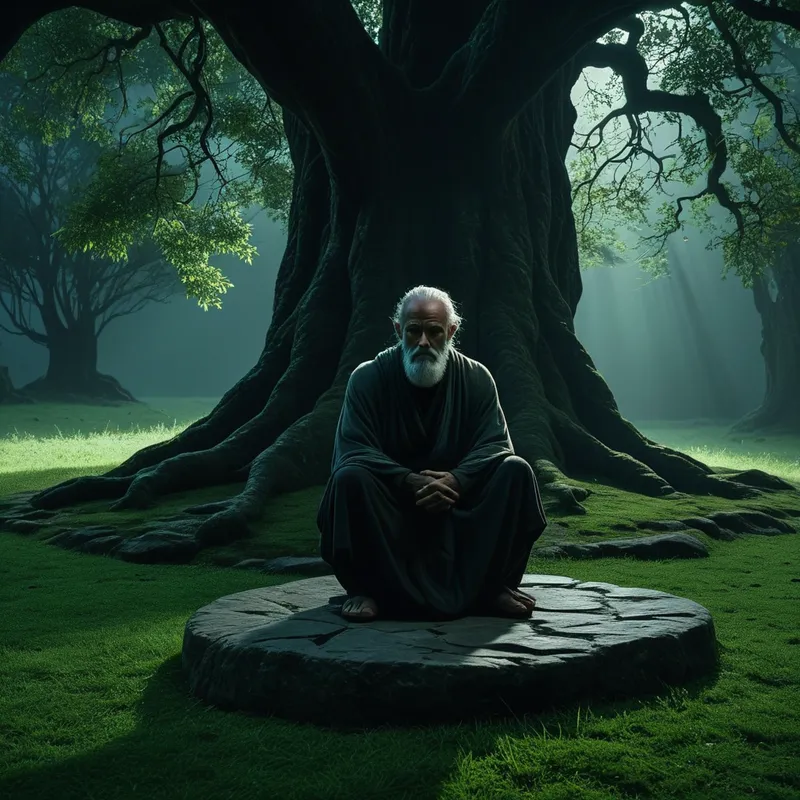
He came upon a great Aśvattha, its canopy wide and welcoming, its heart-shaped leaves whispering secrets to the wind. A grass-cutter named Sotthiya, sensing the seeker’s profound intent, offered a bundle of kusha grass. The man took it, spread it at the base of the mighty tree, and sat down facing east. He made a vow that shook the foundations of the cosmos: “Though only my skin, sinews, and bones remain, and my blood and flesh dry up and wither away, I will not stir from this seat until I have attained the supreme and final wisdom.”
As he settled into unwavering meditation, the earth trembled in witness. But this tremor also stirred Māra, the lord of illusion, the demon of death and desire. Māra’s realm was the entire world of clinging and fear, and here was one attempting to escape it. The cosmic battle began not with clashing swords, but with a siege upon the mind.
First came Māra’s army—a horrifying legion of demons wielding flaming weapons, roaring beasts, and monstrous forms. They hurled mountains of fire and torrents of blood. Yet, as the waves of terror reached the meditator, they dissolved like mist against the radiant field of his metta, his boundless loving-kindness. The weapons turned to flowers.
Enraged, Māra sent his three daughters, Taṇhā, Arati, and Ragā—Discontent, Delight, and Lust. They transformed into visions of breathtaking beauty, dancing and singing, offering every sensual pleasure imaginable. The man’s gaze remained unmoved, seeing in them only the impermanent, hollow nature of all conditioned things. They too faded away.
Finally, Māra himself approached, mounted on his great war elephant. “Arise!” he thundered. “This seat of enlightenment belongs to me! Who is your witness to prove your worthiness?” The demon-king pointed to his monstrous army, all shouting their allegiance. In a gesture of infinite grace, the meditator reached down and touched the earth with the fingertips of his right hand. “This solid earth,” he said softly, “is my witness.” And the Earth Goddess, Bhūmi, emerged, wringing from her hair a torrent of water—the accumulated waters of the seeker’s countless acts of selfless virtue over lifetimes. The flood surged forth, sweeping Māra and his legions away.
The night deepened. The distractions fell silent. With a mind purified, concentrated, and imbued with equanimity, the man turned his attention inward, through the watches of the night. He saw his own past lives, the births and deaths of all beings, and finally, with the rising of the morning star, he pierced the fundamental cause of suffering—ignorance, and its cessation. He saw reality as it is: arising and passing, empty of a separate, permanent self. In that moment, he was no longer Siddhartha the seeker. He was the Buddha. The tree that had sheltered him, that had been his steadfast companion in the ultimate struggle, was now the Bodhi Tree. It had borne witness to the birth of liberation itself.
Cultural Origins & Context
The story of the Bodhi Tree is not a later allegorical addition but is central to the earliest strata of Buddhist texts, the <abbr title=“The “basket” of discourses, the earliest Buddhist scriptures”>Sutta Piṭaka. It is the foundational narrative of the tradition, the axis mundi around which the Dhamma revolves. Passed down orally by the monastic community for centuries before being committed to writing, its primary function was not merely historical but inspirational and pedagogical. It served as the ultimate validation of the Buddha’s authority—his awakening was not a speculative philosophy but a hard-won, experiential truth, achieved through relentless effort against the very fabric of existential delusion.
The site of the Bodhi Tree in Bodh Gaya became, and remains, the most sacred pilgrimage site in the Buddhist world. The tree itself was seen as a living successor to the original, a direct descendant or spiritual emanation. Its societal function was profound: it was a tangible link to the awakening event, a symbol that enlightenment was not a mythical abstraction but something that occurred here, on this earth, under this sky. It democratized the potential for awakening, showing that the path was real and its fruit attainable. The narrative was told to instill faith (saddhā) and resolve (adhiṭṭhāna), providing a template of perseverance for every practitioner sitting on their own meditation cushion, facing their own inner Māra.
Symbolic Architecture
The Bodhi Tree is the ultimate symbol of the awakened mind—rooted in the earth of experience, yet reaching toward the unbounded sky of liberation. It represents the axis mundi, the world pillar that connects the human realm with the transcendent. Its heart-shaped leaves are not incidental; they symbolize the integration of wisdom (prajñā) and compassion (karuṇā), the two wings of enlightenment. The tree is both a shelter and a catalyst.
The seat beneath the tree is not a geographical location, but the unshakable ground of one’s own being, discovered only when all external supports are relinquished.
Siddhartha’s journey to the tree embodies the rejection of two futile extremes: the palace of sensual indulgence and the forest of self-mortification. The tree marks the fertile middle ground where true work begins. Māra is not an external demon but the personification of the psyche’s own most entrenched defenses—our cravings, fears, arrogance, and doubt. The entire battle is an internal, psychological event. The touching of the earth (bhūmisparśa mudrā) is the critical symbolic act. It represents grounding ultimate authority not in divine revelation or external validation, but in the reality of one’s own embodied experience and accumulated ethical integrity. It is the gesture of total authenticity.

The Dreamer’s Resonance
When the Bodhi Tree appears in a modern dream, it signals a profound moment of psychic reorientation. The dreamer is likely at a crisis point, having exhausted familiar strategies—perhaps a period of frantic “doing” (the palace) or one of depressive withdrawal and self-neglect (the ascetic forest). The tree emerges as an image of nascent stability and potential growth at the core of this turmoil.
To dream of sitting beneath it suggests a readiness to face one’s inner “Māras”—perhaps as swirling anxieties, seductive fantasies of escape, or a crushing sense of unworthiness. The somatic experience might be one of initial panic giving way to a deep, grounded calm. To dream of the tree being attacked or withering may reflect a fear that one’s newfound center or insight is fragile. Conversely, dreaming of its luminous leaves or robust roots indicates a strengthening connection to inner wisdom and resilience. The tree in a dream does not promise immediate enlightenment, but it confirms the dreamer is on the seat—the place where the real, transformative inner work is now unavoidable and possible.

Alchemical Translation
The myth of the Bodhi Tree is a master blueprint for the alchemical process of individuation—the Jungian journey toward psychological wholeness. The prince leaving the palace is the ego abandoning its identification with the persona, the comfortable, socially-constructed self. The years of wandering represent the necessary, often painful, engagement with the shadow—all the rejected parts of the self encountered in the “forest.”
The Bodhi Tree itself symbolizes the emergent Self, the archetype of totality, which begins to grow at the precise point where the ego surrenders its total control and agrees to simply witness.
Sitting down with the vow is the commitment to this process of self-confrontation and integration. The assault of Māra is the fierce resistance of the psychic status quo; every demon and temptation is a familiar complex—a pattern of thought, emotion, or memory—fighting for survival. The alchemical nigredo, the dark night of the soul, is this entire battle. The touching of the earth is the coniunctio, the sacred marriage: the conscious ego (the meditator) aligning with the vast, unconscious ground of being (the Earth Goddess), drawing strength from the accumulated “virtue” or wholeness of the personal and collective unconscious.
The final awakening at dawn is the albedo and rubedo—the dawn of clarity and the integration of that clarity into a transformed way of being. For the modern individual, the myth teaches that enlightenment or wholeness is not an escape from the world, but a deeper, unshakeable grounding in it. The goal is not to become a disembodied sage on a mountaintop, but to become like the tree itself: deeply rooted in the earth of human experience, weather-beaten but resilient, offering shelter and bearing the fruit of insight, all while reaching steadily toward the light.
Associated Symbols
Explore related symbols from the CaleaDream lexicon: