The Bhagavad Gita Myth Meaning & Symbolism
On a sacred battlefield, a prince paralyzed by moral crisis receives cosmic wisdom from his divine charioteer, revealing the path of selfless action.
The Tale of The Bhagavad Gita
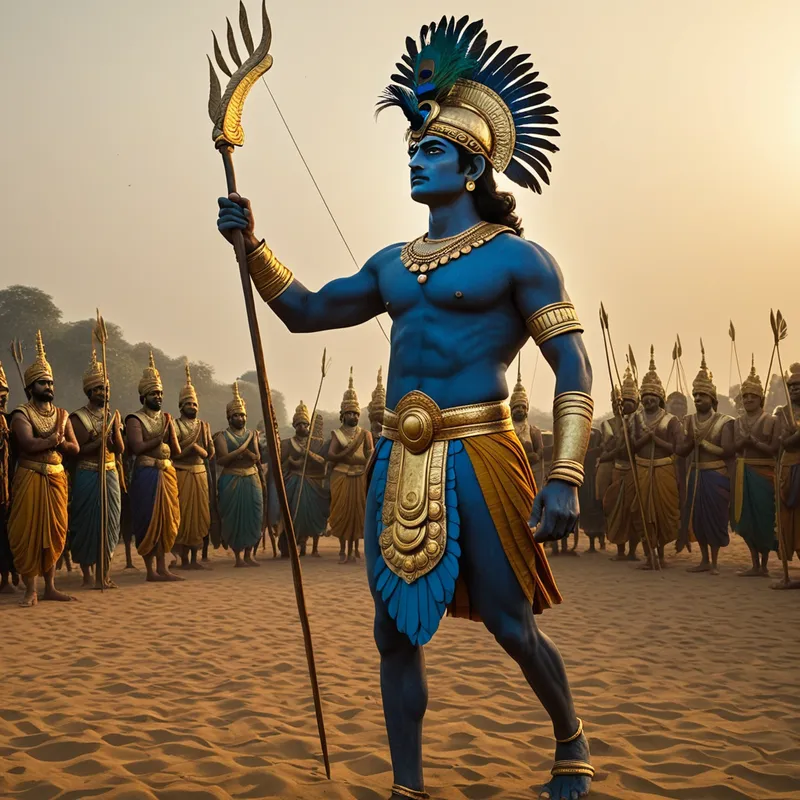
Listen. The air on the field of Kurukshetra is thick with the scent of dust and destiny. It is a dawn choked with the silence before the storm, a silence broken only by the blast of conch shells and the thunderous rumble of chariot wheels. Two vast armies face each other, a sea of glittering armor and raised banners—the Kurus and the Pandavas—poised to tear [the world](/myths/the-world “Myth from Tarot culture.”/) asunder.
In the Pandava host, the great archer Arjuna stands in his resplendent chariot. His fingers know the curve of his divine bow, [Gandiva](/myths/gandiva “Myth from Hindu culture.”/), as a poet knows his pen. But as he looks across the no-man’s-land, his vision clears and his soul shatters. He does not see enemies; he sees grandfathers, teachers, uncles, cousins. Faces from his childhood, voices from his hearth. To wage war here is to sever the very roots of his world.
A tremor takes him. His mighty arms fall slack; Gandiva slips from his grasp, clattering against [the chariot](/myths/the-chariot “Myth from Tarot culture.”/) floor. “O [Krishna](/myths/krishna “Myth from Hindu culture.”/),” he whispers, his voice a dry leaf in [the wind](/myths/the-wind “Myth from Various culture.”/). “My limbs fail, my mouth is parched. I see no good in killing my kin. I desire no victory, no kingdom, no pleasures born of this bloodshed.” He sinks onto the chariot’s bench, consumed by a grief that drowns out the drums of war. “I will not fight.”
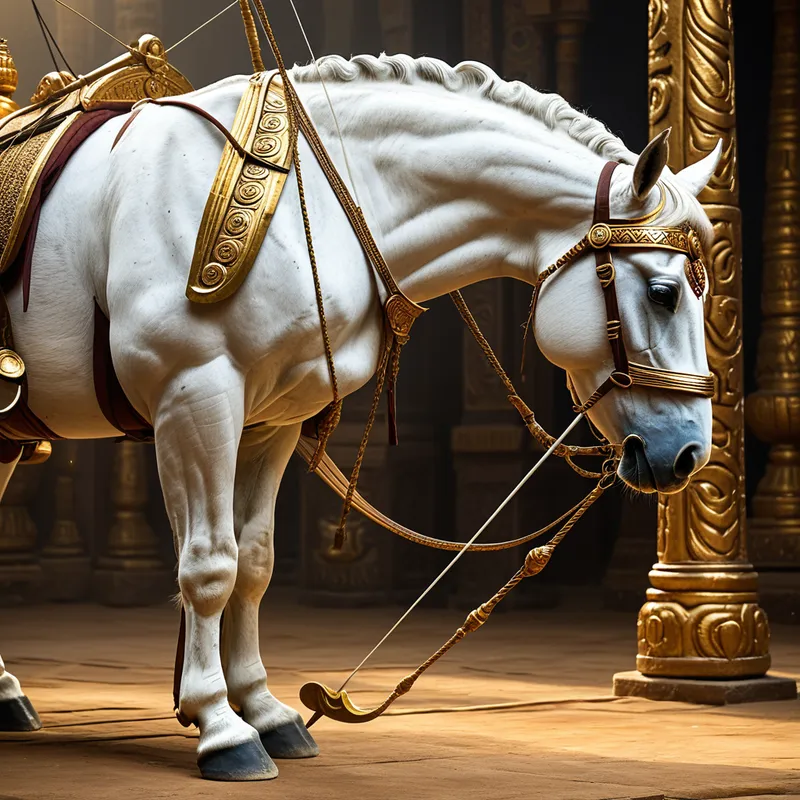
His charioteer, Krishna, has been silent, holding the reins of four white steeds. He is prince, friend, and counselor. But now, as Arjuna surrenders to despair, Krishna smiles—a smile that holds neither mockery nor pity, but the infinite patience of the cosmos. The chariot, parked between the two armies, becomes the still point of the turning world.
And Krishna begins to speak.
His voice is not loud, yet it pierces the cacophony of impending doom. He does not command Arjuna to fight. Instead, he unveils the architecture of reality. He speaks of the eternal Atman, which neither slays nor is slain. He maps the paths of spiritual discipline: the yoga of selfless action ([Karma Yoga](/myths/karma-yoga “Myth from Hindu culture.”/)), the yoga of devoted love (Bhakti Yoga), and the yoga of transcendent knowledge (Jnana Yoga).
He reveals his own cosmic form—the [Vishvarupa](/myths/vishvarupa “Myth from Hindu culture.”/)—and in a moment of shattering awe, Arjuna sees all of time and space, all creation and destruction, swirling within the body of his friend. He sees the warriors already rushing into the mouth of the divine, their fates ordained not by Krishna’s will, but by the relentless law of cause and effect, of their own past actions.
The discourse flows like a mighty river—from the nature of duty (Dharma) to the qualities of mind, from the discipline of meditation to the pinnacle of surrender. The battlefield remains, the armies wait, but within the chariot, a universe is being born in Arjuna’s consciousness.
Finally, the divine voice softens. The vision recedes. Arjuna, his tears dried by the fire of understanding, his confusion burned away in the light of wisdom, picks up his bow. His duty is no longer a burden of desire or fear, but an offering. His hands are steady. “My delusion is destroyed,” he says. “I stand firm, my doubts dispelled. I will act according to your word.”
The conch shells sound again. The chariot of Krishna and Arjuna moves forward. The war begins. But everything has changed.
Cultural Origins & Context
The Bhagavad Gita is not a standalone text but a luminous, self-contained episode within the colossal epic, the Mahabharata. Its composition is traditionally placed between the 5th and 2nd centuries BCE, a period of intense philosophical fermentation in ancient India. It emerged from an oral tradition, recited by bards and sages, before being codified in Sanskrit.
Its societal function was multifaceted. For the warrior class (Kshatriyas), it provided a spiritual rationale for their duty to fight and govern justly. For the broader culture, it synthesized and made accessible the profound, often esoteric insights of the Upanishads. It presented a practical spirituality that could be lived within the world, not apart from it. By placing the ultimate spiritual teaching on a literal battlefield, it declared that the arena for enlightenment is not the remote forest, but the very heart of life’s most intense moral and emotional conflicts.
Symbolic Architecture
The Gita is a supreme psychological [allegory](/symbols/allegory “Symbol: A narrative device where characters, events, or settings represent abstract ideas or moral qualities, conveying deeper meanings through symbolic storytelling.”/). The battlefield of Kurukshetra is the [human](/symbols/human “Symbol: The symbol of a human represents individuality, complexity of emotions, and social relationships.”/) [psyche](/myths/psyche “Myth from Greek culture.”/) itself, a field of conflicting duties, desires, loyalties, and fears. The two armies represent the perpetual civil war within us—the forces of light ([clarity](/symbols/clarity “Symbol: A state of mental transparency and sharp focus, often representing resolution of confusion or attainment of insight.”/), duty, higher [purpose](/symbols/purpose “Symbol: Purpose signifies direction, meaning, and intention in life, often reflecting personal ambitions and core values.”/)) versus the forces of darkness (attachment, delusion, egoic desire).
Arjuna’s paralysis is the crisis of the modern soul: the moment when one’s inherited map of the world—its duties, relationships, and identities—collapses, revealing an abyss of meaninglessness.
Krishna is not an external god but the symbolic embodiment of the integrated Self, the inner guide or [sakshi](/myths/sakshi “Myth from Hindu culture.”/). He is the charioteer, representing the intellect and higher wisdom that must take control of the senses (the horses) and direct the individual [soul](/symbols/soul “Symbol: The soul represents the essence of a person, encompassing their spirit, identity, and connection to the universe.”/) (Arjuna) through the battle of [life](/symbols/life “Symbol: The symbol of ‘Life’ represents a journey of growth, interconnectedness, and existential meaning, encompassing both the joys and challenges that define human experience.”/). His teaching of nishkama [karma](/myths/karma “Myth from Hindu culture.”/)—[action](/symbols/action “Symbol: Action in dreams represents the drive for agency, motivation, and the ability to take control of situations in waking life.”/) without attachment to results—is the psychological key to freeing oneself from the neurotic cycles of [anxiety](/symbols/anxiety “Symbol: Anxiety in dreams reflects internal conflicts, fears of the unknown, or stress from waking life, often demonstrating the subconscious mind’s struggle for peace.”/), regret, and compulsive doing.
The [revelation](/symbols/revelation “Symbol: A sudden, profound disclosure of truth or insight, often through artistic or musical means, that transforms understanding.”/) of the Vishvarupa is the ultimate confrontation with the totality of existence, the terrifying and liberating realization that life encompasses both beautiful creation and ruthless destruction, and that one’s small personal [drama](/symbols/drama “Symbol: Drama signifies narratives, emotional expression, and the exploration of human experiences.”/) is part of this vast, impersonal process.

The Dreamer’s Resonance
When this myth stirs in the modern dreamer, it often manifests as a profound vocational or moral crisis. One might dream of being forced to make an impossible choice at work that pits loyalty against ethics, or of being handed a tool (a pen, a key, a weapon) they feel utterly unworthy or terrified to use. The somatic feeling is one of paralysis—heavy limbs, a choked voice, a sinking heart.
The figure of Krishna may appear in guised form: a surprisingly calm mentor, a stranger with impossibly knowing eyes, or even one’s own reflection speaking with detached wisdom. This signals the psyche’s attempt to activate the inner compass, the transcendent function that can navigate the dilemma. The dream is not about finding an easy external answer, but about the internal shift from being a victim of circumstance (“I can’t”) to becoming a conscious agent of necessary action (“I must, but how?”). It marks the painful but necessary death of a naive worldview.

Alchemical Translation
The alchemy of the Gita is the transmutation of action itself. The base metal of action driven by fear, desire, and ego is heated in the furnace of conscious crisis (Arjuna’s despair) and exposed to the catalyst of non-attached wisdom (Krishna’s discourse). The result is the gold of dharmic action—action that is right, necessary, and performed as an offering to the whole, free from the poison of personal gain or loss.
The process models individuation not as a retreat from the world, but as a full, conscious, and responsible entry into it. One does not transcend their svadharma—their unique, intrinsic duty—but fulfills it with a liberated spirit.
[The first stage](/myths/the-first-stage “Myth from Alchemical culture.”/) is Descent & Paralysis: the conscious confrontation with [the shadow](/myths/the-shadow “Myth from Jungian culture.”/), with the morally ambiguous aspects of one’s life and choices. The second is Dialogue & Revelation: engaging the deeper Self, allowing a wisdom beyond [the ego](/myths/the-ego “Myth from Jungian culture.”/)‘s calculations to emerge. The final stage is Resolved Action: returning to the world, not with the blind certainty of dogma, but with the steady clarity of one who acts because it is right, not because it is safe or rewarding. The battlefield remains, the conflict persists, but the warrior is reborn. They are in the world, but no longer of it. Their action becomes a form of meditation, their life a field of sacred duty.
Associated Symbols
Explore related symbols from the CaleaDream lexicon: