The Bee Hieroglyph Myth Meaning & Symbolism
The myth of the divine bee, born from the tears of Ra, whose sacred script imposes order on chaos and bestows the power of kingship.
The Tale of The Bee Hieroglyph
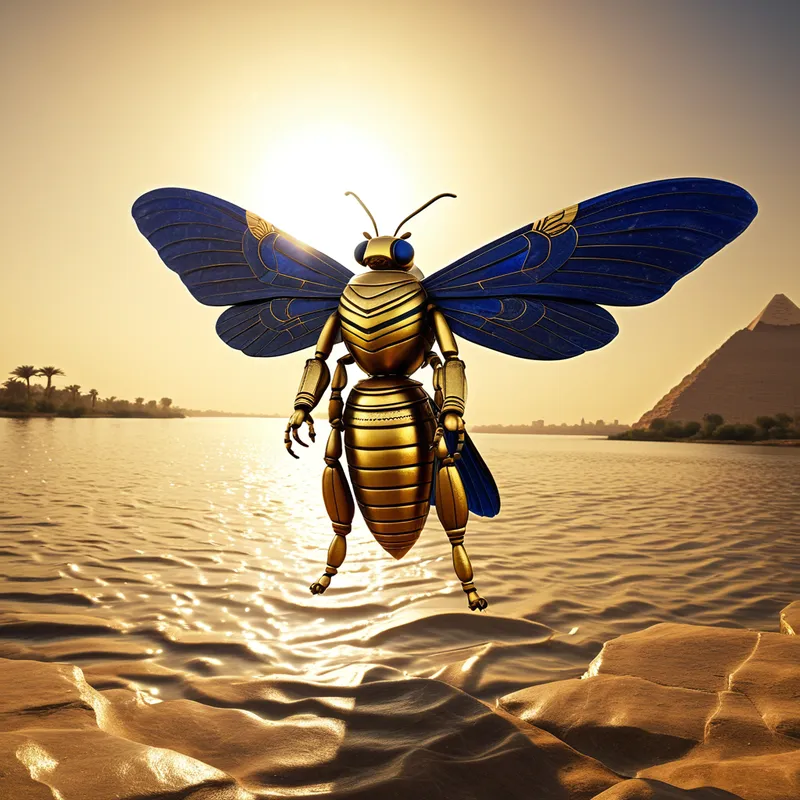
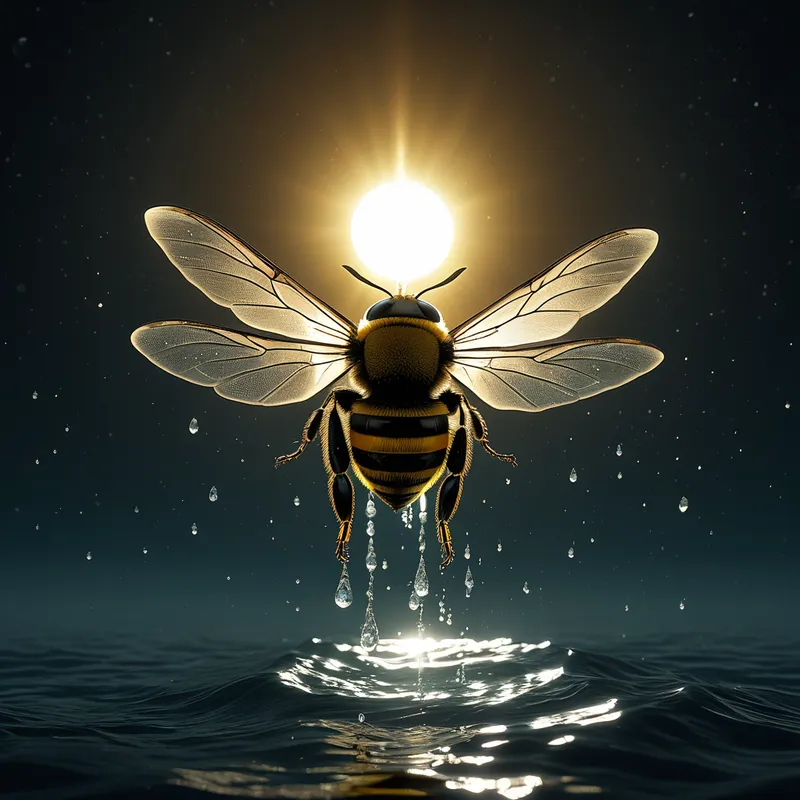
In the time before time, when [the world](/myths/the-world “Myth from Tarot culture.”/) was a dark, silent ocean of Nun, the great sun, Ra, wept. His loneliness was a weight upon the cosmos. From his eye, a single tear fell, a perfect sphere of liquid gold and sorrow. It did not dissolve into the endless waters. Instead, it hardened, it hummed, it took wing. From Ra’s grief was born the first creature of industry and song: a bee, but no ordinary insect. Its body was of polished carnelian, its wings thin sheets of beaten electrum, and its eyes held the piercing intelligence of the creator himself.
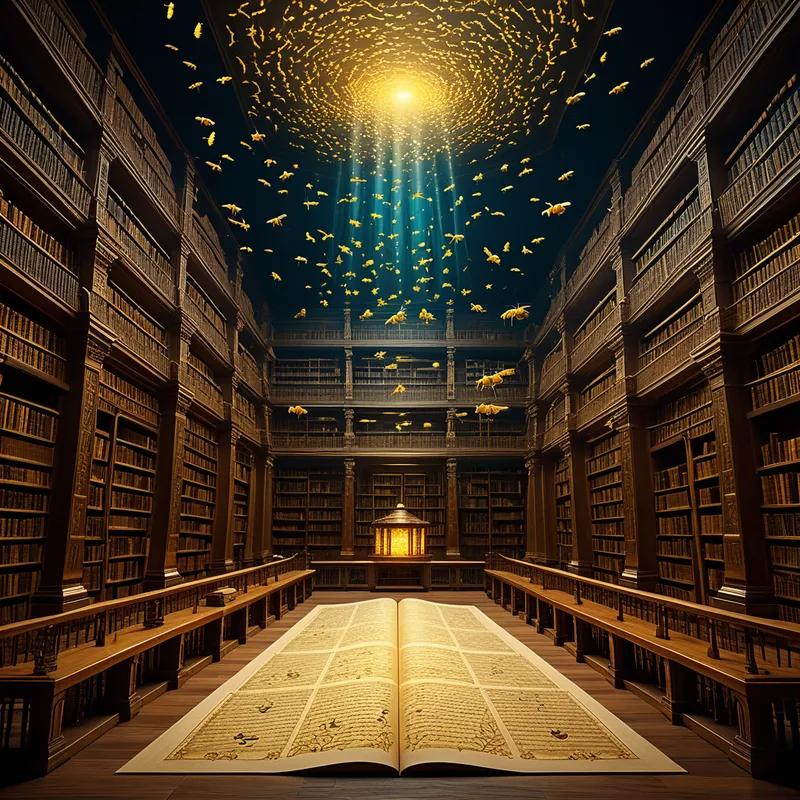
This bee did not wander. It had a purpose written into its very form. It flew to the first mound of dry land, the Benben stone, and there it began to build. Not with mud or wax, but with light and intention. It traced patterns in the air with its flight, and where it passed, symbols remained—a hawk, a reed, a loaf of bread. These were not mere pictures; they were the bones of reality, the true names of things. This was the first writing, the sacred script, humming into existence.
But the silence of Nun was not empty. It was filled with Isfet, the formless urge toward dissolution. It sensed this imposition of order, this humming song of definition, and recoiled. A great mist rose from the waters, seeking to blur the sharp lines of the new hieroglyphs, to return the world to mute, undifferentiated soup. The bee’s hum grew fierce. It dove into [the mist](/myths/the-mist “Myth from Celtic culture.”/), its golden light cutting through the grey. Where it stung, the chaos recoiled, crystallizing into defined, knowable things—a rock, a wave, a star. The sting was not an attack of malice, but an act of radical clarification, a painful but necessary puncture of ambiguity.
Having secured the foundation of the world, the bee turned its attention to the rulers of the land. It flew to the first king, a man standing bewildered on the bank of the newly-formed Nile. It circled his head three times, and then, with infinite precision, inscribed a single, complex glyph upon his brow—the sign of the sedge and the bee, the nesu-bit. In that moment, the king was no longer just a man. He was infused with the bee’s essence: the authority to organize, the duty to protect [the hive](/myths/the-hive “Myth from Various culture.”/) of the nation, the sacred responsibility to maintain Maat against the ever-present whisper of Isfet. The hum of the bee became the silent vibration of rightful rule, the blueprint for civilization itself, passed down through the bloodline of the kings.
Cultural Origins & Context
The bee was not merely an insect in ancient Egypt; it was a potent symbol of kingship and divine order. The title “He of the Sedge and the Bee” (nesu-bit) denoted the ruler of unified Upper and Lower Egypt, with the bee representing the Delta. This was not just political branding, but a mythological claim to a sacred, organizing principle. The bee’s mythic origin from Ra’s tear connects it directly to the act of creation and the god’s authoritative power.
This narrative was woven into the fabric of royal ideology, transmitted through temple rituals, royal iconography, and the teachings of the lector priests. It functioned as a cosmological justification for [the pharaoh](/myths/the-pharaoh “Myth from Egyptian culture.”/)’s absolute authority. He was not a tyrant, but the human embodiment of the divine bee—the one charged with the continual, active work of imposing the “[honeycomb](/myths/honeycomb “Myth from Natural culture.”/)” of Maat onto the potential chaos of the world, ensuring the fertility of the land and the favor of the gods through correct ritual and just rule.
Symbolic Architecture
The Bee [Hieroglyph](/symbols/hieroglyph “Symbol: Ancient Egyptian writing system using pictorial symbols, representing sacred knowledge, communication with the divine, and the power of language to shape reality.”/) myth is a profound map of the [psyche](/myths/psyche “Myth from Greek culture.”/)’s [movement](/symbols/movement “Symbol: Movement symbolizes change, progress, and the dynamics of personal growth, reflecting an individual’s desire or need to transform their circumstances.”/) from undifferentiated potential to structured [consciousness](/symbols/consciousness “Symbol: Consciousness represents the state of awareness and perception, encompassing thoughts, feelings, and experiences.”/). The tear of Ra represents a [moment](/symbols/moment “Symbol: The symbol of a ‘moment’ embodies the significance of transient experiences that encapsulate emotional depth or pivotal transformations in life.”/) of acute [awareness](/symbols/awareness “Symbol: Conscious perception of self, surroundings, or internal states. Often signifies awakening, insight, or heightened sensitivity.”/)—a painful but fertile recognition of [separation](/symbols/separation “Symbol: A spiritual or mythic division between realms, states of being, or consciousness, often marking a transition or loss of connection.”/) and the need for [expression](/symbols/expression “Symbol: Expression represents the act of conveying thoughts, emotions, and individuality, emphasizing personal communication and creativity.”/). The bee that emerges is the [archetype](/symbols/archetype “Symbol: A universal, primordial pattern or prototype in the collective unconscious that shapes human experience, behavior, and creative expression.”/) of the organizing principle.
The sting of the bee is the pain of consciousness itself, the necessary violence that separates one thing from another to create a world of meaning.
The bee’s [construction](/symbols/construction “Symbol: Construction symbolizes creation, building, and the process of change, often reflecting personal growth and the need to build a solid foundation.”/) of the hieroglyphs symbolizes the [birth](/symbols/birth “Symbol: Birth symbolizes new beginnings, transformation, and the potential for growth and development.”/) of [language](/symbols/language “Symbol: Language symbolizes communication, understanding, and the complexities of expressing thoughts and emotions.”/) and symbolic thought—the very tools we use to [structure](/symbols/structure “Symbol: Structure in dreams often symbolizes stability, organization, and the framework of one’s life, reflecting how one perceives their environment and personal life.”/) our internal and external realities. The confrontation with Isfet is the eternal psychological struggle between [the ego](/myths/the-ego “Myth from Jungian culture.”/)’s need for order, [identity](/symbols/identity “Symbol: Identity represents the sense of self, encompassing personal beliefs, cultural background, and social roles.”/), and boundaries, and the unconscious pull toward [dissolution](/symbols/dissolution “Symbol: The process of breaking down, dispersing, or losing form, often representing transformation, release, or the end of a state of being.”/), [ambiguity](/symbols/ambiguity “Symbol: A state of uncertainty or multiple possible meanings, often found in abstract art and atonal music where clear interpretation is intentionally elusive.”/), and the blissful oblivion of non-[differentiation](/symbols/differentiation “Symbol: The process of distinguishing or separating parts of the self, emotions, or identity from a whole, often marking a developmental or psychological milestone.”/). The bee does not destroy [chaos](/symbols/chaos “Symbol: In Arts & Music, chaos represents raw creative potential, uncontrolled expression, and the breakdown of order to forge new artistic forms.”/); it defines it, giving it form and, thus, a place within the ordered whole.
The Dreamer’s Resonance
When this myth stirs in the modern dreamer, it often manifests as dreams of intricate, overwhelming systems—a labyrinthine office, a machine of incomprehensible complexity, or a language of beautiful but untranslatable symbols. One might dream of being pursued by a low, ominous hum that feels both threatening and profoundly intelligent, or of finding a single, perfect golden bee in a place of personal chaos or grief.
Somatically, this can feel like a pressure in the forehead (the site of the king’s inscription) or a tight, buzzing anxiety in the chest. Psychologically, this signals a critical phase of individuation: the psyche is attempting to impose a new, more authentic order on a life that feels chaotic, meaningless, or out of control. The dreamer is being “stung” by the necessity to define themselves, to make difficult choices, to establish boundaries, and to take authoritative responsibility for their own inner kingdom. The humming is the call to the conscious, structuring mind to engage, even when the task feels immense.
Alchemical Translation
The alchemical journey modeled by the Bee Hieroglyph is the transmutation of raw experience into sacred law. It begins with the [nigredo](/myths/nigredo “Myth from Alchemical culture.”/): the dark, watery Nun of unprocessed emotion or life circumstance—the “tear” of suffering or isolation. The bee’s birth is the albedo, the first flash of illuminating consciousness that sees pattern within the pain.
The hieroglyph is the philosopher’s stone of the soul—the crystallized symbol that turns the leaden confusion of experience into the gold of understanding.
The active work of inscribing and defending against chaos is the citrinitas, the arduous, sun-colored work of building a coherent worldview and a resilient ego-structure based on personal truth, not inherited dogma. Finally, the bestowal upon the king is the [rubedo](/myths/rubedo “Myth from Alchemical culture.”/): the full integration of this organizing principle into the personality. The individual becomes the rightful ruler of their own psyche. They no longer react to chaos; they engage with it, define it, and integrate it, producing not rigid control, but the nourishing, golden “honey” of a life lived with purpose, structure, and authentic authority. The hum of the bee becomes the steady, guiding frequency of a self-governed soul.
Associated Symbols
Explore related symbols from the CaleaDream lexicon: