The Baths of Athena Myth Meaning & Symbolism
The myth of Tiresias, who witnessed Athena bathing and was blinded, then gifted with prophetic sight as compensation for his transgression.
The Tale of The Baths of Athena
Hear now the tale of sight and blindness, of a price paid in darkness for a gift of terrible light. It begins not in the sunlit courts of Zeus, but in the deep, green heart of the world, on the slopes of sacred Helicon. Here, the air is cool and smells of damp earth and wild thyme. Here, a spring, born from the hoof-strike of the winged horse Pegasus, bubbles forth with water clearer than crystal. It is a place of the Muses, a place of secrets.
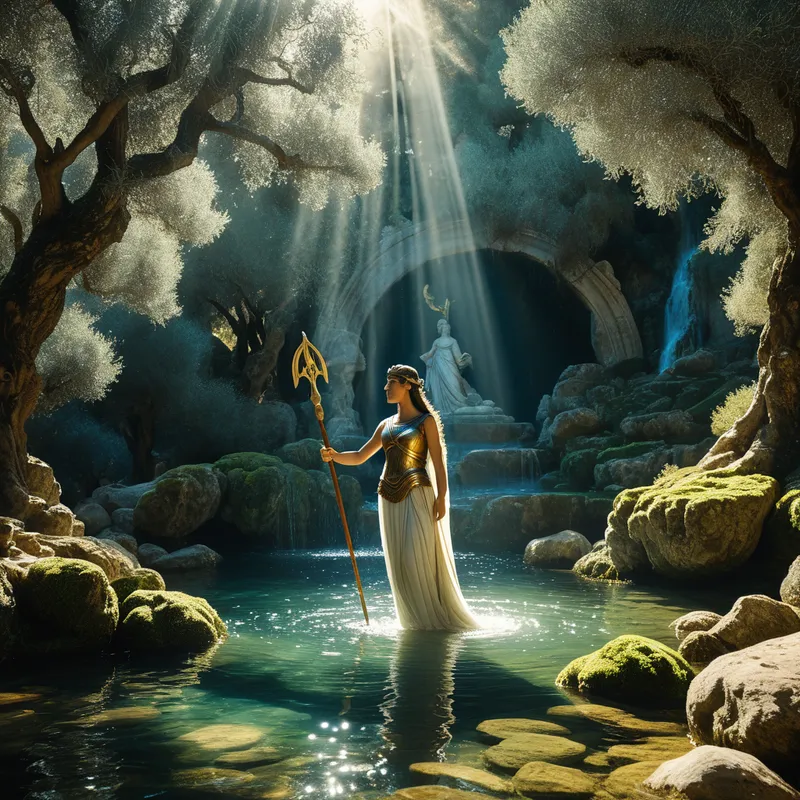
And to this secret place came Athena, daughter of Zeus, she of the gray, unblinking eyes. Weary from the labors of guiding heroes and guarding cities, she sought the solitude of the grove. She laid aside her aegis, heavy with the gaze of the Gorgon. She set down her bronze-tipped spear against the mossy stone. And she entered the pool, the sacred waters of the Hippocrene, to wash the dust of mortality from her immortal skin.
But the grove had another visitor. A young hunter, Tiresias, driven by thirst or perhaps by a fate he could not yet comprehend, strayed from the path. The sound of water drew him, a siren song in the quiet wood. He pushed through the final curtain of willow fronds, and the world stopped.
There, in the dappled light, was a vision no mortal eye was meant to see. The goddess, unveiled, a form of power and perfection that was not for his kind. The water shimmered around her like liquid silver. In that single, eternal moment, Tiresias saw. He witnessed the divine in its most vulnerable, most intimate state. His breath caught; the very air turned to ice.
Athena’s head snapped up. Her gray eyes, which saw the weave of fate and the plans of men, fixed upon him. There was no anger in them, not as a mortal would know it. There was a cosmic coldness, the implacable enforcement of a divine law. “Mortal,” her voice echoed, not from her lips, but from the stones, the trees, the water itself. “Your eyes have taken what they cannot hold.”
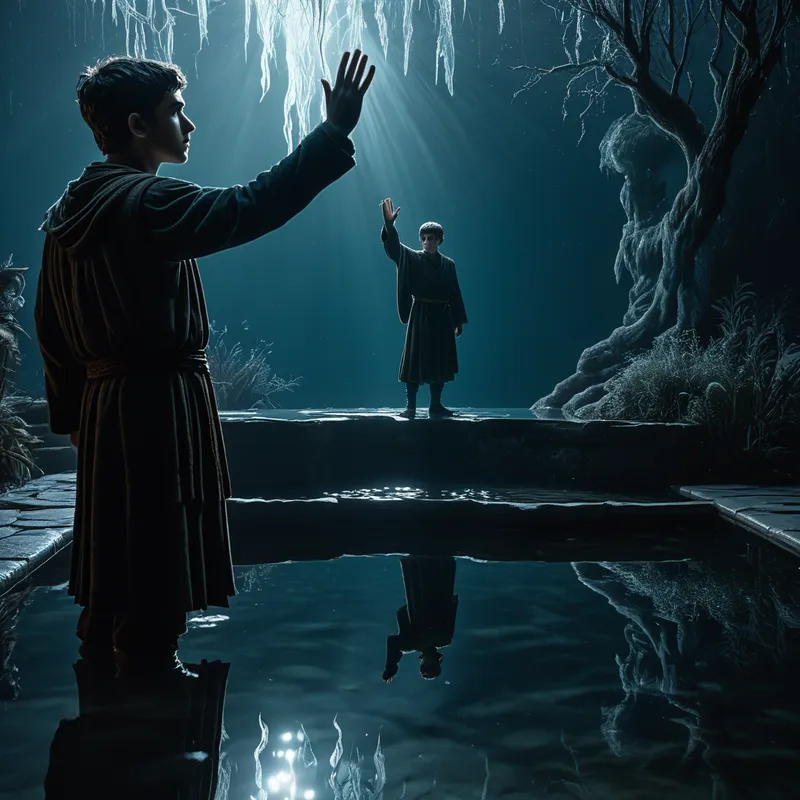
She did not raise her hand in violence. She simply spoke the consequence. A darkness, swift and absolute, fell upon Tiresias. The vibrant green of the grove, the shimmering form in the water, the very light of the sun—all were swallowed by an endless night. He stumbled back, blind, the price for his glimpse of the forbidden paid in full.
But the story does not end in darkness. For Athena is not cruel; she is just. And justice, in the realm of the gods, has two faces. As Tiresias knelt in despair, her voice came again, softer now, carrying a strange mercy. “You have lost the sight of the sun, son of Everes. But for the light you have stolen from me, I give you another. You will see what is to come, not what is. The eyes of your spirit will be opened, where the eyes of your body are closed.”
With those words, the inner world of Tiresias erupted into visions. The tangled threads of future and past, the whispers of souls, the hidden motives of kings and gods—all flooded into the void left by the light. The blind man became the seer. He had looked upon a goddess and was blinded; for that blindness, he was granted the terrible, weighty gift of prophecy. His journey back from the grove was not one of a hunter, but of a man forever walking the line between two worlds: the tangible world he could no longer see, and the spectral world of truth he was now condemned to know.
Cultural Origins & Context
This haunting episode is found within the labyrinthine mythological corpus surrounding the prophet Tiresias, most notably in Callimachus’s Hymn to Athena and later echoed in the works of Pseudo-Apollodorus. It is a myth that operates in the interstitial spaces of Greek religious thought—not a foundational epic of heroes, but a profound etiological tale explaining the origin of a famous seer’s condition. It was a story told to answer the question: “Why is the wise Tiresias blind?”
Its societal function was multifaceted. On one level, it reinforced a core tenet of Greek piety: the absolute, unbridgeable gulf between mortal and divine. To see a god in their true, unveiled form was a transgression with severe, often fatal, consequences (as with Semele). The myth served as a warning about boundaries and the dangers of accidental sacrilege. On another level, it explored the complex Greek relationship with disability and gift. Tiresias’s blindness was not a random tragedy but a direct, meaningful exchange—a quid pro quo with the cosmos. His physical loss was the prerequisite for his spiritual gain, modeling a cultural narrative where profound wisdom is often born from profound suffering and separation from ordinary life.
Symbolic Architecture
The Baths of Athena is a masterful allegory of consciousness and the cost of knowledge. The spring itself is no ordinary pool; it is the Hippocrene, the “Horse’s Spring,” a symbol of poetic inspiration and the bursting forth of the unconscious. Athena bathing here represents the individuated Self in a state of vulnerable, unarmored reflection—the core of wisdom stripped of its defensive, worldly implements (her spear and shield).
To witness the naked truth is to be blinded by its radiance; true sight begins only when the illusions of the everyday world are taken away.
Tiresias, the mortal hunter, represents the conscious ego, wandering the forest of life. His “thirst” is the seeking drive of the psyche. His transgression is the inevitable, often accidental, confrontation with a content of the unconscious (the Self/Athena) that is too potent, too complete, for the conscious mind to assimilate without being utterly overthrown. The blinding is not a punishment, but a necessary psychic defense. The conscious framework, the “sight” that navigates the external world, must be dissolved to make room for a new mode of perception.
The compensatory gift of prophecy is the birth of inner sight—insight. It is the ability to perceive patterns, meanings, and potentials (the future) that are invisible to the outward-oriented senses. Tiresias becomes a living symbol of the introverted, intuitive function, navigating by an inner light after the outer light has been extinguished.
The Dreamer’s Resonance
When this myth stirs in the modern unconscious, it rarely appears as a literal scene of a goddess bathing. Instead, it manifests as a dream of profound, shocking revelation that carries a simultaneous sense of awe and violation. A dreamer might find themselves accidentally opening a forbidden door, reading a private diary, or seeing a parent or authority figure in a moment of raw, vulnerable humanity. The somatic feeling is one of freezing, of breath held, followed by a wave of guilt and dread.
Psychologically, this dream pattern signals a critical moment of confrontation with a content of the personal or collective unconscious that the ego is not prepared to handle. It is the “too much truth” moment. The subsequent feeling of being “blinded” or cursed in the dream—losing one’s way, technology failing, lights going out—represents the ego’s temporary disorientation and incapacitation. The psyche is declaring that the old way of seeing the world (the dreamer’s current conscious attitude) is no longer tenable. It has been incinerated by a more profound reality. The dreamer is in the liminal space between Tiresias the hunter and Tiresias the seer, having glimpsed their own inner Athena and now paying the price of their former ignorance.

Alchemical Translation
The alchemical journey modeled here is the nigredo, the necessary blackening, the descent into darkness that precedes illumination. For the modern individual, the “Bath of Athena” is that life event or inner realization that shatters our naive, outward-focused consciousness. It is the loss of a job that defined us, the end of a relationship that structured our world, the diagnosis that changes everything, or the sudden, uncomfortable insight into our own shadow. This is the blinding.
The gift is always hidden within the wound. The compensation of the Self is not a reward, but the only possible adaptation to the new, more complex reality we have been forced to perceive.
The process of psychic transmutation lies in enduring the darkness without fleeing back into illusion. It is the slow, painful acceptance of Tiresias: to stop lamenting the lost sunlight and to begin learning to interpret the chaotic, symbolic language of the inner visions. The “prophecy” granted is not about telling the future, but about developing a profound inner knowing—an intuition that sees the deeper currents beneath surface events. The individual learns to navigate by the stars of the soul, not the landmarks of the world. The spear and shield of old identities (the professional, the partner, the healthy person) are left at the pool’s edge. What emerges is a wiser, more integrated consciousness, one that has paid for its sight with a piece of its innocence and now carries the weight of that knowledge. The goal is not to regain the old sight, but to become, like Tiresias, a bridge between worlds, speaking truths that are heard only by those who are also ready to be blinded by them.
Associated Symbols
Explore related symbols from the CaleaDream lexicon: