
The Bath of Athena Myth Meaning & Symbolism
A mortal hunter witnesses the goddess Athena bathing, violating a sacred boundary and unleashing a fateful, transformative curse.
The Tale of The Bath of Athena
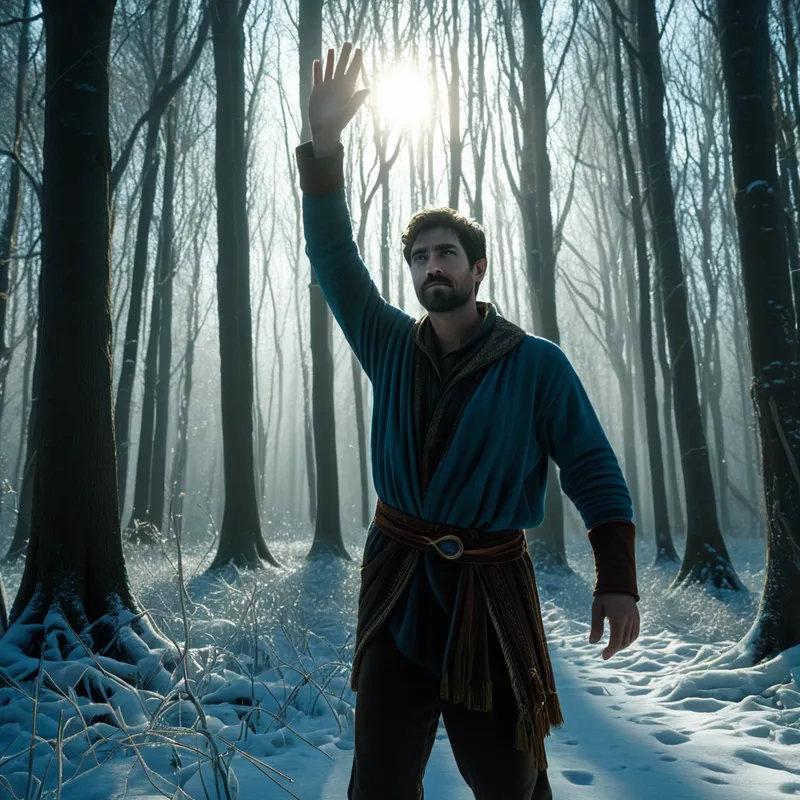
The heat of the high sun lay heavy upon the Cithaeron. In the deep, secret heart of the forest, where the air was cool and smelled of damp earth and stone, a hunter moved with the silence of a ghost. His name was Actaeon, and his feet knew the paths of the wild as well as his own heartbeat. On this day, the chase had been long, and the dogs—fifty strong, a baying, panting pack—were weary. Seeking a place for them to drink and rest, Actaeon followed the sound of trickling water, a sound that grew into the soft music of a hidden spring.
He pushed aside the final curtain of willow fronds, and the world changed.
Before him lay a grove so still it seemed to hold its breath. The light fell in sacred, dappled shafts upon a clear, rock-bound pool. And there, in the water’s embrace, was a vision not meant for mortal eyes. It was Athena, daughter of Zeus, stripped of her glinting aegis and fearsome helm. Her silver armor lay discarded upon a mossy bank like the shed skin of a divine creature. She was bathing, an act of sacred solitude, a moment of vulnerability for the ever-vigilant goddess.
Time shattered. Actaeon’s breath caught in his throat. A branch snapped under his paralyzed foot.
The goddess’s head turned. Her eyes, grey as a storm-laden sky, found his. In them, there was no shock, no human embarrassment. There was a cold, gathering fury as vast and impersonal as the sky itself. This was not a personal violation, but a cosmic one. The sacred boundary between the divine and mortal had been irrevocably crossed by a gaze.
No word was spoken. None were needed. Athena, in a gesture both swift and terrible, flicked water from the pool onto the hunter’s face.
“Now go,” her voice echoed, not in the air, but in the very marrow of his bones. “Tell, if you can, that you have seen Athena unveiled.”
The curse took root not as pain, but as transformation. A strange stiffness seized Actaeon’s limbs. He fell to his hands and knees, but they were no longer hands. They were hard, cloven hooves. A great weight sprouted from his brow—a crown of branching antlers. His own voice, when he tried to cry out, emerged as a frantic, guttural bellow. In the still water of the pool, he saw not his own face, but the wide, terrified eyes of a stag.
Then, he heard the baying. His own hounds, catching the scent of prey, crashed through the undergrowth. He knew their names—Melampus, Pamphagos, every beloved companion—but they knew him not. He turned to flee, his new, ungainly body stumbling on the familiar ground. The chase was on, but he was now the quarry. He raced through the woods he once ruled, his heart hammering against ribs that were no longer his own, until he could run no more. At a river’s edge, cornered, he turned to face them. He saw the recognition die in their eyes, replaced by pure hunting instinct. The pack, his pack, descended.
The last sound was not a man’s scream, but the cry of a stag, cut short. The grove, once violated, returned to its sacred silence. The goddess was gone, leaving only the whispering leaves and the slowly clearing water to bear witness.
Cultural Origins & Context
This haunting narrative comes to us primarily from the Roman poet Ovid, in his epic Metamorphoses, though echoes of the tale exist in earlier Greek sources like the Catalogues of Women and the works of Hesiod. It is a classic metamorphosis myth, a genre that served as a foundational way for the ancients to explain the origins of natural phenomena, cultural taboos, and the capricious power of the gods.
The myth functioned on multiple societal levels. For hunters, it was a cautionary tale about the sacredness of certain spaces—groves and springs were often temenos, property of the gods. It reinforced the concept of hubris—not mere pride, but the catastrophic overstepping of one’s allotted mortal sphere. To witness a god in their true, unguarded form was to partake of a knowledge that annihilates the knower. The story was told not just as entertainment, but as a religious lesson in boundaries, fate, and the terrifying cost of accidental sacrilege.
Symbolic Architecture
At its core, the Bath of Athena is a myth about the psychology of vision and the price of consciousness. The pool is not merely a bathing spot; it is the mirror of the soul, the reflective surface of the unconscious where a deity—an archetype of supreme wisdom and disciplined power—resides in a state of essential being.
To gaze upon the naked archetype is to be consumed by it. The vision re-makes the viewer in its own image, dissolving the old identity.
Actaeon, the conscious ego in pursuit of worldly goals (the hunt), stumbles unprepared into the sanctum of the Self. Athena represents the Self in its unadorned, potent reality: wisdom, strategy, and creative force stripped of its protective, personified symbols (her armor). His “crime” is one of unconscious perception. He does not willfully spy; he sees. And in that seeing, his old self cannot survive. The transformation into a stag symbolizes his regression to a purely instinctual, prey-animal state. He is hunted down by his own passions and drives (his hounds), which no longer recognize their master. The myth dramatizes a psychic catastrophe: the ego, confronted directly with the raw power of the Self, is shattered and assimilated by the unconscious forces it sought to command.

The Dreamer’s Resonance
When this myth stirs in the modern dreamer, it often manifests as dreams of profound, accidental exposure. You may dream of walking into a room you shouldn’t, of seeing a parent or authority figure in a vulnerable, private state, or of discovering a secret so vast it feels like a physical blow. The somatic feeling is one of freezing, of being caught in a gaze that petrifies. There is a deep, instinctual shame—not for an action, but for an awareness.
Psychologically, this signals a moment where a previously hidden aspect of the psyche—a core complex, a buried talent, a traumatic truth—has suddenly surfaced into consciousness. The dream-ego, like Actaeon, is not ready to integrate this “naked” knowledge. The feeling of being transformed and pursued represents the psyche’s defensive reaction; it attempts to flee from this new consciousness, to become something else, only to find that the very tools of one’s personality (the hounds) are now turned against the self in a process of painful, necessary disintegration.

Alchemical Translation
The alchemical journey mirrored here is the nigredo, the blackening, the utter dissolution of the ego’s known form. Actaeon’s fate is not a finale, but a brutal beginning.
The curse is the first gift of the goddess. To be unmade is the prerequisite for being remade under a new, more conscious law.
For the individual, the “Bath of Athena” moment occurs when life circumstances—often seemingly accidental—force a confrontation with a truth we have spent a lifetime armoring ourselves against. It is the unexpected diagnosis, the sudden betrayal, the visionary insight that dismantles our worldview. We are, in that moment, “splashed” by the divine. The old identity—the hunter, the one in control—dies. We feel antlered, awkward, exposed, and pursued by our own fears.
The alchemical work begins in the aftermath of this vision. The goal is not to avoid the gaze, but to learn how to bear it. To integrate the wisdom of Athena is not to become her, but to internalize her qualities: to don the aegis of conscious discernment and the helm of disciplined thought. One must learn to command the hounds of instinct and passion, not as a wild hunter, but as a wise ruler. The pool remains, but the relationship to it changes. We learn to approach the sacred not as trespassers, but as initiates, understanding that some truths are not to be grasped by the ego, but served by the whole being. From the dissolution of Actaeon emerges the potential for a consciousness that has seen the divine nakedness and, instead of being destroyed, is ultimately refined by its terrible, clarifying light.
Associated Symbols
Explore related symbols from the CaleaDream lexicon: