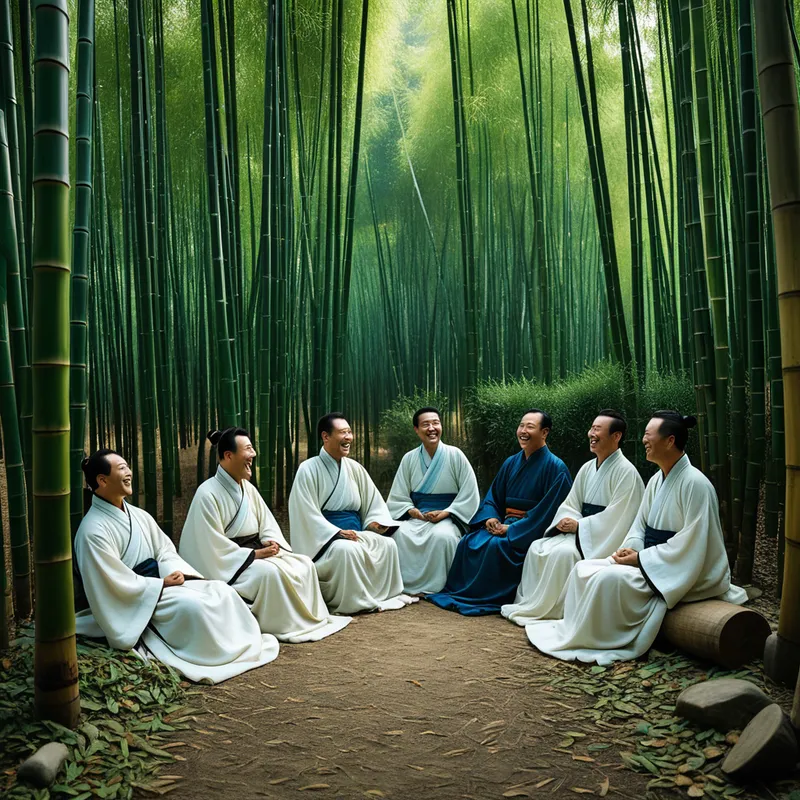
The Bamboo Grove Seven Myth Meaning & Symbolism
Seven Wei-Jin dynasty scholars retreat to a bamboo grove, rejecting corrupt politics for wine, poetry, and philosophical freedom, embodying the rebel archetype.
The Tale of The Bamboo Grove Seven
Let the clamor of the court fade. Let the dust of ambition settle. Come, listen, and step into the whispering shadows of a bamboo grove during the twilight of the Wei-Jin dynasty.
The air here is cool and carries the scent of damp earth and green vitality. The tall canes of bamboo creak and sigh with a secret language, their leaves filtering the harsh sun into a thousand dancing coins of light. This is no ordinary forest. This is a sanctuary, a world deliberately chosen.
Here, they gathered. Not as officials, not as sons bound by duty, but as souls in flight. They were seven: Ji Kang, whose zither-play could halt passing clouds; Ruan Ji, whose piercing eyes saw through the hollow pageantry of the age; Shan Tao, Xiang Xiu, Liu Ling, Wang Rong, and Ruan Xian. Each a luminary in his own right, a master of Qingtan, poetry, or music. Yet in the world of men, they found only a theater of corruption, a court ruled by the ruthless Sima clan, where integrity was a liability and truth a danger.
So, they turned their backs. They forsook the marble halls for the earthen floor, the silken robes for loosened garments, the edicts of the emperor for the only law they recognized: the pursuit of authenticity. Their rebellion was not of swords, but of spirit. Their arsenal was wine, poetry, music, and unbridled conversation.
Picture them now. Ji Kang’s fingers dance over the strings of his guqin, the notes flowing like a mountain stream, clear and untamed. Liu Ling, followed by a servant carrying a jug of wine and a shovel (to bury him where he fell), declaims verses that mock mortal pretensions. Ruan Ji drives his cart into the wilderness, and when the path ends, he sits among the thickets and weeps—not for the lost road, but for the absurdity of the world. They drink deeply, not to forget, but to remember—to remember a state of being before names and duties, to touch the raw Dao.
Their conflict was not with a dragon, but with the very fabric of a society they deemed false. The rising action was the daily, conscious choice to remain outside, to cultivate their grove of the mind. The resolution was not a victory, but a state of being. They lived, and in that living—in their drunken laughter, their melancholic silences, their brilliant, fleeting works—they forged a legend. They became the Zhulin Qixian, eternal residents of a green refuge they built not from wood, but from will.
Cultural Origins & Context
This is not a myth of high antiquity, but a legend born from historical fissures. The Three Kingdoms and Wei-Jin periods were times of immense political turmoil and moral uncertainty. The rigid Confucian order that had held the Han dynasty together had shattered. In its place arose the Daoist revival, with its values of naturalness (ziran), freedom, and a deep suspicion of artificial social constructs.
The Bamboo Grove Seven were likely a real, loose-knit circle of intellectuals in the 3rd century CE, centered around the magnetic, tragic figure of Ji Kang. Their story was amplified and romanticized in texts like Shishuo Xinyu (A New Account of the Tales of the World), a collection of anecdotes about Wei-Jin elites. It served a powerful societal function: it provided a model of dignified resistance. In an era where open political dissent could mean death, their “retreat” (yinyi) was a profound political statement. It said that true power and integrity lay not in compliance, but in the conscious act of removing one’s spirit from a corrupt game. They became the ultimate literati ideal—the sage who finds sovereignty in seclusion.
Symbolic Architecture
The myth is a masterclass in symbolic resistance. Every element is an archetypal counterpoint to the “world.”
The Bamboo Grove is the temenos, the sacred enclosure. Bamboo itself is hollow, flexible yet unbreakable, evergreen—a perfect symbol for the resilient, adaptable, and principled mind. It represents a psyche that bends but does not sell its core.
The Seven are not a hierarchy but a constellation. They model a community based on mutual recognition of genius and frailty, not on rank or utility. They represent the fragmented parts of the Self finding wholeness outside collective norms.
The Wine is the intoxicant of raw truth and liberated emotion. It dissolves the ego’s armor, allowing for the expression of unvarnished grief (Ruan Ji’s tears) and unbridled joy. It is the prima materia of their creative and philosophical outpouring.
Their Arts—music, poetry, debate—are not mere pastimes. They are the rituals of this green sanctuary, the means by which they transmute the pain of the world into something beautiful and enduring. Ji Kang’s final act, playing the guqin before his execution, is the ultimate statement: you can kill the man, but the melody born in the grove is immortal.

The Dreamer’s Resonance
When this myth stirs in the modern dreamer, it signals a profound psychological process: the soul’s imperative to withdraw. One may dream of finding a hidden room in a familiar house, of turning down a forgotten path in an urban jungle, or of refusing to speak a mandated language. These are somatic visions of the “inner bamboo grove.”
The dreamer is likely experiencing a season of intense alienation from their professional, social, or even familial roles. A feeling that the “game” they are playing is corrupt at its core, demanding the sacrifice of authenticity for hollow rewards. The psyche is initiating a necessary retreat. This is not escapism, but a vital incubation period. The emotional tone can range from the liberating joy of the group’s laughter to the profound, solitary melancholy of Ruan Ji. It is the Self insisting, “To participate here is to die. We must go elsewhere to live.”
Alchemical Translation
The journey of the Seven is a precise map for the modern individuation process, what Jung called the “nigerdo” or the blackening. It is the first, crucial act of separatio.
The first alchemical operation is not to conquer, but to refuse. To consciously withdraw one’s identity, one’s life-force, from the collective complexes that have claimed it.
Their myth teaches that individuation often begins with a no. A no to the false persona, to the corrupting demands of the collective, to the “shoulds” that strangle the soul. This retreat is not the goal, but the essential precondition. In the grove—the vessel of the inner work—the elements of the Self (the seven scholars) can commune freely. The wine of shadow material is drunk and expressed. The music of the anima/animus is played. The poetry of the unconscious is written.
The triumph is not in returning to society reformed, but in having established an inner citadel so authentic that one’s relationship to the outer world is forever changed. One may return to the “court,” but never again as a subject. One carries the grove within. The ultimate alchemical gold they produce is not a political solution, but a state of unassailable inner freedom—the sovereignty of the Self that chooses its engagements from a place of wholeness, not need. Their legacy is the proof that sometimes, to save your soul, you must vanish into the green.
Associated Symbols
Explore related symbols from the CaleaDream lexicon: