The Bamboo Grove Myth Meaning & Symbolism
A divine maiden descends to a mortal bamboo grove, where her love for a shepherd births a celestial child, weaving a myth of sacrifice, connection, and the sacred in the ordinary.
The Tale of The Bamboo Grove
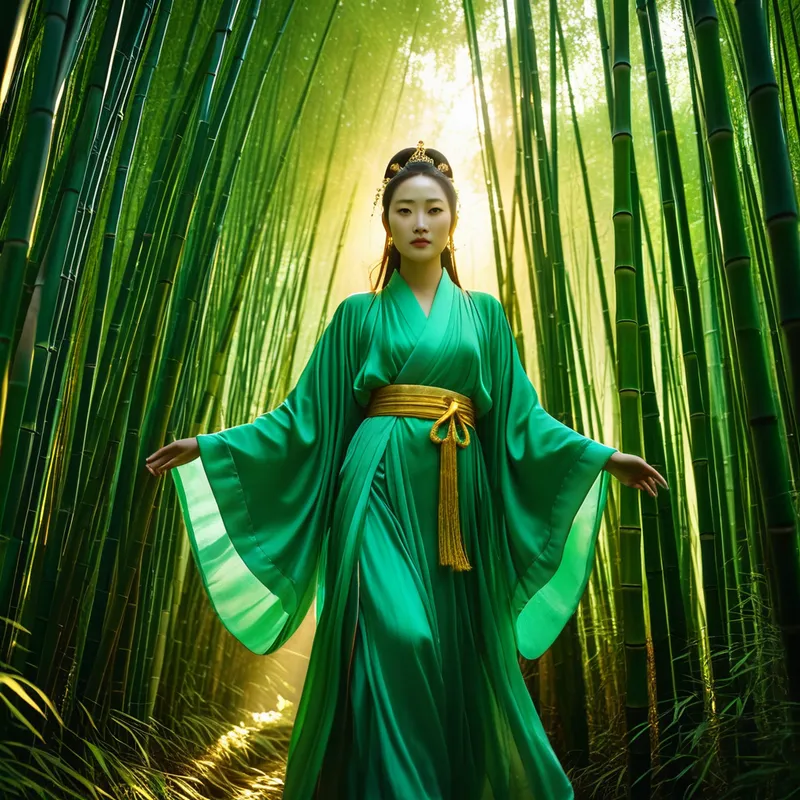
Listen, and let the mists of time part. In the celestial courts of the [Jade Emperor](/myths/jade-emperor “Myth from Chinese culture.”/), there was a maiden of such grace that the stars themselves paused in their dance to watch her. She was a Tiannü, a weaver of cloud-silk and dawn-light, whose duty was to tend [the immortal](/myths/the-immortal “Myth from Taoist culture.”/) gardens. Yet, her heart was a lonely bird in a gilded cage, her eyes forever gazing downward, past the pearlescent clouds, to the vibrant, breathing world below.
One fateful day, [the veil](/myths/the-veil “Myth from Various culture.”/) between realms grew thin. With six of her sister maidens, she slipped past the heavenly gates, their laughter like silver bells as they descended to the mortal realm. They alighted in a place of profound earthly magic—a vast, whispering bamboo grove. The air was cool and green, filled with the soft clatter of leaves and the scent of damp earth. Here, they shed their celestial solemnity, bathing in a crystal-clear stream, their divine forms reflected in the [water](/myths/water “Myth from Chinese culture.”/) like moonflowers.
But fate, that silent weaver, had already chosen its thread. A young shepherd, poor in worldly goods but rich in kindness, wandered into this sacred grove. His name is lost to [the wind](/myths/the-wind “Myth from Various culture.”/), but his heart was true. Discovering the maidens’ robes of cloud and light draped upon [the bamboo](/myths/the-bamboo “Myth from Taoist culture.”/), he did not steal, nor did he flee in fear. Instead, captivated by a robe woven with the pattern of [the morning star](/myths/the-morning-star “Myth from Astrological culture.”/), he gently took it, not as a thief, but as one enchanted by a beauty he could not comprehend.
The hour of return came. Six maidens donned their robes and ascended on shafts of light, tears glistening for their lost sister. The seventh stood alone, her connection to heaven severed. It was then the shepherd emerged, holding her celestial garment. In his eyes, she saw not avarice, but awe; not possession, but profound reverence. In that silent grove, under the cathedral of bamboo, a bond was forged—not of captivity, but of mutual choosing. The divine maiden chose the mortal world; the mortal man chose the divine mystery.
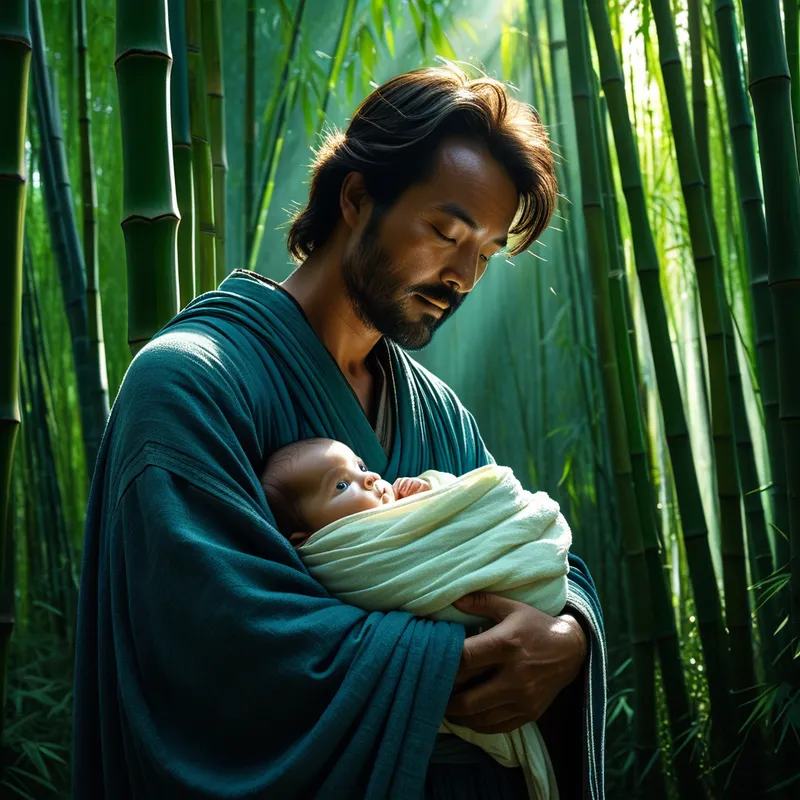
They built a life of simple harmony. From their union was born a son, a child who carried the light of heaven in his smile. Yet, the cosmos demands balance. The Jade Emperor, learning of his daughter’s descent, was rent by wrath and grief. The heavens darkened. Celestial soldiers descended upon the bamboo grove, their armor cold as winter stars. The maiden, knowing her time of earthly grace was ended, turned to her shepherd husband one last time, her touch a final blessing. She donned the recovered robe, its fabric now heavy with the weight of mortal love. As she ascended, forced back to the celestial palace, her tears fell upon the grove like summer rain, and the bamboo forever after bore a secret, glistening stripe—the mark of a love that bridged two worlds.
Cultural Origins & Context
This poignant narrative, often known as the “Legend of the Heavenly Weaver” or the “Cowherd and the Weaver Girl,” finds its roots deep in Chinese folklore, with versions dating back to the Zhou Dynasty. It is a foundational myth associated with the Qixi Festival, often called Chinese Valentine’s Day, celebrated on the seventh day of the seventh lunar month. The story was not confined to dusty scrolls; it was sung by farmers in fields, recounted by grandmothers at hearths, and immortalized in poetry and opera. Its primary function was etiological—explaining the origins of [the star](/myths/the-star “Myth from Tarot culture.”/) constellations Vega and Altair, separated by [the Milky Way](/myths/the-milky-way “Myth from Greek culture.”/), and the magpies that supposedly form a bridge for their annual reunion. On a societal level, it reinforced Confucian values of filial piety (the Emperor’s authority) while simultaneously giving voice to a universal human longing: the desire for a love that transcends rigid social and cosmic order.
Symbolic Architecture
The myth’s power lies in its stark, elegant [symbolism](/symbols/symbolism “Symbol: The use of symbols to represent ideas or qualities, often conveying deeper meanings beyond literal interpretation. In dreams, it’s the language of the unconscious.”/). The [bamboo](/symbols/bamboo “Symbol: A symbol of resilience, flexibility, and spiritual growth, often representing strength through adaptability and connection to nature.”/) [grove](/symbols/grove “Symbol: A grove symbolizes a sacred space of nature, tranquility, and introspection, often associated with spiritual growth and connection.”/) itself is the ultimate liminal [space](/symbols/space “Symbol: Dreaming of ‘Space’ often symbolizes the vastness of potential, personal freedom, or feelings of isolation and exploration in one’s life.”/)—neither fully wild [forest](/symbols/forest “Symbol: The forest symbolizes a complex domain of the unconscious mind, representing both mystery and potential for personal growth.”/) nor cultivated field. It is a place of meeting, a sacred [grove](/symbols/grove “Symbol: A grove symbolizes a sacred space of nature, tranquility, and introspection, often associated with spiritual growth and connection.”/) where [heaven](/symbols/heaven “Symbol: A symbolic journey toward ultimate fulfillment, spiritual transcendence, or connection with the divine, often representing life’s highest aspirations.”/) and [earth](/symbols/earth “Symbol: The symbol of Earth often represents grounding, stability, and the physical realm, embodying a connection to nature and the innate support it provides.”/) converse. [Bamboo](/symbols/bamboo “Symbol: A symbol of resilience, flexibility, and spiritual growth, often representing strength through adaptability and connection to nature.”/), with its hollow stem, represents humility, [resilience](/symbols/resilience “Symbol: The capacity to recover quickly from difficulties, adapt to change, and maintain strength through adversity.”/), and the [vessel](/symbols/vessel “Symbol: A container or structure that holds, transports, or protects something essential, representing the self, emotions, or life journey.”/) that contains [spirit](/symbols/spirit “Symbol: Spirit symbolizes the essence of life, vitality, and the spiritual journey of the individual.”/). The celestial [robe](/symbols/robe “Symbol: A robe often represents comfort, authority, or a transition in one’s life, symbolizing the roles we play or the comfort of solitude.”/) is the [symbol](/symbols/symbol “Symbol: A symbol can represent an idea, concept, or belief, serving as a powerful tool for communication and understanding.”/) of divine [identity](/symbols/identity “Symbol: Identity represents the sense of self, encompassing personal beliefs, cultural background, and social roles.”/) and power; its [loss](/symbols/loss “Symbol: Loss often symbolizes change, grief, and transformation in dreams, representing the emotional or psychological detachment from something or someone significant.”/) is not a theft but a necessary shedding for incarnation, for entering into the [fullness](/symbols/fullness “Symbol: A state of complete satisfaction, abundance, or completion, often representing emotional, spiritual, or physical fulfillment.”/) of embodied experience.
The [shepherd](/symbols/shepherd “Symbol: A shepherd symbolizes guidance, protection, and the nurturing aspects of leadership, often reflecting the dreamer’s desire for direction or support.”/) represents the grounded, nurturing [aspect](/symbols/aspect “Symbol: A distinct feature, quality, or perspective of something, often representing a partial view of a larger whole.”/) of the [human](/symbols/human “Symbol: The symbol of a human represents individuality, complexity of emotions, and social relationships.”/) [soul](/symbols/soul “Symbol: The soul represents the essence of a person, encompassing their spirit, identity, and connection to the universe.”/)—[the ego](/myths/the-ego “Myth from Jungian culture.”/) capable of witnessing and holding the numinous without being destroyed by it. The Tiannü is the archetypal [anima](/symbols/anima “Symbol: The feminine archetype within the male unconscious, representing soul, creativity, and connection to the inner world.”/), the [soul](/symbols/soul “Symbol: The soul represents the essence of a person, encompassing their spirit, identity, and connection to the universe.”/)-[image](/symbols/image “Symbol: An image represents perception, memories, and the visual narratives we create in our minds.”/), the divine fragment that descends to animate a [human](/symbols/human “Symbol: The symbol of a human represents individuality, complexity of emotions, and social relationships.”/) [life](/symbols/life “Symbol: The symbol of ‘Life’ represents a journey of growth, interconnectedness, and existential meaning, encompassing both the joys and challenges that define human experience.”/) with meaning, [beauty](/symbols/beauty “Symbol: This symbol embodies aesthetics, harmony, and the appreciation of life’s finer qualities.”/), and a touch of the eternal.
The sacred marriage, the hieros gamos, always occurs in the liminal space—the grove, the shore, the dream. It is the ego’s encounter with the soul, where possession is impossible, but communion transforms both.
Their forced [separation](/symbols/separation “Symbol: A spiritual or mythic division between realms, states of being, or consciousness, often marking a transition or loss of connection.”/) is not merely a tragic ending but a necessary archetypal [truth](/symbols/truth “Symbol: Truth represents authenticity, honesty, and the quest for knowledge beyond mere appearances.”/). The complete and permanent merging of divinity and humanity is unsustainable in the mortal coil; the [tension](/symbols/tension “Symbol: A state of mental or emotional strain, often manifesting physically as tightness, pressure, or unease, signaling unresolved conflict or anticipation.”/) of the separation, the longing across the [river](/symbols/river “Symbol: A river often symbolizes the flow of emotions, the passage of time, and life’s journey, reflecting transitions and movement in one’s life.”/) of stars, is what creates the ongoing psychic dynamism—the poetry, the [festival](/symbols/festival “Symbol: A festival typically symbolizes celebration, community, and a collective joy that brings people together for a shared experience.”/), the enduring myth in the [heart](/symbols/heart “Symbol: The heart symbolizes love, emotion, and the core of one’s existence, representing deep connections with others and self.”/).
The Dreamer’s Resonance
When this myth stirs in the modern unconscious, it often manifests in dreams of profound, bittersweet connection. You may dream of finding a lost, beautiful object of immense value in an unexpected, natural place (the robe in the grove). You may dream of a luminous, guiding figure who must leave at dawn, leaving you with a mixture of grief and expanded awareness. The somatic experience is often one of heartache paired with a strange fullness—a “sacred wound.”
This dream pattern signals a pivotal psychological process: the encounter with, and temporary integration of, a soul-quality. You have touched a part of your own inner divinity—creativity, compassion, or deep love—and made it real in your earthly life (the relationship, [the child](/myths/the-child “Myth from Alchemy culture.”/)). The ensuing feeling of loss or separation is the soul’s way of recalibrating. The divine cannot be owned by the ego; it can only be visited, loved, and released, leaving the dreamer forever changed, marked like the bamboo with the stripe of that encounter. It is the [psyche](/myths/psyche “Myth from Greek culture.”/) working through the necessary suffering of consciousness, the price of having tasted the nectar of a deeper reality.

Alchemical Translation
For the individual on the path of individuation, the Bamboo Grove myth is a perfect map of psychic alchemy. The initial state is a sterile, ordered heaven (a rigid [persona](/myths/persona “Myth from Greek culture.”/) or conscious attitude). The descent is the crucial, often involuntary, movement into the unconscious—the lush, ambiguous grove of feelings, instincts, and forgotten potentials.
The meeting with the shepherd and the maiden is the coniunctio, [the sacred marriage](/myths/the-sacred-marriage “Myth from Various culture.”/). This is the moment when a conscious attitude (the grounded, caring shepherd) recognizes and engages with a potent content from the unconscious (the divine anima). The “child” born of this union is the transcendent function—a new, living attitude that is more than the sum of its parts. It might be a creative work, a profound insight, or a new capacity for relationship.
The alchemical gold is not the permanent possession of the divine, but the enduring capacity to be visited by it. The grove itself becomes the lasting inner sanctuary.
The enforced return of the maiden represents the inevitable dissolution of this temporary synthesis. The conscious mind cannot permanently hold the full force of [the Self](/myths/the-self “Myth from Jungian culture.”/). Yet, this is not failure. The alchemical work is in the transmutation of [the vessel](/myths/the-vessel “Myth from Alchemical culture.”/). The shepherd (the ego) is not the same; he has loved and lost a goddess. The bamboo grove (the psyche itself) is forever sanctified by the event. The individual learns to hold the tension of the opposites—heaven and earth, spirit and matter, union and separation—without collapsing into one pole. They learn to host the sacred encounter, to honor it, to let it go, and to forever after hear the whisper of the divine in the rustling of their own inner bamboo.
Associated Symbols
Explore related symbols from the CaleaDream lexicon: