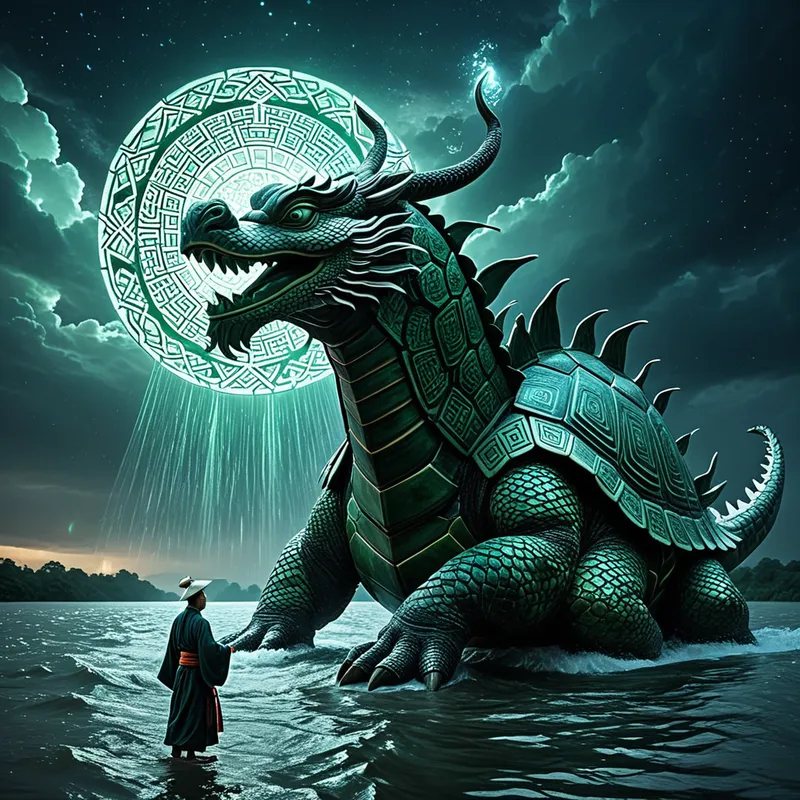
The Bagua Myth Meaning & Symbolism
A sage deciphers the cosmic order from a turtle's shell, revealing the eight fundamental principles that weave the fabric of heaven, earth, and human destiny.
The Tale of The Bagua
Before names, before kingdoms, when the world was a broth of mist and shadow, the great sage Fu Xi walked the earth. He walked not to conquer, but to listen. He listened to the wind’s secret language in the reeds, to the slow, grinding song of the mountains, to the chaotic, beautiful chatter of the stars. Yet their messages were tangled, a symphony without a score.
A great unrest stirred in his spirit. Above him, the heavens wheeled in majestic, silent patterns. Below, the earth held fast in patient, deep-rooted stillness. And between them, all of life—the rushing rivers, the fleeing deer, the sprouting grain—thrashed in a torrent of ceaseless change. There was a pattern to this dance, he felt it in his bones, a hidden logic written into the very fabric of things, but it remained just beyond the grasp of his mind, like a fish glimpsed in murky water.
Then came the day the sky tore open. It was not a storm of anger, but one of revelation. The air grew thick and electric; the Yellow River, usually a muddy brown, churned like molten jade. From the heart of this aquatic chaos, a form emerged. It was the Dragon-Horse, or in other whispers, the Spirit Turtle. This was no ordinary beast. Its scales held the patina of ages, and on its broad, mountainous back was a shell inscribed not by time, but by the cosmos itself.
As lightning etched the sky, illuminating the creature, Fu Xi saw. The natural cracks and plates of the shell were not random. They formed shapes—broken and unbroken lines, stacked in triads. Some were three solid bars, firm as mountain peaks. Others were lines broken in the middle, yielding as flowing water. There were eight. Exactly eight.
In that flash of celestial light, the symphony resolved. The wind’s whisper, the mountain’s groan, the star’s chatter—they all spoke in these eight words. The three solid lines were Qian, the pure, driving force of heaven. The three broken lines were Kun, the deep, nurturing body of earth. Between them were the six children: Zhen, the shock that awakens; Kan, the peril that flows; Gen, the stillness that endures; Xun, the penetration that spreads; Li, the clarity that illuminates; and Dui, the joy that connects.
The conflict of chaos was resolved not by force, but by perception. The rising action was the universe straining to be understood. The resolution was this silent, geometric poem. Fu Xi did not create the law; he witnessed its signature. He translated the cosmos’s first language, and in doing so, gave humanity its first compass to navigate the great river of change.

Cultural Origins & Context
The myth of Fu Xi and the revelation of the Bagua is not a folktale told for mere entertainment. It is a foundational narrative of Chinese cosmological thought, emerging from the mists of the Three Sovereigns and Five Emperors era. It represents the moment culture heroically imposed order on nature’s raw, overwhelming presence.
This myth was passed down through the most venerable of Chinese classics, primarily the appendices of the I Ching (Yijing). Here, Fu Xi is not depicted as a god in the Western sense, but as a sage-king, a civilizing bringer of wisdom who taught his people not just the Bagua, but also hunting, fishing, and domestication. The myth served a profound societal function: it legitimized the I Ching as a sacred text of cosmic, not human, origin. It argued that the principles governing human fate, ethics, and statecraft were the same principles that governed the turning of the seasons and the motions of the stars. The diviner consulting the yarrow stalks was, in a sense, re-enacting Fu Xi’s primal act of deciphering the celestial script.
Symbolic Architecture
The Bagua is not a static symbol but a dynamic system—an alphabet of reality. Its core architecture is a map of psychic and cosmic potentials.
The broken line is not emptiness, but potential. The unbroken line is not rigidity, but direction. Together, they are the binary code of existence.
Each trigram is a three-layered portrait of a fundamental force. The bottom line represents the foundation, the earthly realm. The middle line represents the human, the mediating realm. The top line represents the heavenly, the inspirational realm. Thus, Kan (water) shows a solid, yang line trapped between two broken, yin lines: danger that is firm at its core. Li (fire) shows a broken, yin line held between two solid, yang lines: clarity that depends on a receptive center.
Psychologically, the Bagua represents the complete archetypal field of the human experience. Qian is the archetype of the active, focused Father/King. Kun is the archetype of the nurturing, containing Mother/Matrix. The other six are the “family” of complexes that arise from their interaction: the thunderous awakening of new insight (Zhen), the clinging illumination of an idea (Li), the abysmal descent into the unconscious (Kan), the gentle, pervasive influence of adaptation (Xun), the joyous connection of relationship (Dui), and the still, silent integration of the self (Gen).
The Dreamer’s Resonance
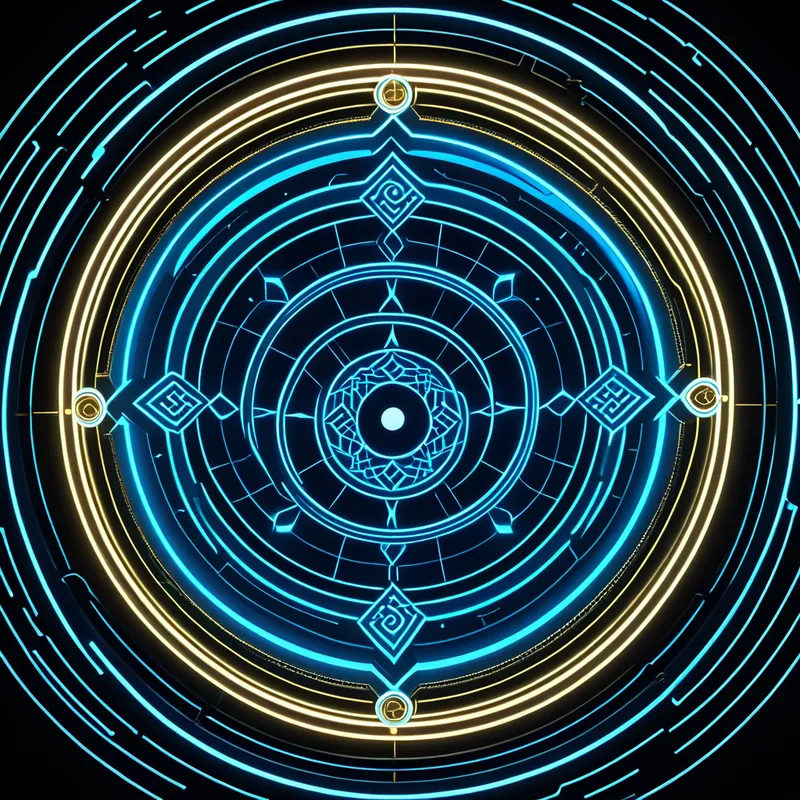
When the Bagua appears in a modern dream, it is rarely as a neat, printed circle. It may manifest as a strange, glowing grid on a wall, a recurring pattern in floor tiles, or a cryptic tattoo on a dream figure. This is the psyche announcing that it is attempting to map a situation.
The somatic feeling is often one of simultaneous overwhelm and profound order—a dizzying sense of complexity that nonetheless promises a key. To dream of the Bagua shifting or rotating suggests the dreamer is in a state of radical psychic transition; the foundational “trigrams” of their personality (their default responses to challenge, relationship, and creativity) are being reconfigured. A dream where one specific trigram is emphasized—like standing under a mountain (Gen) or being caught in a sudden storm (Zhen)—points directly to the archetypal energy currently active. The psyche is using this ancient code to diagnose its own state of flow or blockage.
Alchemical Translation
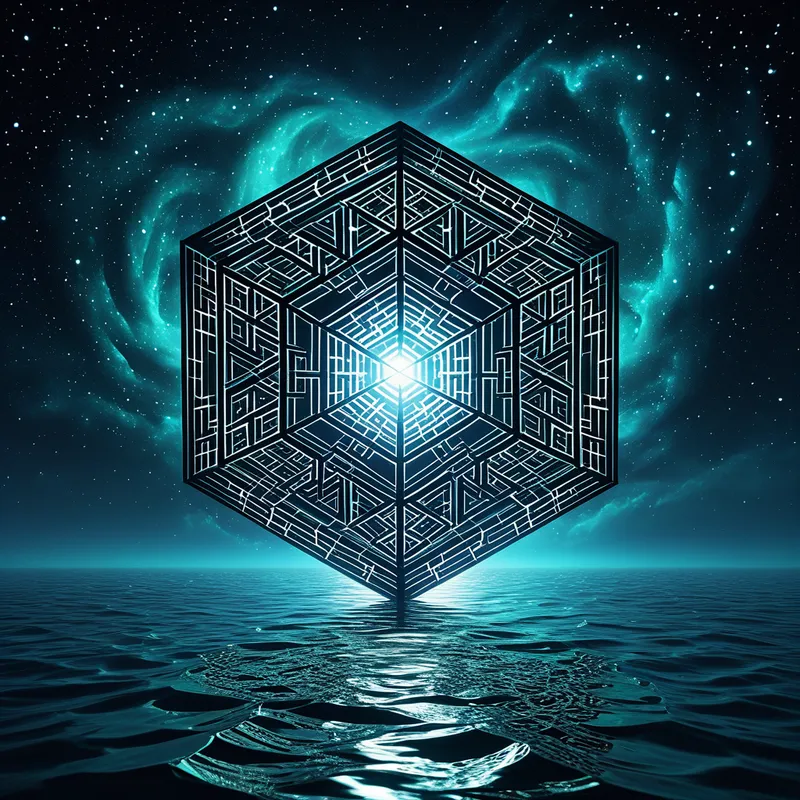
The myth of the Bagua models the entire process of individuation—the alchemical journey toward psychic wholeness. It begins with the prima materia: the “broth of mist and shadow,” the undifferentiated chaos of the unconscious (the Wuji). The sage’s restless spirit represents the emerging ego-consciousness, feeling there is meaning but unable to see it.
The revelation does not come from willful thinking, but from a receptive witnessing of the unconscious as it presents itself—the numinous “turtle” rising from the deep.
The eight trigrams are the crystallization phase. The infinite potentials of the unconscious are distilled into eight core, manageable patterns. This is the crucial act of discrimination. In our own lives, this is the work of sorting our chaotic feelings, impulses, and life events into understandable categories: “This is my father complex (Qian) at play,” “This situation requires the yielding wisdom of Kun,” “My anger here is the shocking energy of Zhen.”
Finally, the arrangement of the trigrams into the circular, dynamic map of the Later Heaven Sequence represents integration. The individual archetypes are no longer isolated; they are seen in their eternal, cyclical relationship. Fire gives way to Earth, which gives way to Lake, and so on. The modern individual achieves the sage’s perspective when they no longer identify solely with one trigram (e.g., always being the “Creative” hero or the “Receptive” caregiver), but can fluidly move through the entire cycle as life demands. They become, like Fu Xi, a conscious participant in the cosmic pattern, navigating the great river of change not with blind fear, but with the decoded map of reality itself held in the mind’s eye.
Associated Symbols
Explore related symbols from the CaleaDream lexicon: