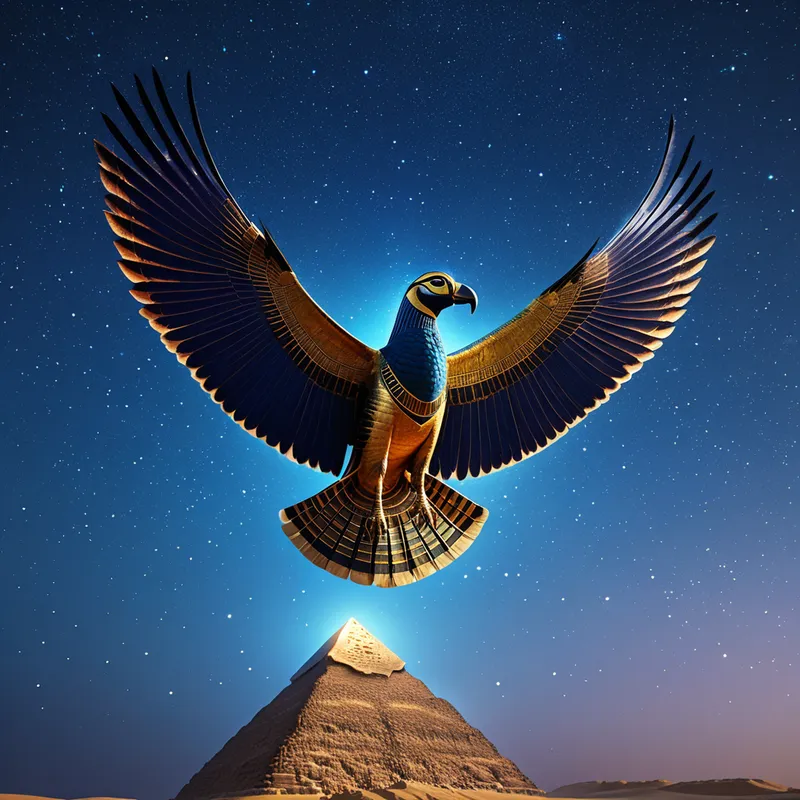
The Ba Soul Myth Meaning & Symbolism
The Ba, a human-headed bird, is the mobile soul that must reunite with its mummified body and divine essence to achieve eternal, conscious life.
The Tale of The Ba Soul
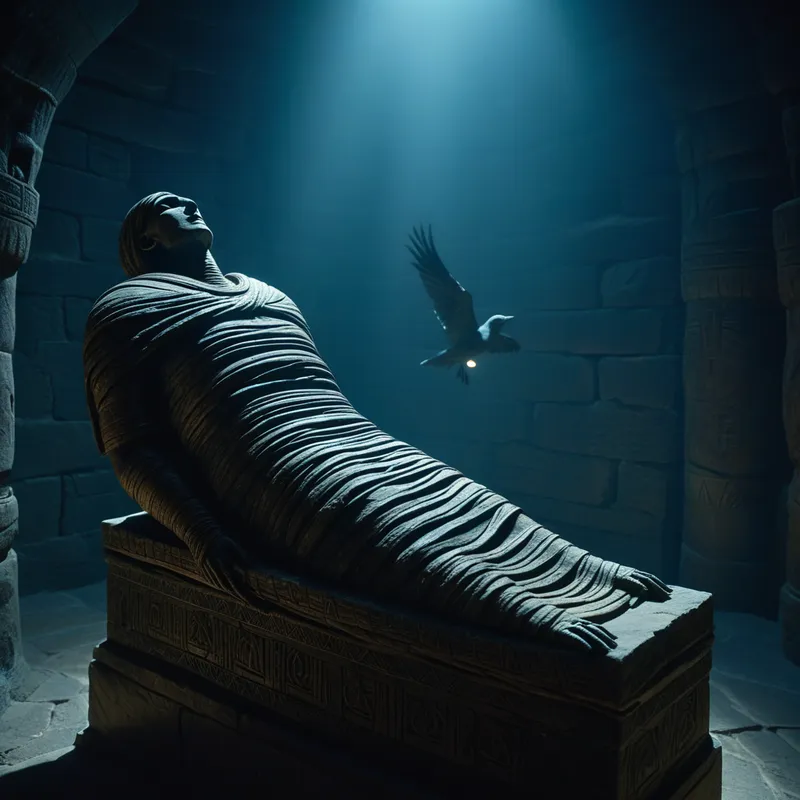
In the deep, star-chilled hours when the sun barque of Ra sails through the perilous Duat, a different kind of journey begins. It starts not with a cry, but with a profound silence—the stillness of a body laid in a tomb, wrapped in linen and resin, surrounded by amulets and spells. This is the husk, the Khat. But from this stillness, a stirring emerges.
A shimmer gathers in the air above the still chest. It coalesces, taking form from the very essence of memory, desire, and personality. It is the Ba. It manifests as a bird, glorious of wing, but with the unmistakable face of the one who has passed—their eyes, their smile, their knowing gaze. With a beat of wings that makes no sound, the Ba lifts from the cold stone. It feels a terrible pull, a centrifugal loneliness. It is free, yet unmoored; it is consciousness untethered.
Its flight is not one of joy, but of desperate seeking. It soars through the tomb’s shaft, into the vast Egyptian night, drawn by an invisible thread back to the places it knew: the riverbank where it fished, the courtyard where children played, the temple where it prayed. It can see, it can remember, but it cannot touch, cannot taste, cannot be. It is a ghost of its own life, a heart without a hearth. The world is a beautiful, painful dream from which it is forever waking.
But the ancient spells painted on the tomb walls whisper on the cosmic winds. They speak of a reunion. The Ba’s true destination is not the world of the living, but a return to its own sanctified shell. Guided by the magic of Anubis and the prayers of the living, the Ba descends back into the darkness of the burial chamber. There, in the absolute quiet, it finds its Khat. It also finds, waiting within, the divine spark, the Akh, and the shadow-self, the Sheut.
In a moment of profound mystery, the Ba alights. It does not enter, but merges. The mobile consciousness rejoins the preserved vessel, is infused with the divine flame, and acknowledges its own shadow. From this union—Ba, Khat, and Akh—arises something new and eternal: a perfected, effective spirit. The Ba is no longer a wanderer. It has come home to itself, achieving Akh, capable of dwelling with Osiris in the Field of Reeds, or traveling with Ra in the sun barque. The journey ends not in an escape, but in a sublime and hard-won integration.
Cultural Origins & Context
The concept of the Ba evolved over millennia of Egyptian thought, from the Old Kingdom pyramids to the New Kingdom tombs in the Valley of the Kings. It was not a story told around a fire, but a theological reality inscribed on coffin texts, pyramid walls, and the Book of the Dead. This was esoteric knowledge, the preserve of priests, scribes, and the elite, designed as a manual for the soul’s journey.
Its societal function was paramount. It provided a complete cosmology of the self, justifying the immense cultural focus on mummification, tomb preparation, and grave goods. The body had to be preserved (Khat) because it was the eternal home for the Ba. The elaborate rituals ensured the Ba could recognize and return to it. This myth was the psychological engine behind an entire civilization’s approach to death, transforming it from an end into a complex, navigable process of becoming. It offered a promise: your personality, your unique “you-ness,” was not annihilated but could achieve a dynamic, conscious eternity.
Symbolic Architecture
The Ba is one of the most potent symbols of the individuated psyche ever conceived. It represents the conscious personality—the part of us that experiences, desires, remembers, and acts in the world. Its bird form symbolizes freedom, mobility, and the higher perspective of consciousness. The human head signifies that this is not an anonymous spirit, but your specific identity, your unique face in the cosmos.
The Ba’s lonely flight is the consciousness that has outgrown its origins but does not yet know its destination. It is freedom experienced as exile.
The central drama—the Ba’s separation from and necessary return to the Khat (body)—encodes a profound psychological truth: consciousness cannot exist in a pure, disembodied state without losing its grounding and potency. The body is not a prison, but an anchor and a vessel. The reunion with the Akh represents the integration of the personal self with the transpersonal, divine spark within. The entire process is a map of psychic wholeness, where the mobile ego (Ba), the grounded physical and instinctual self (Khat), and the guiding Self or divine core (Akh) are brought into alignment.
The Dreamer’s Resonance
When this mythic pattern stirs in the modern dreamer, it often manifests as dreams of searching or flying. You may dream of being a bird, or of having the ability to fly, but feeling lost, aimless, or unable to land. You might dream of trying to return to an old house (the tomb/body) that is both familiar and strangely foreign. These are not dreams of simple escapism, but of the Ba-state: your conscious psyche feeling unmoored from its foundations.
Somatically, this can correlate with feelings of dissociation, anxiety, or a “floating” sensation—where the mind feels disconnected from the bodily experience. Psychologically, it indicates a phase where one’s identity or awareness has expanded or been disrupted (through trauma, growth, or major life change) but has not yet been integrated back into a new, stable sense of self. The dream is the soul’s navigation system, urging a return—not to a past life, but to a deeper embodiment and a search for the inner Akh (the Self) that can make this new, wider consciousness a functional whole.
Alchemical Translation
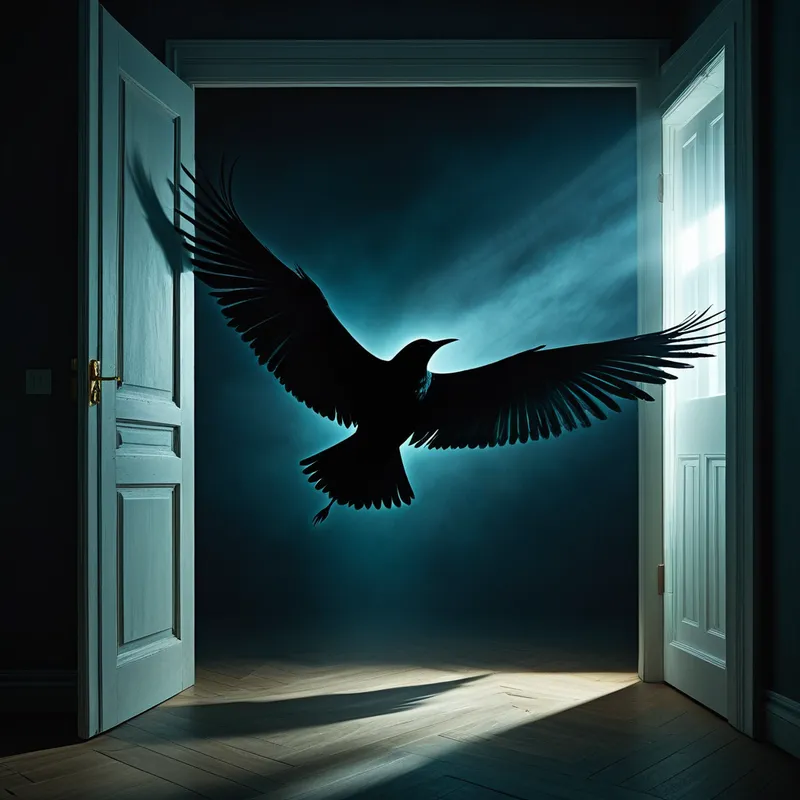
The alchemical process mirrored in the Ba’s journey is that of solve et coagula: dissolve and coagulate. First, the ego-consciousness (Ba) must be separated, allowed to fly free and explore its own nature and its memories (the solve or dissolution of old, rigid identifications). This is the necessary phase of analysis, introspection, and deconstruction.
The midnight flight of the Ba is the nigredo of the soul—the dark night where one confronts the blackness of isolation to find the gold of true identity.
But the work is not complete until the coagula—the coagulation. This is the return and integration. For the modern individual, this means consciously grounding insights back into daily life, honoring the body as the temple of the psyche, and seeking the “divine spark” or core Self (the Akh) that gives life meaning and direction. We must build our own “tomb”—not a place of death, but a sacred, bounded interiority (a practiced mindfulness, a creative discipline, a psychological container) where this reunion can consciously occur. The triumph is not escaping the human condition, but achieving a perfected, effective state within it—becoming an Akh, where every part of the self is in dialogue, and life is lived with both freedom and profound connection.
Associated Symbols
Explore related symbols from the CaleaDream lexicon: