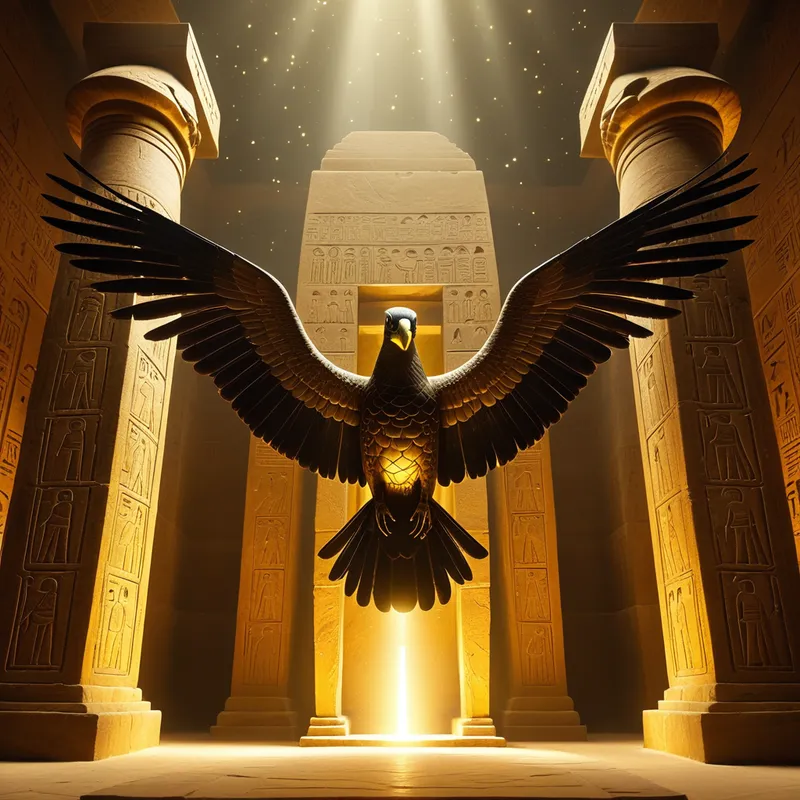
The Ba and Ka Myth Meaning & Symbolism
The myth of the soul's two halves, the Ka and Ba, and their perilous, necessary reunion in the Duat to forge an eternal, complete self.
The Tale of The Ba and Ka
Listen, and hear the tale written not on [papyrus](/myths/papyrus “Myth from Egyptian culture.”/), but in the breath of [the world](/myths/the-world “Myth from Tarot culture.”/) and the silence of the tomb.
In the beginning, when Khnum shaped the first man from the clay of the Nile, he fashioned not one form, but two. Into the body of clay, he breathed the Ka—the vital spark, the double, the sustaining force that whispers “I am” with every heartbeat. This Ka was [the anchor](/myths/the-anchor “Myth from Christian culture.”/), the image in [the mirror](/myths/the-mirror “Myth from Various culture.”/) of life, dwelling in the tomb-statue and the mortal house of flesh. Yet the creation was incomplete. From the heat of the sun-disc of Ra, he drew forth the Ba. This was the restless essence, the unique personality that soars on the winds of experience—the laughter at a feast, the grief at a loss, the memory of a lover’s face. [The Ba](/myths/the-ba “Myth from Egyptian culture.”/) was the traveler, the Ba was the seeker.
For a lifetime, these two companions lived in uneasy partnership. The Ka remained rooted in the body, a constant, hungry presence needing offerings of bread and beer. The Ba flew free each day, gathering the scents of [lotus](/myths/lotus “Myth from Hindu culture.”/) blossoms, the sounds of the marketplace, the sting of [the desert](/myths/the-desert “Myth from Biblical culture.”/) wind, returning each night to the body’s shelter. They knew each other only in the twilight of sleep and the certainty of the heartbeat.
But the day of parting always comes. When the mortal body failed, when the final breath sighed out like a lost prayer, a great rupture occurred. The Ka, bereft, retreated to its shadowy home—the tomb, the statue, the dark, cool earth. It became a ghost of potential, a memory of hunger, waiting in the silence. The Ba, suddenly untethered, was cast adrift. It became a bird of lament, a human-headed hawk crying a lonely, piercing call across [the threshold](/myths/the-threshold “Myth from Folklore culture.”/) of the world. It could visit the places it loved, but found only echoes. It could see the living, but could not touch them. A profound, cosmic loneliness settled upon it, a homesickness for the anchor it had always taken for granted.
The Ba’s only hope lay in the perilous journey through the Duat, a land of fire-lakes, serpent-demons, and inverted stars. Guided by spells from the Book of the Dead, it had to navigate labyrinthine corridors, declare its innocence before forty-two assessor gods, and have its heart weighed against the [Feather of Ma’at](/myths/feather-of-maat “Myth from Egyptian culture.”/) on the scales of Anubis. Only if the heart did not betray its bearer with the weight of falsehood would [the way](/myths/the-way “Myth from Taoist culture.”/) forward open.
And at the end of this harrowing voyage, in the deepest chamber of [the Duat](/myths/the-duat “Myth from Egyptian culture.”/), illuminated by a light that cast no shadow, the Ba would find it. Not the decaying body, but the Ka—its other half, shining with a patient, steady light. Here, in this sacred and silent place beyond the world, the reunion would occur. The soaring Ba would descend, folding its wings of experience around the steadfast Ka. In a moment of profound integration, they would merge, not into what they once were, but into something new and eternal: the Akh. A transformed, radiant being of pure effectiveness, capable of dwelling with the imperishable stars, a complete soul forged in [the crucible](/myths/the-crucible “Myth from Alchemical culture.”/) of separation and sought-after return.
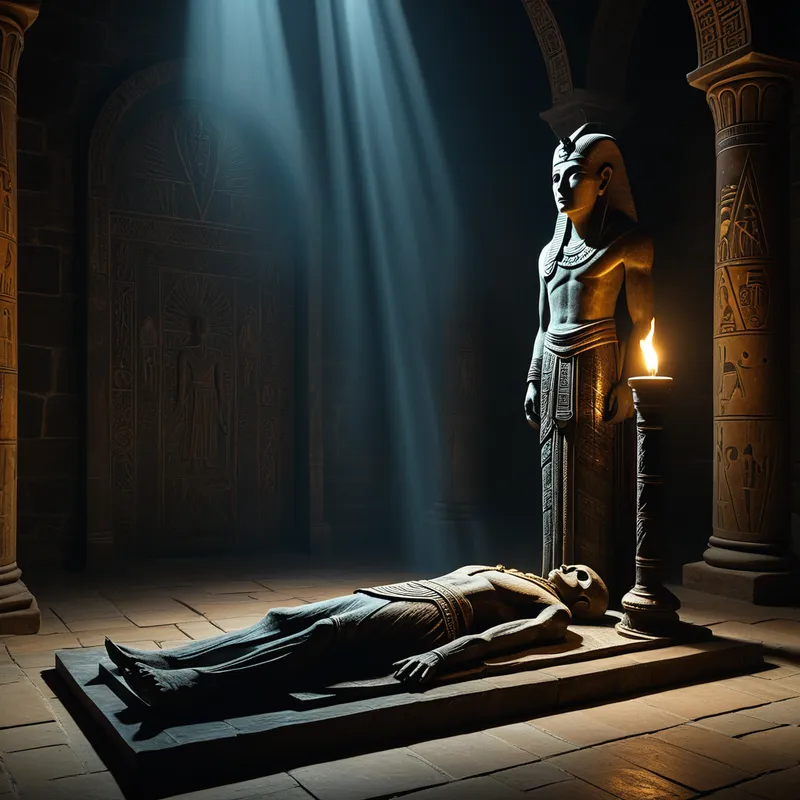
Cultural Origins & Context
This was not a single story told around a fire, but the foundational bedrock of an entire civilization’s relationship with death and identity. The concepts of the Ka and Ba permeated every level of ancient Egyptian society for over three millennia. They were articulated in [Pyramid Texts](/myths/pyramid-texts “Myth from Egyptian culture.”/) carved into royal burial chambers (c. 2400 BCE), elaborated in the Coffin Texts of the nobility, and democratized in the Book of the Dead papyri placed with commoners.
The myth’s primary function was pragmatic and profound: to provide a roadmap for eternal life. It explained the disorienting experience of death (the separation) and prescribed the ritual and ethical actions (the journey, the weighing) required to overcome it. The elaborate tomb, the mummification process, the daily offering rites—all were technologies to sustain the Ka and guide the Ba. Priests acted as the technicians of this myth, performing the rituals that maintained the bond between the two halves. Thus, the myth was less a tale to entertain and more an operative truth to enact, a sacred script ensuring the continuity of the individual beyond the grave.
Symbolic Architecture
At its [heart](/symbols/heart “Symbol: The heart symbolizes love, emotion, and the core of one’s existence, representing deep connections with others and self.”/), the myth of the Ba and Ka is a profound map of the [human](/symbols/human “Symbol: The symbol of a human represents individuality, complexity of emotions, and social relationships.”/) [psyche](/myths/psyche “Myth from Greek culture.”/), describing a fundamental duality that must be reconciled to achieve wholeness.
The Ka is the vessel of being; the Ba is the content of becoming. One is the cup, forever waiting to be filled; the other is the wine, longing for a cup to hold it.
The Ka symbolizes our foundational, instinctual self. It is the [body](/symbols/body “Symbol: The body in dreams often symbolizes the dreamer’s self-identity, personal health, and the relationship they have with their physical existence.”/)‘s intelligence, the template of our form, our genetic and familial inheritance. Psychologically, it represents [the ego](/myths/the-ego “Myth from Jungian culture.”/) in its most basic sense—the “I” that persists, the sense of continuous [identity](/symbols/identity “Symbol: Identity represents the sense of self, encompassing personal beliefs, cultural background, and social roles.”/) anchored in [history](/symbols/history “Symbol: History in dreams often represents the dreamer’s past experiences, lessons learned, or unresolved issues that continue to influence their present.”/) and place. It is our need for sustenance, [security](/symbols/security “Symbol: Security denotes safety, stability, and protection in one’s personal and emotional life.”/), and a home. In its [shadow](/symbols/shadow “Symbol: The ‘shadow’ embodies the unconscious, repressed aspects of the self and often represents fears or hidden emotions.”/) [aspect](/symbols/aspect “Symbol: A distinct feature, quality, or perspective of something, often representing a partial view of a larger whole.”/), a Ka untethered from its Ba is mere potential, a stagnant pool of un-lived [life](/symbols/life “Symbol: The symbol of ‘Life’ represents a journey of growth, interconnectedness, and existential meaning, encompassing both the joys and challenges that define human experience.”/), trapped in repetition and dependency.
The Ba, in contrast, is our dynamic, experiential self. It is [consciousness](/symbols/consciousness “Symbol: Consciousness represents the state of awareness and perception, encompassing thoughts, feelings, and experiences.”/), [personality](/symbols/personality “Symbol: Personality in dreams often symbolizes the traits and characteristics of the dreamer, reflecting how they perceive themselves and how they believe they are perceived by others.”/), [memory](/symbols/memory “Symbol: Memory symbolizes the past, lessons learned, and the narratives we construct about our identities.”/), and desire. It is the part of us that learns, changes, loves, and creates. It represents the [spirit](/symbols/spirit “Symbol: Spirit symbolizes the essence of life, vitality, and the spiritual journey of the individual.”/) of [adventure](/symbols/adventure “Symbol: ‘Adventure’ signifies exploration, discovery, and the pursuit of new experiences in one’s life journey.”/), the voice of individuality, and the accumulation of a unique life [story](/symbols/story “Symbol: The symbol of ‘Story’ represents the narrative woven through our lives, embodying experiences, lessons, and emotions that shape our identities.”/). Its shadow is rootlessness—the Ba severed from its Ka is a ghost of experience without substance, a collection of memories with no anchor, leading to existential [loneliness](/symbols/loneliness “Symbol: A profound emotional state of perceived isolation, often signaling a need for connection or self-reflection.”/) and [fragmentation](/symbols/fragmentation “Symbol: The experience of breaking apart, losing cohesion, or being separated into pieces. Often represents disintegration of self, relationships, or reality.”/).
The Duat, then, is not merely an [underworld](/symbols/underworld “Symbol: A symbolic journey into the unconscious, representing exploration of hidden aspects of self, transformation, or confronting repressed material.”/) but the unconscious itself. The perilous [journey](/symbols/journey “Symbol: A journey in dreams typically signifies adventure, growth, or a significant life transition.”/) is the [inward](/symbols/inward “Symbol: A journey toward self-awareness, introspection, and the exploration of one’s inner world, thoughts, and unconscious mind.”/) [odyssey](/symbols/odyssey “Symbol: A long, adventurous journey filled with trials, transformations, and eventual homecoming, symbolizing life’s quest for meaning and self-discovery.”/) we must all undertake to confront our shadows (the demonic guardians), integrate our moral failures ([the weighing of the heart](/myths/the-weighing-of-the-heart “Myth from Egyptian culture.”/)), and ultimately seek the lost part of ourselves. The glorious Akh that results from their union is the [symbol](/symbols/symbol “Symbol: A symbol can represent an idea, concept, or belief, serving as a powerful tool for communication and understanding.”/) of the individuated Self—the transcendent, integrated personality where instinct and spirit, [stability](/symbols/stability “Symbol: A state of firmness, balance, and resistance to change, often represented by solid objects, foundations, or steady tools.”/) and growth, are finally harmonized.
The Dreamer’s Resonance
When this ancient pattern stirs in the modern dreamer, it speaks to a profound psychological process of integration or fragmentation. One does not dream of “a Ka and Ba” explicitly, but of their symbolic dynamics.
Dreams of a familiar house (the Ka’s tomb) that feels empty, cold, or hauntingly still, while a bird (the Ba) beats its wings against a skylight, point to a disconnect. The dreamer may feel their daily life (the house/body) is a hollow shell, devoid of meaning, while their spirit or passions (the bird) feel trapped, unable to infuse their existence with vitality. This is the somatic ache of separation.
Conversely, dreams of a radiant, comforting presence in a room (the Ka) that welcomes home a weary but joyful traveler (the Ba) signal a process of deep integration. The dreamer may be reconciling a long-ignored part of their nature with their active life, coming home to themselves after a period of exploration or crisis. The feeling upon waking is one of profound peace and solidity.
Nightmares of being a ghost unable to interact with loved ones, or of a body that feels like an empty, alien statue, are the Ba and Ka crying out in their isolation. They indicate a severe psychic split, often due to trauma, where the feeling self has dissociated from the physical or social self. The myth thus provides a container to understand this terrifying experience not as madness, but as a sacred, if agonizing, stage in a deeper journey toward wholeness.

Alchemical Translation
For the modern individual, the myth models the alchemical process of individuation. Our culture often glorifies the Ba—the endless journey, the curated personality, the accumulation of experiences. We are encouraged to “find ourselves” out in the world. Yet we neglect the Ka—the deep, slow, nourishing ground of being, the quiet self that exists before and beyond social performance.
The alchemical work is not to choose between the journey and the home, but to make the home the destination of the journey, and the journey the purpose of the home.
[The first stage](/myths/the-first-stage “Myth from Alchemical culture.”/), Separation, is a given in the modern age. We feel fragmented, our identities scattered across roles and digital personas. The “Ka-work” involves grounding: tending to the body, honoring routines, creating sacred space, and connecting with ancestry and place. It is building a sturdy tomb-statue of [the self](/myths/the-self “Myth from Jungian culture.”/) that can endure.
The “Ba-work” is the conscious adventure: courageously gathering experiences, reflecting on one’s unique truths, and venturing into the inner Duat of therapy, shadow work, and creative expression. This is the [weighing of the heart](/myths/weighing-of-the-heart “Myth from Egyptian culture.”/)—facing one’s truths and falsehoods with ruthless honesty.
The crisis point is the recognition of the profound loneliness this separation creates, the yearning for integration. The final, sacred operation is the Reunion. This is the moment of synthesis, where we bring the wisdom and spirit of our travels (the Ba) back to the core of who we are (the Ka). We allow our experiences to transform our foundational identity, and we anchor our newfound spirit in the reality of our being. We no longer just have a life (Ba) or just occupy a life (Ka); we are a life, singular and complete. We become the Akh—an effective, radiant, and eternal presence in our own right, capable of shining in our own darkness and navigating our own heavens.
Associated Symbols
Explore related symbols from the CaleaDream lexicon: