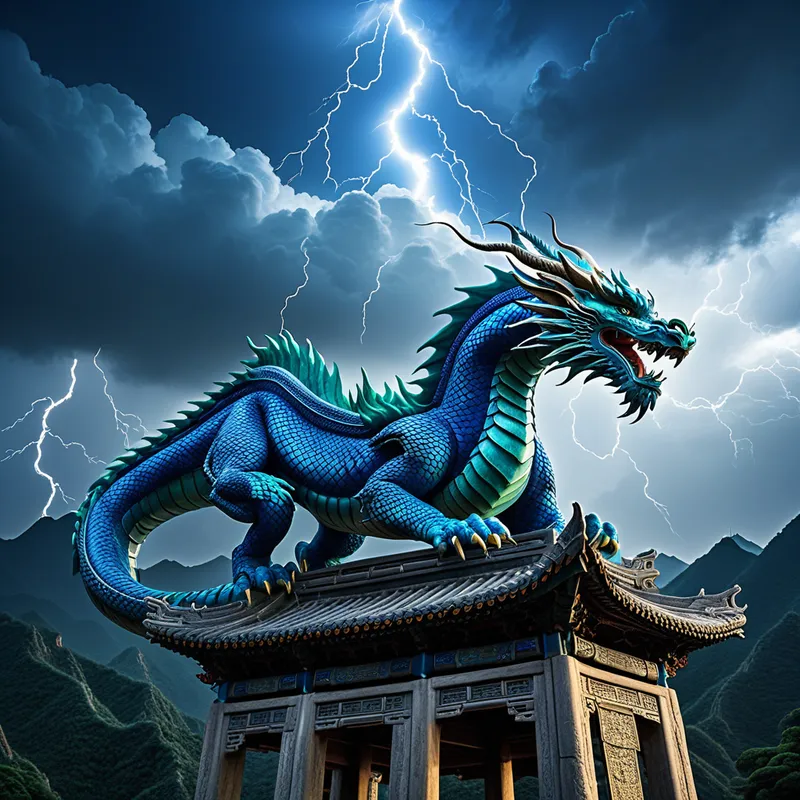
The Azure Dragon Myth Meaning & Symbolism
The Azure Dragon, a celestial guardian of the East, embodies cosmic order, the power of spring, and the deep psychological process of integrating primal, creative forces.
The Tale of The Azure Dragon
Before the first emperor drew breath, before the first character was carved into bone, the world was a canvas of chaos and potential. The heavens, a vast and silent dome, held their breath. Then, from the formless deep of the primordial east, a presence stirred.
It was not born; it manifested. A ripple in the fabric of the sky became a coil, and the coil became a being of impossible majesty. This was Qing Long, the Azure Dragon. His scales were not mere skin but plates of living jade and lapis lazuli, catching the first light that had ever been. His eyes were twin pools of molten mercury, seeing not just shapes, but the very qi—the breath—of the world. His body stretched across a quarter of the sky, a river of azure muscle and celestial will.
He did not roar; his voice was the first crash of spring thunder that cracks the iron grip of winter. With that sound, the direction of East was born. He took his place as its sovereign, and where his celestial breath fell, frozen rivers remembered their song. Hard earth softened. The seeds, sleeping in death-like silence, felt the dragon’s exhalation—a wind both gentle and mighty, carrying the scent of rain and promise. This was the Dong Feng, the East Wind, his herald.
His domain was the season of Wood, the explosive green force of life. He presided over the seven stellar mansions that formed his constellation—the Horn, the Neck, the Root, the Room, the Heart, the Tail, the Winnowing Basket—each a step in the great celestial dance of renewal. His eternal task was a vigil: to guard the sacred axis of order against the clamoring chaos. He was the arbiter of beginnings, the patron of righteous rulership, the celestial architect ensuring the seasons turned in their proper wheel.
His conflict was not with a monster, but with entropy itself—the slow slide back into formlessness. His rising action was the eternal, patient struggle of life against stagnation, of spring against perpetual winter, of benevolent structure against anarchic void. His resolution came with each dawn, with each equinox, as his influence waxed and the world, once more, chose growth over decay, harmony over discord, under his watchful, mercury gaze.
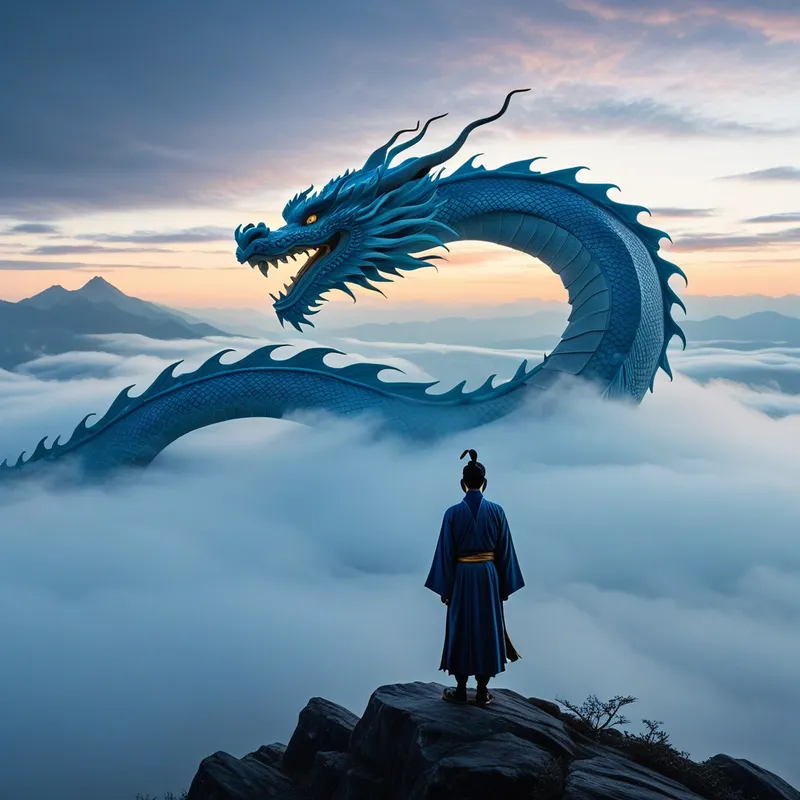
Cultural Origins & Context
The Azure Dragon is not a character from a single, bound epic, but a foundational pillar of a cosmological system. Its origins are woven into the earliest strands of Chinese thought, emerging from the astrological observations of the Zhou Dynasty and crystallizing during the Han Dynasty. It is a core component of the Wuxing (Five Phases) and the Si Xiang (Four Symbols) schema.
This myth was passed down not by bards around a fire, but by court astronomers, I Ching scholars, and Taoist mystics. It was etched onto bronze ritual vessels, painted on tomb walls to guide the soul, and charted on star maps. Its societal function was profound: it provided a cosmic blueprint for order. The Emperor, the Son of Heaven, ruled under the mandate of these celestial guardians. The Azure Dragon of the East validated his authority, provided a model for benevolent governance (nurturing growth like spring), and offered a symbolic language to understand everything from the change of seasons to the flow of energy in a landscape (Feng Shui). It was a myth that organized reality itself.
Symbolic Architecture
The Azure Dragon is a master symbol of structured, benevolent power. Unlike the Western dragon often hoarding gold in a cave, Qing Long is a celestial administrator, a ruler of realms both seen and unseen.
Psychologically, it represents the archetypal force that brings order to the inner chaos of the psyche. It is the principle that can take the raw, undifferentiated potential of the unconscious (the primordial east) and give it form, direction, and life-giving purpose. Its element, Wood, symbolizes this perfectly: the relentless, upward-seeking growth of a tree, which is both flexible and strong, following an innate pattern toward the light.
The Dragon does not create the seed, but provides the indispensable conditions—the spring thunder, the east wind—for the seed to become what it was always meant to be.
Its azure color links it to the heavens, to spirituality, and to depth. The seven mansions of its constellation symbolize the stages of any true process of development or initiation—from the first budding “Horn” of an idea to the “Winnowing Basket” that separates the essential from the chaff. It is a myth about the sovereignty of conscious, life-affirming structure over the tyranny of either chaos or rigid, deadening control.
The Dreamer’s Resonance
When the Azure Dragon coils through the landscape of a modern dream, it signals a profound somatic and psychological process: the awakening of a dormant, ordering, and creative principle within the dreamer. This is not the flash of a sudden insight (that is more the domain of lightning), but the slow, sure, inevitable rising of a new season in one’s inner world.
The somatic experience might be one of deep, rhythmic tension—like the feeling before a spring storm—giving way to a release and a sense of expansive energy in the chest and limbs, the “wood” element stirring. Psychologically, the dreamer is likely at a point where a period of internal “winter”—perhaps depression, stagnation, or confusion—is beginning to thaw. The dragon’s appearance confirms that the unconscious itself is initiating a cycle of renewal. It may call the dreamer to take authority over a neglected part of their life, to establish healthy internal boundaries (the “guardian” function), or to nurture a nascent project or aspect of the self that is ready to grow. The dragon’s gaze, often described as penetrating, reflects the dreamer’s own capacity for self-reflection and seeing the true potential beneath the surface of their current circumstances.
Alchemical Translation
The myth of the Azure Dragon models the alchemical stage of albedo, the whitening, often associated with clarification and the arrival of the illuminating spirit. In the journey of individuation, it represents the moment when the chaotic, often shadowy contents of the unconscious (prima materia) are first organized by a transcendent, ordering principle.
The core struggle is the human tendency to either remain in chaos (refusing the call to order) or to impose a harsh, artificial order (a tyrannical “inner emperor”). The dragon’s triumph is the achievement of a natural order, one that aligns with the intrinsic laws of the psyche and the cosmos. The modern individual undergoes this transmutation when they stop forcing growth or resisting it, and instead learn to identify and cooperate with their own inner seasons.
The alchemical work is not to build the dragon, but to recognize its celestial blueprint already within, and to provide the inner east—the open, receptive, expectant space—for its manifestation.
This involves honoring the “east” within: the place of new beginnings, the courage to start anew, and the faith in a benevolent structure emerging from within. It is the process of becoming the sovereign of one’s own inner spring, wielding the dragon’s authority not to dominate, but to protect, nurture, and guide the burgeoning life of the authentic self into its full, verdant expression. The ultimate transmutation is from a soul subject to internal weather into a soul that understands it is part of the celestial climate itself.
Associated Symbols
Explore related symbols from the CaleaDream lexicon: