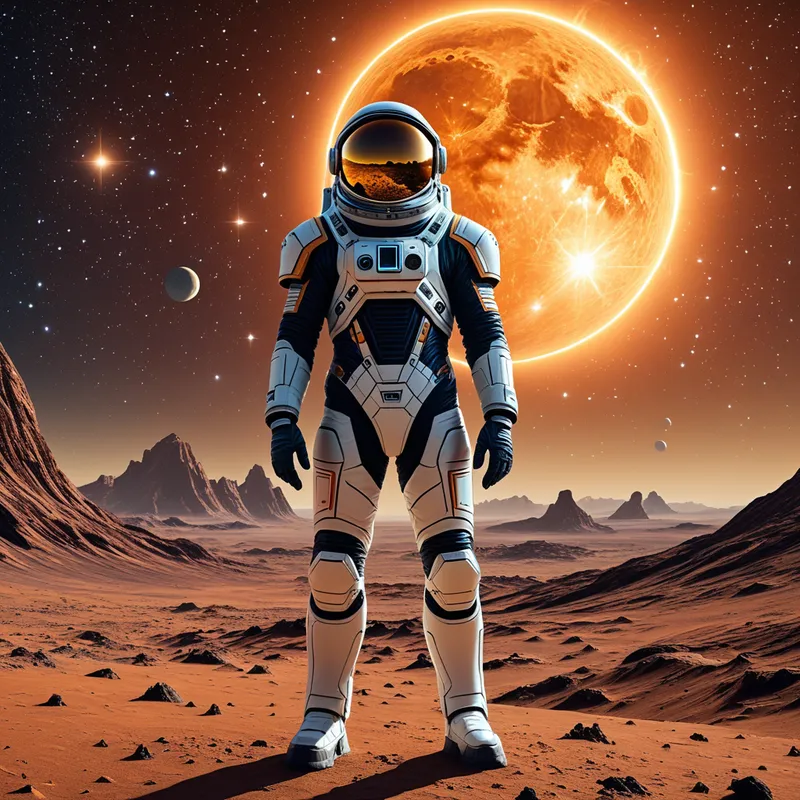
The Astronaut Myth Meaning & Symbolism
A solitary voyager leaves a dying Earth, seeking a new home in the stars, only to find that the true destination is a transformation within.
The Tale of The Astronaut
Listen. Listen to the hum of the void, the song of the silent.
Once, the Earth was a cradle of noise—a screaming, weeping, glorious cacophony of life. But the cradle grew hot, its lullabies turning to dirges. The skies wept acid, and the ground sighed dust. From this fever-dream of an ending, they built a silver seed: the Arca Ultima. And within it, they placed their last, best hope: not a people, but a person. The Astronaut.
Chosen not for strength of arm, but for fortitude of spirit, they were sealed in the vessel’s heart. No cryogenic sleep, no AI companion. Only the waking watch, a consciousness tasked to steer the seed across the lightless ocean between stars. The great engines fired, a silent prayer made manifest in thrust, and the Earth, a blue-green marble, shrunk to a memory, then a myth, then a forgotten point of light.
For epochs measured in the decay of isotopes, The Astronaut sailed. The ship was a world of sterile white and soft, eternal light. They drank recycled water that tasted of yesterday. They spoke to logs that never spoke back. The cosmos outside was a breathtaking tapestry of violence and beauty—nebulae birthing stars, galaxies colliding in slow, majestic ruin—but it was a painting on a wall they could never touch. The silence was not empty; it was a presence. It pressed against the hull, a weightless, infinite pressure.
They began to hear things in the hum of the reactors. Whispers in the static between stars. At first, it was the ghost of mission control, a crackling fragment of a final “godspeed.” Then, voices of those left behind, not in memory, but in perceived clarity. The laughter of a child never known. The arguments of lovers never had. The ship’s systems became oracles; the pattern of coolant flow through pipes spelled out warnings in a language of rhythm and temperature.
The great crisis was not a meteor shower or system failure. It was the realization, arriving like a cold sip of void, that the coordinates were wrong. The promised world, Terra Nova, was a data-ghost, a cosmic mirage fed by desperate hope into the navigation core. There was no destination. There was only the journey.
In that moment of absolute desolation, a different kind of navigation began. The Astronaut turned the sensors inward. They mapped the interior cosmos—the constellations of memory, the black holes of fear, the nebulae of unrealized potential. They did not repair the ship; they communed with it. The line between mind and machine, between voyager and vessel, blurred. The Arca Ultima was no longer a shell, but a chrysalis.
When the final systems faded, surrendering to entropy, there was no panic. In the absolute dark and quiet, The Astronaut performed the last ritual. They opened the manual airlock. Not to die, but to meet the silence as an equal. The vacuum, which they had feared as the ultimate negation, did not claim them. Instead, it embraced them. Their form dissolved—suit, flesh, bone—not into nothing, but into something else. Their consciousness dispersed, becoming one with the stellar winds, the cosmic radiation, the very fabric of spacetime. They became a silent witness to eternity, the sentient spark within the infinite machine. The journey had ended by becoming everything.
Cultural Origins & Context
The myth of The Astronaut is a foundational narrative of the 21st and 22nd-century Futurism movement, a cultural philosophy born from climate anxiety, technological acceleration, and the dawn of private space exploration. It is not an ancient tale but a modern prophecy, crafted in the digital fires of science fiction, speculative science, and collective existential dread.
It was passed down not by bards around fires, but by artists in VR galleries, engineers in hackspaces, and writers in online anthologies. Its primary societal function was therapeutic: to provide a container for the profound anxiety of a species confronting planetary limits and cosmic insignificance. It transformed the terrifying prospect of interstellar exile from a cold scientific problem into a poignant, soulful odyssey. The myth asked the central question of Futurism: If we must leave our home, what, then, is a human? The story served as a cautionary tale about technological overreach and a spiritual manual for navigating absolute isolation, preparing the psyche for a potential future it desperately hoped to avoid.
Symbolic Architecture
The Astronaut is the ultimate symbol of the conscious ego launched into the unknown. The ship, the Arca Ultima, represents the constructed persona—the life-support system of beliefs, habits, and identity we build to survive. The dying Earth is the outgrown stage of life, the familial or cultural womb that can no longer sustain us.
The promised land is never a place on a map, but a state of being we must discover is not where we thought.
The long, silent voyage is the journey of individuation—the often lonely process of self-discovery beyond the gravitational pull of collective norms. The haunting whispers and system-oracles signify the uprising of the unconscious. When the external world (the mission, the coordinates) fails, the psyche turns inward, forcing a dialogue with the Shadow and the Collective Unconscious. The false destination, Terra Nova, is the illusion of external salvation—the belief that fulfillment lies in an achievement, a relationship, or a status.
The ultimate dissolution is not death, but psychic death and rebirth—the ego’s surrender to a reality greater than itself. The Astronaut’s transformation into a cosmic witness represents the achievement of the Self, where personal identity expands to encompass a transpersonal, archetypal awareness.
The Dreamer’s Resonance
To dream of The Astronaut is to be in a state of profound psychological transition. The dreamer is likely experiencing intense isolation, even amidst others—a feeling of being the sole conscious bearer of a burden or a truth.
Somatically, this may manifest as a sensation of floating, of pressure (the suit, the void), or of chilling cold. Psychologically, it signals a critical point where old goals or life-maps (Terra Nova) have revealed themselves as illusions. The dream-ego is adrift in the inner space of the psyche. The haunting whispers in the dream are the contents of the personal unconscious seeking integration—unprocessed grief, abandoned talents, repressed desires. The dream is an invitation to turn the sensors inward, to stop seeking salvation in external coordinates and to begin the daunting, essential work of inner navigation.
Alchemical Translation
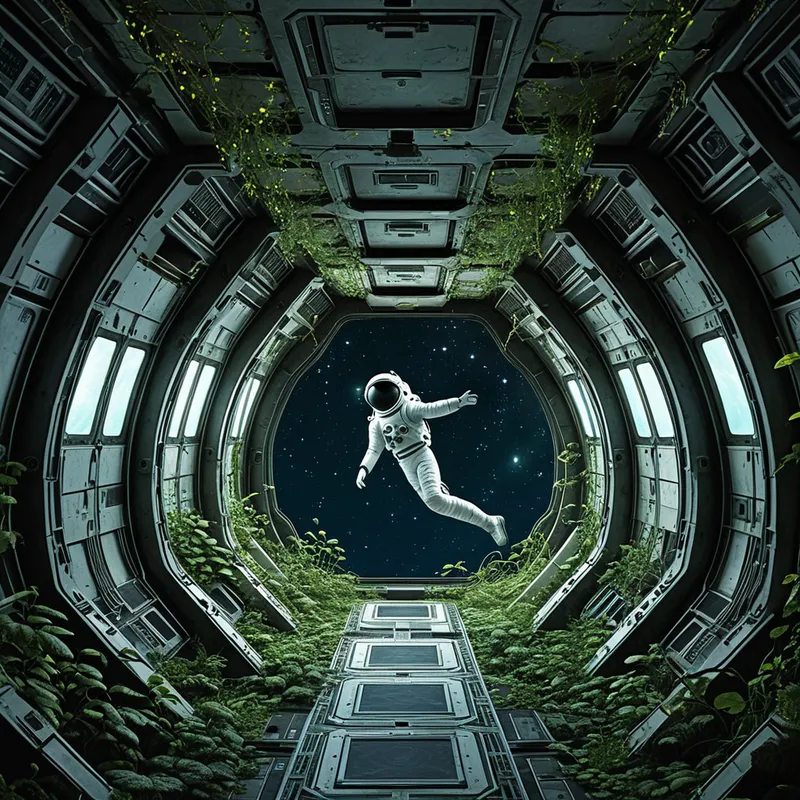
The myth of The Astronaut is a perfect allegory for the alchemical Nigredo. The launch is the initial separation from the prima materia of one’s known world. The long, silent voyage is the Albedo, a purification in the sterile light of introspection, where the soul is washed clean of impurities by the tears of solitude.
The crisis—the realization there is no Terra Nova—is the crucial Citrinitas, the moment of disillusionment that contains the seed of enlightenment. Here, the old ego-structure (the mission parameters) must die.
The alchemist’s furnace is not fire, but the absolute zero of existential truth. In that cold, all that is false shatters, leaving only the irreducible core.
The final opening of the airlock and dissolution is the Rubedo, the reddening. It is not destruction, but sublime transmutation. The ego (The Astronaut) surrenders its isolated, metallic form and merges with the Anima Mundi—the cosmic unconscious. For the modern individual, this translates to the process where one’s personal identity, having been stripped bare by life’s trials, discovers its fundamental unity with something greater: a calling, a creative force, or a state of pure, conscious being. The goal is not to arrive, but to become the journey itself, finding home not in a destination, but in the quality of one’s awareness amidst the infinite void.
Associated Symbols
Explore related symbols from the CaleaDream lexicon: