
The Arrow of Apollo - both as Myth Meaning & Symbolism
A myth of divine duality where the arrow that wounds is also the arrow that heals, revealing the sacred unity of suffering and transformation.
The Tale of The Arrow of Apollo - both as
Hear now a truth sung not in one tongue, but whispered in the marrow of [the world](/myths/the-world “Myth from Tarot culture.”/). Before the division of things into good and ill, before the sundering of cure from curse, there existed a single, terrible, and beautiful potential. It resided in the quiver of Apollo, the Far-Darter, the god who is light itself and [the shadow](/myths/the-shadow “Myth from Jungian culture.”/) it casts.
He stands upon the sun-baked shoulder of the world, his bow a curve of celestial intent. His arrows are not mere shafts of wood and bronze; they are condensed packets of his essence. One day, gazing upon the teeming, fragile world of mortals below—a world of love and decay, of ambition and frailty—a profound and paradoxical will moved within him. He would not choose between his aspects. He would not send an arrow of pure pestilence to cleanse, nor one of pure healing to mend. He would send the arrow.
He nocked a single missile. As he drew the string, the universe held its breath. The arrowhead did not resolve into one form, but held two natures in a shimmering, unstable unity. It was the piercing point of revelation and the crushing weight of fever. It was the searing light of truth and the desiccating heat of drought. With a sound like a sigh of inevitability, he loosed it.
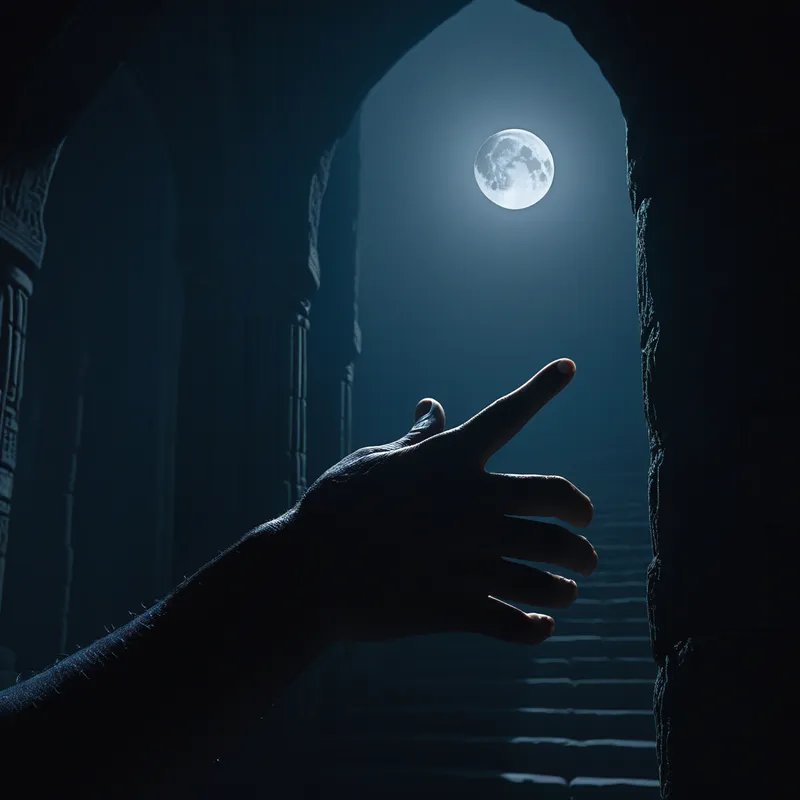
It fell not upon a city or an army, but upon the soul of the world itself. It struck the shepherd on the hill, who felt a sudden, clarifying knowledge of his own mortality even as a wasting chill entered his bones. It struck the queen in her palace, who understood the fragility of her power in the same instant a searing pain bloomed in her side. Where it struck, it did not simply injure; it opened. It created a sacred wound, a aperture through which the raw, unfiltered nature of existence—its brilliance and its brutality—poured into the individual.
The cries that rose were not only of agony, but of awful, unwanted enlightenment. The body faltered, shook with divine fire, while the spirit was forced to gaze upon truths it had spent a lifetime avoiding. This was the action of the Arrow—both as the agent of crisis and the seed of its own resolution. The fever burned away illusion; the piercing point created a channel. And from the very core of the wound, if one dared to look not away but into it, a second, quieter light began to emanate. It was the same arrow, having completed its arc, now manifesting its other face: the mending of the break with a stronger seam, the healing that knows the precise shape of the hurt because it is the hurt, transformed.
Cultural Origins & Context
The myth of [the Arrow of Apollo](/myths/the-arrow-of-apollo “Myth from Greek culture.”/) - both as does not belong to a single scroll or tablet; it is a transcultural archetype woven into the understanding of divinity and fate across countless traditions. We see it in the Greek Apollo, who spreads plague with one hand and offers cathartic prophecy and medicinal arts with the other. We hear it in the hymns to [Rudra](/myths/rudra “Myth from Hindu culture.”/)-[Shiva](/myths/shiva “Myth from Hindu culture.”/) in the Vedas, the auspicious one who is the terrific roarer, the divine physician who wields the fever that purifies. It is present in the ambivalent arrows of gods of hunting and sovereignty, where the kill ensures the tribe’s survival.
This story was never just a priestly doctrine; it was a folk understanding, passed down in the quiet words spoken beside a sickbed: “This illness has a purpose.” It was [the shaman](/myths/the-shaman “Myth from Siberian culture.”/)’s insight that the spirit causing the affliction must be negotiated with, not merely vanquished. Its societal function was profound: to provide a container for suffering, to frame catastrophe not as meaningless chaos but as a brutal, sacred dialogue with the divine. It taught that the powers which govern life are not simply benevolent or malevolent, but complex, complete, and operating on a logic that transcends human comfort.
Symbolic Architecture
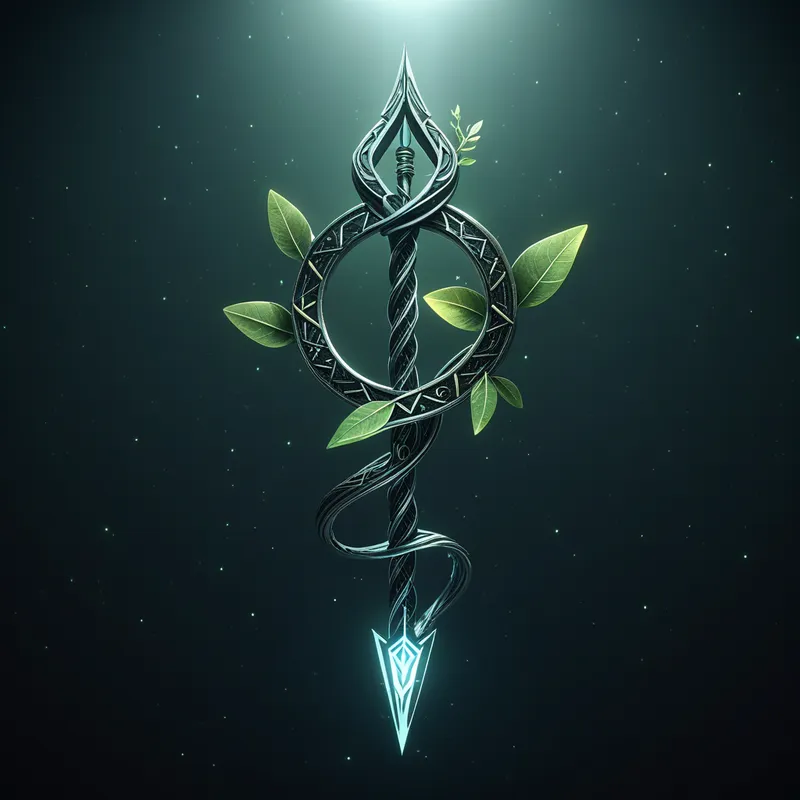
At its core, the [Arrow](/symbols/arrow “Symbol: An arrow often symbolizes direction, purpose, and the pursuit of goals, representing both the journey and the destination.”/) symbolizes the irreducible unity of opposites that characterizes wholeness. Apollo, as the god of the sun, represents [consciousness](/symbols/consciousness “Symbol: Consciousness represents the state of awareness and perception, encompassing thoughts, feelings, and experiences.”/), order, and form. Yet his [arrow](/symbols/arrow “Symbol: An arrow often symbolizes direction, purpose, and the pursuit of goals, representing both the journey and the destination.”/) carries the chaotic, form-dissolving powers of [disease](/symbols/disease “Symbol: Disease represents turmoil, issues of control, or unresolved personal conflicts manifesting as physical or emotional suffering.”/) and madness—realms typically ascribed to the unconscious or to chthonic deities. The myth asserts that true consciousness, true light, includes an intimate [knowledge](/symbols/knowledge “Symbol: Knowledge symbolizes learning, understanding, and wisdom, embodying the acquisition of information and enlightenment.”/) of its own [shadow](/symbols/shadow “Symbol: The ‘shadow’ embodies the unconscious, repressed aspects of the self and often represents fears or hidden emotions.”/).
The wound and the cure are not two separate arrows shot from different bows; they are the before and after of a single, transformative event.
The Arrow’s [flight](/symbols/flight “Symbol: Flight symbolizes freedom, escape, and the pursuit of one’s aspirations, reflecting a desire to transcend limitations.”/) is the trajectory of [fate](/symbols/fate “Symbol: Fate represents the belief in predetermined outcomes, suggesting that some aspects of life are beyond human control.”/) or moira, an impersonal force that strikes where it will. The “both as” quality represents the dual potential within any [life](/symbols/life “Symbol: The symbol of ‘Life’ represents a journey of growth, interconnectedness, and existential meaning, encompassing both the joys and challenges that define human experience.”/)-altering [event](/symbols/event “Symbol: An event within dreams often signifies significant life changes, transitions, or emotional milestones.”/): it can be experienced solely as a catastrophe (the arrow as [destroyer](/symbols/destroyer “Symbol: A figure or force representing radical change through dismantling existing structures, often evoking fear and awe.”/)) or, if engaged with consciously, as the catalyst for [initiation](/symbols/initiation “Symbol: A symbolic beginning or transition into a new phase, status, or awareness, often involving tests, rituals, or profound personal change.”/) (the arrow as [healer](/symbols/healer “Symbol: A figure representing restoration, transformation, and the integration of physical, emotional, or spiritual wounds. Often symbolizes a need for care or a latent ability to mend.”/)). The point of impact is the [omphalos](/myths/omphalos “Myth from Greek culture.”/), the sacred center of the individual’s [universe](/symbols/universe “Symbol: The universe symbolizes vastness, interconnectedness, and the mysteries of existence beyond the individual self.”/), where the divine intersects with the personal, creating a [crisis](/symbols/crisis “Symbol: A crisis symbolizes turmoil, urgent challenges, and the need for immediate resolution or change.”/) that is also a calling.
The Dreamer’s Resonance
When this myth stirs in the modern dreamer, it often manifests not as a classical god, but as a potent, ambiguous symbol of simultaneous violation and invitation. One might dream of being struck by a beam of light that burns and illuminates, or of receiving a surgical incision that reveals a hidden, glowing organ. The dreamer may feel a piercing pain in a specific body part—the shoulder, the side, the brow—accompanied by a strange sense of clarity or calm.
Somnially, this signals a profound psychological process: [the ego](/myths/the-ego “Myth from Jungian culture.”/)’s defensive structures are being punctured by content from the personal or collective unconscious. This is a somatic experience of initiation. The “wound” is the emergence of a complex, a trauma, or a divine discontent that can no longer be ignored. The dream is presenting the crisis in its complete form: it is terrifying and it is the only path to becoming whole. The body in the dream registers the shock, the breaking open, preparing the [psyche](/myths/psyche “Myth from Greek culture.”/) for the arduous work of holding the tension of the “both as.”

Alchemical Translation
The alchemical journey mirrored in this myth is the [nigredo](/myths/nigredo “Myth from Alchemical culture.”/), the blackening, followed not by a separate process, but by the revelation that the blackness itself contains the seed of light. The individual’s task is not to find a different arrow to pull out the first, but to perform the sacred surgery of turning the embedded arrowhead, of gazing into the wound until its nature shifts from “[thing](/myths/thing “Myth from Norse culture.”/) that is harming me” to “thing that is transforming me.”
Individuation is the process of discovering that the poison is the medicine, and that the god who afflicts you is the same god who awaits your conscious, courageous response.
This requires a radical acceptance of life’s ambivalent wholeness. To integrate the Arrow is to cease railing against fate as a malicious attack and to begin engaging with it as a severe form of communication. The healing that emerges is not a return to a prior, unscathed state. It is the creation of a new, more resilient form of consciousness, one that has consciously assimilated the piercing truth the arrow carried. The individual becomes, in a small way, like Apollo: a vessel capable of holding light and shadow, capable of understanding that to be an agent of healing, one must first know the precise architecture of the wound. The arrow remains within, but it is no longer a foreign object; it has become the axis around which a greater, more compassionate self revolves.
Associated Symbols
Explore related symbols from the CaleaDream lexicon: