The Ark of the Covenant Myth Meaning & Symbolism
A sacred chest containing divine law, a throne for an invisible presence, and a terrifying power that forges a covenant between humanity and the absolute.
The Tale of The Ark of the Covenant
Listen. In the furnace of the desert, beneath a sky of hammered bronze, a people walked, dust-choked and spirit-worn. They were fugitives, a nation born from the groans of slaves. And their god, YHWH, was a fire in the mountain, a voice that split stone. To this trembling assembly, through the mediator Moses, He gave not just commandments etched by divine finger on tablets of stone, but a design. A blueprint for a dwelling place of the un-dwellable.
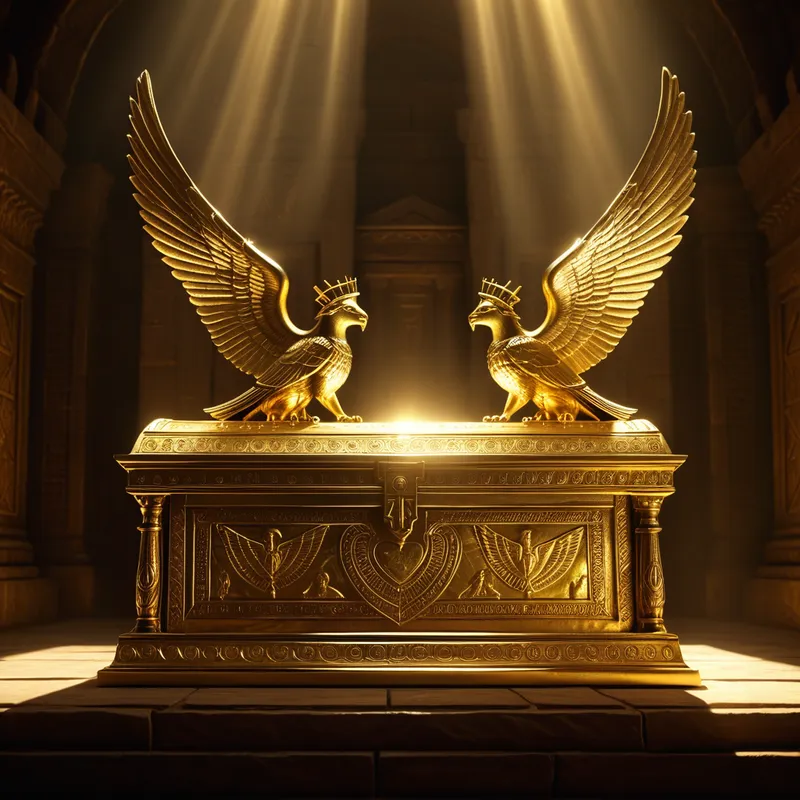
The artisans Bezalel and Oholiab worked with trembling hands. Acacia wood, incorruptible, was overlaid with pure gold, inside and out. A crown of gold ran around its top. And for its lid, a single slab of gold was hammered into the Mercy Seat, and from it arose two cherubim of hammered gold, their wings outstretched and touching, their faces inclined toward the space between them. An empty space. A throne for the invisible.
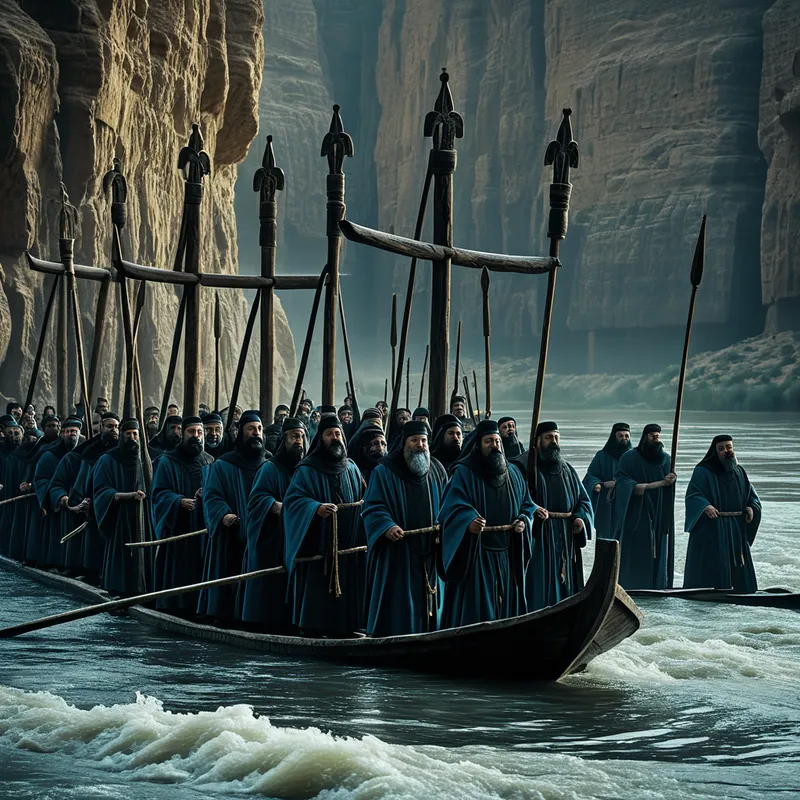
Within this chest were placed the stone tablets, a jar of manna, and the staff of Aaron that had budded. Then the cloud, the Kabod, descended and filled the Tabernacle. The Ark was its heart. When the cloud lifted, the people would march, the Levites bearing the Ark on poles upon their shoulders, a nucleus of sacred terror at the center of the camp. It parted the waters of the Jordan. The walls of Jericho fell at its circuit.
But the Ark was no talisman. It was a relationship, fierce and exact. When treated with profane familiarity, it struck out. The men of Beth Shemesh looked into it and were slain. Uzzah reached out to steady it on an oxcart—a seemingly pious act—and fell dead, for the holy cannot be stabilized by human hand. It was captured by the Philistines, and in their temples, their idol Dagon fell prostrate before it, broken. Plagues broke out among them until, desperate, they sent it back on a cart drawn by milk cows, a guilt offering alongside golden tumors and rats.
It found rest in the house of Abinadab, sanctified, untouched. Decades later, King David, in a frenzy of ecstatic dance, brought it up to Jerusalem. But this time, carried by priests, as prescribed. It entered the city with shouts and trumpet blasts, the tangible presence of the covenant coming to dwell in the heart of the kingdom. His son, Solomon, would finally house it in the inner sanctum, the Holy of Holies, in a temple of stone and cedar, where once a year, in a cloud of incense, the High Priest would approach the Mercy Seat with blood to atone for the people. And there, in the silence between the cherubim, the Presence waited.
Cultural Origins & Context
The myth of the Ark emerges from the core identity crisis of ancient Israel: a tribal confederation forging itself into a people under a singular, aniconic (anti-image) deity. Its primary sources are the priestly and historical texts of the Torah and the books of Samuel and Kings. This was not a story told by bards around a fire for entertainment, but a sacred history recited, taught, and ritualized by the priestly Levites and later by scribes.
Its societal function was multifaceted. It served as the physical anchor for the Sinaitic Covenant, making an abstract relationship terrifyingly concrete. It legitimized the central priesthood and the later Jerusalem Temple as the sole locus of true worship. It was a narrative of divine election and warning—God was with them, but on precise, non-negotiable terms. The Ark’s journey from portable desert shrine to fixed Temple throne mirrors Israel’s own transition from nomadic tribalism to settled monarchy, always centering the divine law as the true king.
Symbolic Architecture
The Ark is the ultimate symbol of sacred containment. It is not God, but the throne of God; not the law itself, but the vessel that holds it. This distinction is everything.
The vessel is not the contained, but without the vessel, the contained is formless, lethal, and spills into oblivion.
Psychologically, the Ark represents the ego’s necessary function as a container for the Self (the totality of the psyche, the inner image of the divine). The acacia wood—human, earthly, mortal—overlaid with pure gold symbolizes the mortal ego structure refined and made sacred by its task: to hold something infinitely greater than itself. The two stone tablets within are the foundational, non-negotiable laws of one’s own being, the core principles that give structure to life. The manna is the sustenance received from the unconscious, and Aaron’s staff is the authority that blossoms from alignment with the divine will.
The cherubim guarding the empty Mercy Seat symbolize the tension of opposites (conscious/unconscious, male/female, known/unknown) that frame the space where the transcendent function—the direct experience of the sacred—can appear. The Ark’s deadly power to those who handle it improperly (Uzzah) is a profound statement: the ego cannot “manage” the Self. One cannot steady the sacred with conscious intention. One must carry it with the prescribed poles—with ritual, respect, and symbolic distance—or be shattered by its raw voltage.
The Dreamer’s Resonance
When the Ark appears in a modern dream, it rarely manifests as a biblical artifact. It appears as the dreamer’s own “sacred container.” It might be a locked safe humming with energy, a beautifully crafted but sealed box in the attic of the childhood home, or a severe, geometric structure in a landscape that feels overwhelmingly “official” or “true.”
The somatic feeling is key: a mix of awe, dread, and magnetic attraction. This is the psyche signaling a confrontation with its own foundational law. The dreamer may be approaching a core, Self-level truth about their identity, a destiny, or a moral imperative they have been avoiding or mishandling. The dream of trying to open the Ark without reverence (prying it open, seeing it crack) speaks to a psychological Uzzah complex—a conscious ego attempting to forcibly integrate or control a deep unconscious content before one is prepared to bear its responsibility. The consequence in the dream is often a shock, a paralysis, or a symbolic death, representing the ego’s temporary dissolution in the face of the numinous.
Alchemical Translation
The myth of the Ark models the alchemical opus of individuation: the creation of the vas philosophorum—the philosophical vessel strong enough to withstand the fires of transformation.
The first stage is construction (the building of the Ark to specifications). This is the often-neglected work of building a competent ego: developing discipline, ethics, and a structure of consciousness (the “acacia wood” of one’s character) through life’s trials.
The second is reception (placing the tablets inside). This is the conscious integration of one’s own inner law—not societal rules, but the authentic, often difficult truths of one’s nature. This is the lapis, the stone of foundation.
The third and perpetual stage is procession (carrying the Ark). The individuated life is not one of static achievement but of dynamic, careful carriage. The ego, now gilded with the gold of awareness, does not possess the Self but carries it forward through life’s journey, using the “poles” of symbolic living—art, relationship, vocation, ritual—to maintain the necessary sacred distance.
The goal is not to open the Ark, but to become the Ark—a living vessel through which the law of the Self is carried in the world, creating a covenant between one’s mortal life and the eternal pattern within.
The final mystery, as in the Temple, is that the vessel is brought to rest in the Holy of Holies, the innermost chamber of the psyche. There, in the silence of contemplation, between the cherubim of our deepest tensions, we do not find an object to behold, but a presence to inhabit. The container and the contained, the seeker and the sought, for a moment, become one.
Associated Symbols
Explore related symbols from the CaleaDream lexicon: