The Argonauts' Voyage Myth Meaning & Symbolism
A band of heroes sails into the unknown on the Argo, seeking a magical fleece, confronting monsters, gods, and their own fates in a foundational quest.
The Tale of The Argonauts’ Voyage
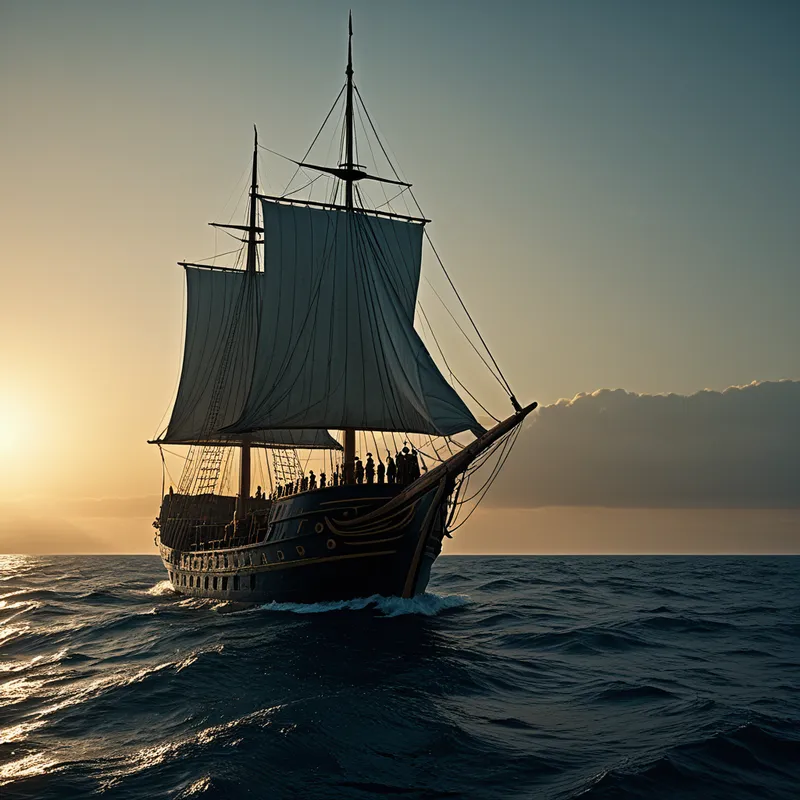
Hear now the song of the first ship, the Argo, and the men who dared to stitch the sea with her prow. It begins not with a hero, but with a crime. In the shadowed halls of Iolcus, a throne was stolen. The rightful king, Aeson, was usurped by his half-brother, the cruel Pelias. An oracle’s chilling whisper warned Pelias to beware a man with one sandal. Years flowed like the river Anauros, where one day a young man, crossing its swift current, lost a shoe. He arrived at the palace thus: one foot bare upon the earth, the other shod for a journey. This was Jason, son of Aeson, come to claim his birthright.
Pelias, his blood running cold, saw the prophecy walking. With a tyrant’s cunning, he set an impossible price: “Bring me the Golden Fleece,” he said, “that hangs in the sacred grove of Ares, in the distant land of Colchis, guarded by a dragon that never sleeps, and you shall have your throne.” It was a sentence of death disguised as a quest. But Jason, whose heart was woven from the threads of fate, accepted.
The call went out across Hellas. From every corner they came, the greatest heroes of the age before Troy. Heracles, whose strength could hold up the sky. Orpheus, whose lyre could charm stones and quell the fury of the sea. Peleus. Castor and Polydeuces. The visionary shipwright Argus, who, with the blessing of Athena, fashioned the Argo from the talking timber of the sacred forest of Dodona. She was no mere vessel; she was a living being, her keel a spine of prophecy.
Their voyage was a stitching-together of the world’s wonders and terrors. They were nearly dashed on the Symplegades, living cliffs that roared together to crush ships, escaping only by the flight of a dove and the desperate strength of their oars. On the island of Lemnos, they found a kingdom of women who had slain their husbands, a paradise of eerie silence and offered permanence. They buried a comrade on the coast of Mysia. They heard the haunting, lethal song of the Sirens, but Orpheus struck a louder, more beautiful chord and saved their souls. They passed the fiery breath of the bronze giant Talos on Crete, felled by the witch-healer Medea’s cunning.
For in Colchis, the true trial began. King Aeëtes set Jason labors as deadly as Pelias’s promise: yoke fire-breathing bulls, sow a field with dragon’s teeth, and fight the armed men who would sprout from them. Here, Jason was not enough. It was Medea, daughter of Aeëtes, priestess of Hecate, who saw in the foreign hero the shape of her own escape. Love, or perhaps a fierce will to self-determination, struck her. With her sorcery, she anointed Jason with protective charms, gave him the secrets to conquer the bulls and the earth-born warriors. And when the final guardian remained—the unsleeping serpent coiled around the oak—her spells and herbs poured a tide of sleep upon the beast. In the deep, drugged quiet of the grove, Jason reached out and took the Fleece, a shimmering pelt of captured sunlight.
The return was a flight, a pursuit, a scattering of Apsyrtus’s limbs across the waves to slow his father’s fleet, a purification by Circe, and a navigation through the monstrous perils of Scylla and Charybdis. They returned to Iolcus not as the bright band that left, but as men transformed by salt, loss, and a terrible knowledge. The Fleece was delivered, but the story, like the sea, had no true end—only cycles of betrayal, vengeance, and the broken hull of the Argo placed among the stars.

Cultural Origins & Context
The saga of the Argonauts is one of the oldest and most pervasive narratives in the Greek world, predating even the Trojan War in the mythological chronology. Its primary literary vessel is the Argonautica of Apollonius of Rhodes, a Hellenistic epic from the 3rd century BCE, but the story’s roots are far more ancient. It was a tale told and retold in oral tradition, a foundational “road map” of the known (and unknown) world. Local cults and city-states across the Mediterranean—from Iolcus to Corinth, from Lemnos to Cyzicus—claimed connection to the voyage, embedding the myth into their landscapes and genealogies.
Functionally, it served as a myth of origins and exploration. It explained Greek contact with the peoples of the Black Sea (the Euxine, literally “the Hospitable,” a euphemism for its treacherous nature). It was a catalog of heroic lineages, connecting later classical heroes to this primordial journey. The Argo, the first ship, represented the audacity of maritime expansion and the terrifying, awe-inspiring act of leaving the sight of land. The myth was not merely entertainment; it was a cultural memory of venturing into the chaotic beyond and bringing back a token of order and divine favor—the Fleece itself.
Symbolic Architecture
At its core, the voyage of the Argo is not Jason’s story alone. It is the myth of the collective soul embarking on its necessary journey. Jason is an unlikely hero, more reliant on persuasion, fate, and the aid of others than on innate, Herculean power. He represents the conscious ego setting a direction, but he is impotent without his crew—the diverse aspects of the psyche.
The quest is never undertaken alone. The Argo is the vessel of the Self, crewed by all the fragmented powers of the individual and the culture.
Each hero aboard is a specialized faculty: Heracles is raw instinctual strength; Orpheus is the harmonizing power of art and the unconscious; the Dioscuri are the balanced duality of mortal and immortal. Their encounters are not random adventures but symbolic encounters with the contents of the unconscious. The Clashing Rocks represent the terrifying, crushing pressure of psychic opposites. The Lemnian women symbolize the allure of remaining in a mother-dominated, unconscious state, rejecting the masculine principle entirely. Medea is the ultimate archetypal figure of this deep psyche: she is the transformative, magical, and ultimately dangerous power of the anima (the inner feminine in the male psyche), the guide who knows the secrets of life and death but demands a terrible price for her aid. The Golden Fleece itself is the ultimate symbol of the treasure hard to attain—the integrated Self, wholeness, kingship, and divine legitimacy, guarded by the dragon of primal, possessive instinct.
The Dreamer’s Resonance
When this myth stirs in the modern dreamer, it often announces a call to a collective endeavor or a profound personal voyage that requires more than one’s solitary resources. Dreaming of a ship with a named purpose, or a crew of disparate yet familiar figures, signals the psyche mobilizing its internal “heroes” for a task.
The somatic feeling is often one of anticipation mixed with deep anxiety—the salt-taste of the unknown. You may dream of preparing for a journey, of gathering tools or companions. To dream of being Jason is to feel the weight of a leadership you may not feel equipped for, tasked with an impossible goal. To dream of being Medea is to confront the ruthless, magical, and morally ambiguous power within yourself that can achieve the goal but may sever you from your past “kingdom.” Dreaming of the unsleeping dragon is to feel the vigilant, paralyzing grip of an old complex or fear that guards your most precious potential. The dream-Argo asks: What is the Fleece you seek? And who must you become, and who must you bring with you, to even approach its grove?

Alchemical Translation
The Argonautica is a perfect blueprint for the alchemical process of individuation. The prima materia is the usurped kingdom—a life out of order, a Self ruled by a fraudulent authority (Pelias, the complex). The quest is the nigredo, the perilous sea-voyage into the unknown, where the old ego is dissolved in the trials of the Symplegades and the Sirens’ call.
The Fleece is not won by force alone, but by the marriage of the heroic will (Jason) with the transformative sorcery of the deep psyche (Medea). This is the sacred coniunctio, the union of opposites essential for transformation.
Jason’s three labors in Colchis are alchemical operations: yoking the fiery, opposing energies (the bulls), planting the “seeds” of conflict (dragon’s teeth), and overcoming the autonomous, warlike structures that sprout from them. Only then can one approach the central mystery. The final act—the retrieval—requires the intervention of the unconscious (Medea’s sleeping potion) to temporarily pacify the guardian dragon of the status quo. The return voyage, stained with betrayal and necessitating purification, is the albedo and rubedo—the whitening and reddening—where the integrated treasure is assimilated, but not without cost. The modern individual on this voyage learns that the goal—the Fleece, the Self—is not a trophy to possess, but a transformation that forever changes one’s relationship to one’s origins, duties, and very soul. You return to Iolcus, but you can never be the person who left.
Associated Symbols
Explore related symbols from the CaleaDream lexicon: